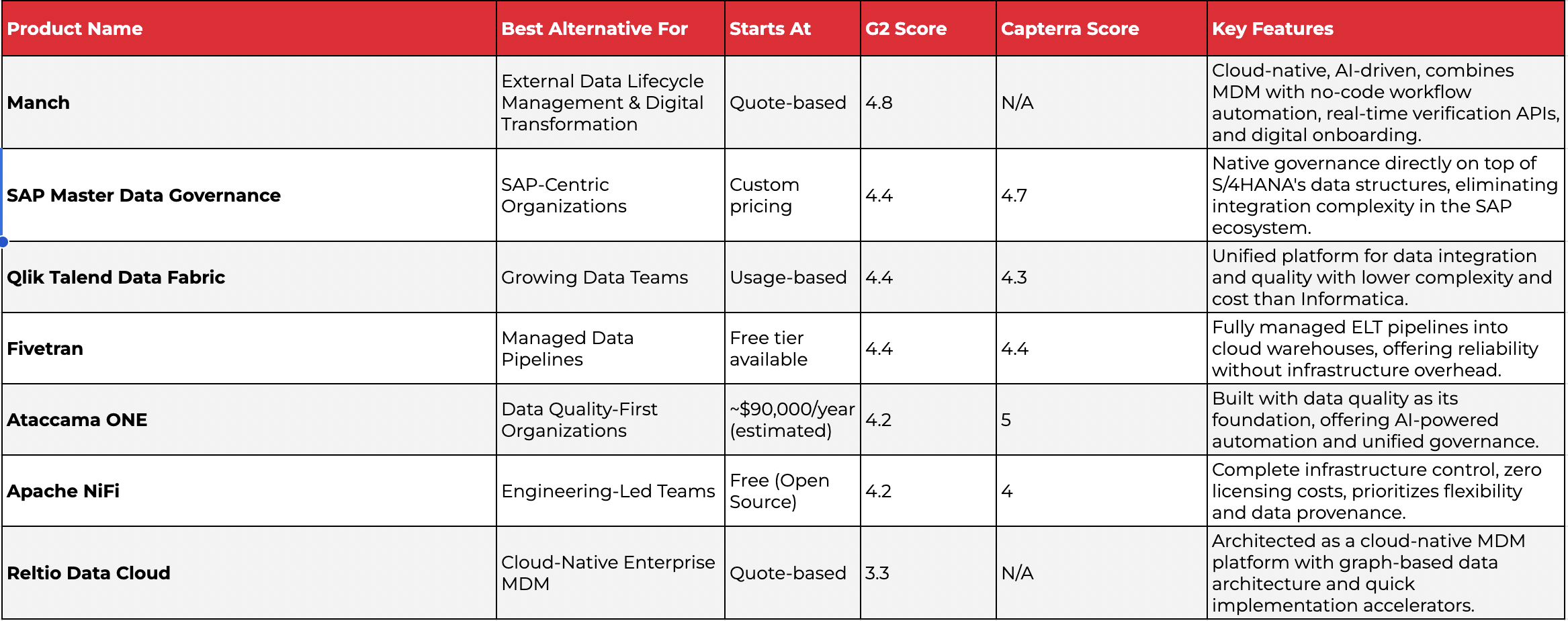
1. Manch — Best Alternative for External Data Lifecycle Management & Digital Transformation
Manch is a cloud-native, AI-driven, no-code platform that combines master data management with workflow automation for enterprises seeking faster time-to-value. While Informatica provides comprehensive capabilities across the data management spectrum, Manch is purpose-built to deliver enterprise-grade functionality through configuration rather than coding—enabling organizations to go live in 4-6 weeks rather than the months or years typical of legacy platforms.
The platform handles comprehensive master data management across all organizational pillars—customers, vendors, products, employees, assets, and finance—while excelling particularly in external stakeholder lifecycle management. Its key capabilities include:
- Master Data Management: Comprehensive MDM covering material masters, employee masters, finance masters (general ledger), pricing masters, and all key organizational data domains with sophisticated duplicate detection and merge/survivability rules
- Digital Onboarding: 100% paperless partner and vendor onboarding with configurable workflows
- eKYC and Video KYC: Complete identity verification solution compliant with RBI and SEBI regulations
- Real-Time Verification APIs: Pre-integrated APIs for instant validation of PAN, GST, bank accounts, and other credentials—eliminating the need for back-office verification teams
- Process Configurator: No-code workflow builder using drag-and-drop building blocks for complex business processes
- mSign: Digital signature solution for executing agreements with single-click OTP verification
- Integrated Document Management: Built-in document handling with OCR for automated data extraction—a capability not available in standard ERP systems
- System-Agnostic Integration: Native connectivity with SAP (as an SAP partner), Microsoft 365/Dynamics 365, Salesforce, and legacy systems without middleware complexity
For organizations whose primary data challenge isn’t moving data between internal systems but rather managing the lifecycle of external relationships—from initial onboarding through ongoing engagement to final settlement—Manch provides a specialized solution designed for this specific use case while offering the flexibility to expand into broader digital transformation initiatives.
Why Choose Manch Over Informatica for Data Lifecycle Management
While Informatica excels at integrating and governing enterprise data across systems with powerful ETL capabilities and a comprehensive feature set, Manch delivers comparable MDM and workflow automation with significantly faster time-to-value and lower total cost of ownership. Here’s where Manch provides advantages:
Cloud-Native Architecture vs. Legacy Platform
Informatica has evolved from its on-premise ETL origins into a cloud platform, but this evolution means some architectural elements still reflect that legacy. Manch was built from the ground up as a cloud-native platform with integrated AI capabilities, resulting in a fundamentally different approach to deployment, scalability, and user experience.
This architectural difference translates directly into implementation speed: where Informatica deployments typically require months of planning, configuration, and specialized expertise, Manch delivers go-live in 4-6 weeks through configuration rather than coding. Pre-built frameworks and accelerators enable this 3x faster deployment while maintaining enterprise-grade capabilities.
External Data Lifecycle Management: Purpose-Built for Partner Relationships
Informatica’s MDM capabilities are designed to create golden records by consolidating data from multiple internal systems, applying matching algorithms, and establishing a single source of truth. This is powerful for customer or product data that exists across CRM, ERP, and other applications.
Manch takes a different approach, focusing on the complete lifecycle of external relationships rather than just internal data consolidation. The platform manages the entire journey from initial partner onboarding (collecting information, verifying documents, obtaining approvals) through ongoing engagement (self-service portals, compliance monitoring) to final settlement.
This lifecycle approach means partners themselves can initiate and manage their own data through self-service portals, update their information in real-time, and track the status of their applications or requests. Informatica’s MDM, while powerful, is designed for internal data stewards managing golden records, not for external parties participating in their own data management.
⚡ Manch in Action: When onboarding a new distribution partner, Manch orchestrates the entire process: the partner receives a link to complete their profile, uploads required documents (which are auto-extracted via OCR), undergoes real-time verification of their PAN, GST, and bank details through pre-integrated APIs, participates in a video KYC session if required, and digitally signs agreements. In documented case studies, this complete workflow has been completed in as little as 30 minutes—reducing processes that previously took seven days to just half an hour, with 100% verified data at the source.
No-Code Configuration: Business User Empowerment
Implementing workflows in Informatica typically requires specialized developers with knowledge of the platform’s tooling. Even with IDMC’s low-code improvements, configuring complex approval processes, validation rules, and integration logic often demands significant technical expertise and ongoing IT involvement.
Manch’s Process Configurator enables business users—operations, finance, and compliance teams—to design and deploy complex workflows without any coding. Using pre-built functional blocks, users can construct end-to-end processes by arranging these blocks in sequence, enabling business-led change rather than IT-dependent transformation.
The platform includes templates for common scenarios that can be customized to match specific business requirements. Organizations can make minor changes themselves using the drag-and-drop interface, avoiding the cost escalation typically associated with software change requests. This approach enables go-live timelines measured in weeks rather than the months typical of enterprise data management implementations.
⚡ Manch in Action: A compliance team needs to implement a new verification workflow to meet regulatory requirements. With Manch, they can configure the required information fields, document collection steps, validation rules, approval hierarchy, and digital signature process themselves, deploying the new workflow in days without waiting for IT resources or specialized developers.
Real-Time Verification APIs: “First Time Right” Data Quality
Informatica’s data quality capabilities are comprehensive, providing profiling, cleansing, standardization, and ongoing monitoring of data quality. The platform has introduced “Shift-Left” capabilities for earlier data quality checks, though these features may require additional configuration.
Manch implements what it calls “First Time Right” validation through pre-integrated APIs that verify data accuracy at the moment of entry—before it ever reaches your systems. This API-first architecture eliminates the need for traditional back-office setup that requires time, money, resources, and creates lag between data input and verification.
The platform integrates with numerous external data sources for instant verification: PAN and Aadhaar validation, GST registration checks, bank account verification through penny drop tests, and company registration validation. When a partner enters their information, it’s verified in real-time against authoritative sources.
⚡ Manch in Action: A vendor submits their GST number during onboarding. Rather than accepting the data and cleansing it later, Manch instantly validates the GST against government databases, confirms the registered business name matches what was provided, and flags any discrepancies before the application proceeds. This “triangulation” of information from multiple sources ensures data accuracy from the start.
Lower Total Cost of Ownership Without Vendor Lock-in
Informatica implementations are famously complex undertakings requiring significant planning, configuration, and specialized expertise. Organizations frequently report implementation timelines measured in months and costs running into six or seven figures, plus ongoing dependency on specialized “Informatica developers.”
Manch’s configuration-based architecture and pre-built components deliver 30-40% lower total cost of ownership compared to larger enterprise platforms when considering licensing, implementation, and ongoing maintenance costs combined. Client case studies document implementations completing in as little as three weeks, with organizations achieving 80% reduction in manual tasks and 60% reduction in back-office resources.
The platform operates on open standards with no proprietary runtime environment, ensuring data and process portability without vendor lock-in. Organizations can integrate Manch with whatever systems they already use—SAP, Oracle, Microsoft, Salesforce, or legacy applications—without being pushed toward specific vendor choices.
⚡ Manch in Action: A major health and wellness brand needed to implement regulatory compliance for documentation and verification. Manch delivered a complete compliance solution in three weeks, eliminating paperwork, automating audit trails, and ensuring regulatory compliance from day one—a fraction of the timeline and cost of traditional enterprise platform implementations.
NOTE: We also evaluated other platforms that touch on external data management, such as specialized KYC solutions and partner relationship management tools. While dedicated KYC platforms like Onfido offer deep identity verification capabilities, and PRM tools like Impartner focus on partner relationship tracking, Manch uniquely combines MDM principles with workflow automation specifically for external stakeholders. This unified approach eliminates the need to stitch together separate verification, workflow, and data management tools—and customers consistently discover they can do much more on the platform beyond the initial implementation scope, contributing to the platform’s zero customer churn rate.
Manch Pricing
Manch uses a quote-based, flexible pricing model tailored to specific business requirements. The company offers three tiers:
- Starter: Basic platform access with self-service mode
- Premium: Enhanced capabilities with additional features
- Enterprise: Full feature set with comprehensive functionality
Manch offers a free trial with no credit card required. Pricing proposals include an assessment of the business problem, the value Manch delivers, and flexible terms. The company positions itself for significantly lower total cost of ownership compared to broader enterprise platforms—with licensing and implementation costs combined often being less than the license fees alone of premium alternatives—supported by documented ROI through reduced manual tasks and accelerated onboarding times.
Who Should Use Manch?
Choose Manch if:
- You manage a large ecosystem of external partners, vendors, or distributors and your primary data challenge is onboarding, verifying, and maintaining accurate information about these external stakeholders rather than integrating internal enterprise systems. Manch’s lifecycle management approach handles the complete partner journey from acquisition to settlement.
- You need to deploy compliant KYC and verification workflows rapidly without extensive IT involvement. Organizations in regulated industries (Fintech, Pharma, FMCG) that must verify partner credentials, collect specific documentation, and maintain audit trails will find Manch’s real-time verification APIs and configurable workflows purpose-built for these requirements.
- Your business operations team needs to own data collection and workflow processes without relying on specialized developers or lengthy IT projects. Manch’s no-code Process Configurator empowers business users to design, deploy, and modify workflows independently, enabling faster response to regulatory changes and business requirements.
- You’re seeking a digital transformation platform that grows with your needs beyond a single use case. Manch’s versatility enables organizations to expand from initial implementations into contract management, asset tracking, employee onboarding, and numerous other workflows on the same platform—maximizing platform investment and avoiding point solution sprawl.
- You want enterprise-grade capabilities without vendor lock-in or IT bottlenecks. Manch’s system-agnostic architecture integrates seamlessly across SAP, Oracle, Microsoft, Salesforce, and legacy systems, while its enterprise-grade security (ISO 27001 and SOC2 Type2 compliant) meets the requirements of regulated industries.
Ready to digitize your partner onboarding and verification workflows—and discover a platform that can grow with your digital transformation needs? Manch’s cloud-native, no-code platform can have you live in weeks, not months. Contact us to see how organizations are achieving 3x faster deployment and 30-40% lower total cost of ownership.
2. SAP Master Data Governance (SAP MDG) — Best Alternative for SAP-Centric Organizations
SAP Master Data Governance (MDG) is an enterprise-grade MDM application that serves as a centralized governance hub for organizations deeply invested in the SAP ecosystem. Unlike platform-agnostic solutions like Informatica that require integration work to connect with SAP systems, SAP MDG sits directly on top of SAP’s core data structures, reusing the same data models, validation logic, and business rules as your operational SAP systems.
Key capabilities include:
- Central Governance with staging-based approval workflows that prevent bad data from reaching production
- Consolidation capabilities powered by SAP HANA for high-speed matching and duplicate resolution
- Pre-built data models for Business Partner, Material, and Finance that can be activated with configuration (implementation effort varies by customer scope)
- Federated governance allowing central attribute governance while domain-specific applications manage local attributes
Why Choose SAP MDG Over Informatica for SAP Environments
While Informatica provides robust, vendor-agnostic data management capabilities that excel across heterogeneous environments, SAP MDG differentiates itself in three critical areas for SAP-centric organizations:
- Zero-Latency Integration with S/4HANA The most significant advantage is that SAP MDG doesn’t just connect to S/4HANA; it’s built on the same ABAP stack and reuses the underlying data model. When you activate the Business Partner domain, you’re leveraging the exact same CVI (Customer-Vendor Integration) framework S/4HANA uses internally. Validation rules from your S/4HANA Customizing settings are automatically enforced in MDG without additional configuration.
- Out-of-the-Box SAP Data Models SAP MDG ships with pre-configured data models aligned with SAP best practices for Material Master, Business Partner, and Financial Accounting hierarchies. These include the full complexity of SAP’s multi-level structures.
- Unified Governance Across the SAP Intelligent Suite MDG provides governance capabilities for master data across SAP’s cloud portfolio, including SAP Ariba (procurement) and SAP SuccessFactors (HR). The SAP Master Data Integration service enables propagation of golden records across connected SAP applications.
🏅 NOTE: We also evaluated IBM InfoSphere MDM (strong for mainframe integration) and Oracle Enterprise Data Management Cloud (ideal for Oracle Fusion environments). SAP MDG is a strong choice specifically for governing master data within SAP-dominated landscapes, leveraging existing SAP infrastructure and skills. However, organizations with heterogeneous IT landscapes that include non-SAP systems may find that platforms like Manch can co-exist with SAP MDG—handling partner onboarding, document workflows, and multi-ERP integrations faster and more cost-effectively while SAP MDG manages core SAP master data governance.
SAP MDG Pricing
SAP MDG pricing varies by deployment model:
Implementation costs are substantial, typically requiring 6-12 months of consulting services depending on scope.
Who Should Use SAP MDG?
Choose SAP MDG if:
- Your organization runs SAP S/4HANA and wants to minimize architectural complexity by leveraging existing infrastructure
- You manage complex, hierarchical SAP data structures like Financial hierarchies or Material Master with multiple organizational views (note: Bill of Materials requires extensions or partner add-ons rather than native standard support)
You’re in a regulated industry requiring enterprise-grade audit trails and approval workflows native to your SAP environment
3. Qlik Talend Data Fabric — Best Alternative for Growing Data Teams
Qlik Talend Data Fabric is a unified data management platform combining data integration, data quality, and governance in a single suite. While Informatica offers comprehensive enterprise capabilities with deep functionality across the data management spectrum, Talend provides an accessible option for mid-sized organizations that need strong capabilities without big-suite complexity. Key features include:
- Unified data integration supporting both ETL/ELT and real-time streaming in a single environment
- Native data quality with Trust Score that automatically profiles data and rates health based on validity and completeness
- Over 1,000 pre-built connectors spanning legacy and modern systems
- Hybrid deployment with processing inside your firewall while management occurs in the cloud
- Code generation approach compiling visual data flows into native Java for transparency and portability
Why Choose Qlik Talend Over Informatica for Growing Teams
While Informatica excels as a comprehensive enterprise platform with extensive capabilities for large-scale data management, Talend distinguishes itself from Informatica in three key areas:
- Lower Barrier to Entry Talend’s capacity-based pricing is often more accessible than comparable Informatica deployments. The visual development environment is designed for data engineers without requiring specialized Informatica expertise.
- Embedded Data Quality as a First-Class Citizen Talend’s data quality components exist in the same palette as integration components. Developers can drop quality checks directly into data flows without switching contexts. The automatic Trust Score (0-5 metric) provides instant assessment of data health at ingestion, enabling a “shift-left” approach to quality.
- Hybrid Architecture with Code Transparency Talend generates compilable Java source code rather than proprietary metadata. Organizations have portability options, though the business rules still rely on Talend-specific libraries for full functionality.
🏅 NOTE: We also considered Matillion (excellent for cloud-native ELT) and Integrate.io (lightweight iPaaS). Talend provides comprehensive integration of data quality and governance for teams needing more than just data movement.
Qlik Talend Pricing
Talend Cloud offers capacity-based subscriptions in four editions:
- Starter: SaaS data ingestion with basic catalog
- Standard: Real-time sync with enhanced deployment options
- Premium: Transformation, lineage, and self-service prep
- Enterprise: Advanced quality and governance capabilities
Client-managed (on-premises) options remain available for organizations with regulatory requirements.
Who Should Use Qlik Talend?
Choose Qlik Talend if:
- Your organization has outgrown basic tools but isn’t ready for Informatica’s complexity
- Data quality is mission-critical and needs enforcement within integration workflows, not as an afterthought
- You need genuine hybrid deployment due to regulatory constraints or preference to keep processing on your infrastructure
4. Fivetran — Best Alternative for Managed Data Pipelines
Fivetran is a fully managed ELT platform that enables organizations to centralize data from disparate sources into cloud data warehouses like Snowflake, BigQuery, and Databricks. While Informatica provides powerful, comprehensive data integration capabilities with extensive transformation options, teams that simply need reliable data pipelines without the overhead of managing comprehensive data management infrastructure may find Fivetran offers a simpler alternative. Key capabilities include:
Why Choose Fivetran Over Informatica for Small Teams
While Informatica delivers enterprise-grade integration with powerful transformation capabilities and broad connectivity, Fivetran differentiates itself through three key advantages for teams with focused pipeline needs:
- Managed Reliability When you configure a Fivetran connector, the platform takes ownership of maintenance. If Facebook’s API changes, Fivetran updates the connector before you notice. Schema migration automatically adds new columns to your warehouse. This model reduces the need for dedicated “data plumbing” engineers.
- Quick Setup The typical workflow: select source, authenticate, select destination, choose tables, click “Start.” Initial sync timing varies by source, with many completing within a day. There are no mappings to design, no transformation logic to code, and no infrastructure to provision beyond a lightweight agent for on-premise sources.
- Modern Cloud-Native Architecture Fivetran was built for the ELT paradigm: load raw data first, transform later in the warehouse using cheap compute. This approach leverages your cloud warehouse’s processing power rather than requiring separate transformation servers.
🏅 NOTE: We considered Stitch Data (lighter weight but fewer connectors) and Hevo Data (competitive in certain markets). Fivetran offers a comprehensive connector library and strong reliability for organizations wanting managed pipelines.
Fivetran Pricing
Fivetran uses consumption-based pricing on Monthly Active Rows (MAR):
- Free Plan: Up to 500,000 MAR and 5,000 Monthly Model Runs
- Standard Plan: Production-grade with 15-minute sync, role-based access, REST API
- Enterprise Plan: 1-minute sync, High Volume Agent for enterprise databases
- Business Critical Plan: Customer-managed encryption, PCI DSS Level 1, private networking
Who Should Use Fivetran?
Choose Fivetran if:
- You use a modern cloud data warehouse and want to eliminate building custom extraction scripts
- You need production-grade reliability but lack resources for dedicated integration specialists
- Your primary integration need is data movement into a centralized warehouse (note: Fivetran has expanded to include governance, transformations, and reverse-ETL capabilities)
5. Ataccama ONE — Best Alternative for Data Quality-First Organizations
Ataccama ONE is a unified, AI-powered data management platform that consolidates data quality, MDM, governance, and observability into a single fabric architecture. While Informatica offers powerful data quality capabilities as part of its comprehensive suite, Ataccama was built from the ground up as a single codebase where all modules share a common metadata repository—with data quality as its foundation. Key capabilities include:
Why Choose Ataccama ONE Over Informatica for Data Quality
While Informatica provides comprehensive data quality tools with extensive functionality as part of its broader platform, Ataccama differentiates itself in several key areas for organizations where data quality is the primary concern:
- True Unified Architecture Ataccama was purpose-built as a single platform. Quality rules defined for analytical purposes can be leveraged for MDM workflows. This eliminates the need to maintain separate tools for different data management functions.
- AI-Powered Data Quality Ataccama’s ONE AI engine can autonomously execute data management tasks. When you connect a new source and trigger profiling, AI can automatically detect domains, suggest business terms, and recommend validation rules.
- Lower TCO Through Automation Customers have reported up to 50% reduction in time spent on manual profiling and rule writing because of AI automation.
🏅 NOTE: We also evaluated Collibra (strong governance and catalog) and Experian Aperture (deep quality for customer data). Ataccama offers seamless integration of quality, MDM, and governance in a single platform.
Ataccama ONE Pricing
Ataccama uses modular subscriptions:
Who Should Use Ataccama ONE?
Choose Ataccama ONE if:
- Data quality and trust are your primary bottleneck rather than data movement
- You need unified governance without maintaining separate contracts for catalog, quality, and MDM tools
- Your industry demands explainable data decisions with audit trails showing how records were created
6. Apache NiFi — Best Alternative for Engineering-Led Teams
Apache NiFi is a free, open-source platform for automating data flow between systems, originally developed at the NSA and released to the Apache Software Foundation in 2014. While Informatica provides powerful enterprise data integration with commercial support and comprehensive functionality, engineering teams that want complete infrastructure control and zero licensing costs may find NiFi offers a fundamentally different approach. Key capabilities include:
Why Choose Apache NiFi Over Informatica for Technical Control
While Informatica delivers enterprise-grade data integration with extensive commercial support, training resources, and a comprehensive feature set, NiFi stands out in three fundamental ways for engineering-led organizations:
- Zero Licensing Costs with Source Code Access Under Apache License 2.0, the software costs nothing. Adding nodes to a cluster requires only infrastructure, not license negotiations. The open-source community, including original NSA creators, actively maintains the codebase with regular security patches.
- Visual Flow-Based Programming with Runtime Modification NiFi’s UI is both design environment and operational control plane simultaneously. You can stop a single processor, change its configuration, and restart it without impacting parallel data paths. Queue connections visually display backpressure status, and error bulletins appear directly on affected components.
- Built-In Data Provenance NiFi automatically generates provenance events every time any processor touches data, recording timestamps, component details, and content pointers. This “chain of custody” supports compliance requirements, though meeting full regulatory compliance (GDPR, HIPAA, SOX) typically requires additional controls beyond NiFi’s provenance capabilities alone.
🏅 NOTE: We also considered Airbyte (simpler ELT) and Singer/Meltano (lightweight Python-based). NiFi provides comprehensive data logistics capabilities for teams needing fine-grained control over routing, transformation, and guaranteed delivery.
Apache NiFi Pricing
- Open Source: Zero software costs; infrastructure and personnel only
- Cloudera DataFlow (Cloud): $0.15 per CCU-hour for Flow Management on Data Hub, $0.30 per CCU-hour for DataFlow Deployments
- Cloudera DataFlow (On-Premise): Annual subscription bundled with CDP
Personnel investment depends on cluster complexity and operational requirements.
Who Should Use Apache NiFi?
Choose Apache NiFi if:
- You have strong data engineering capabilities and value inspecting and controlling every aspect of your data infrastructure
- Data provenance is a compliance requirement and you need automatically-generated, queryable lineage
- You prefer infrastructure ownership and want to avoid vendor lock-in to proprietary runtimes
7. Reltio Data Cloud — Best Alternative for Cloud-Native Enterprise MDM
Reltio Data Cloud is a cloud-native, AI-powered MDM platform designed for Global 2000 enterprises requiring real-time operational master data. While Informatica offers powerful MDM capabilities with a rich feature set developed over decades, Reltio was architected from its 2011 inception to run exclusively as SaaS, leveraging graph databases and Large Language Models for intelligent entity resolution. Key capabilities include:
Why Choose Reltio Over Informatica for Cloud-Native MDM
While Informatica provides comprehensive MDM with extensive functionality and a proven track record across enterprise deployments, Reltio differentiates itself through three architectural decisions:
- Born Cloud-Native Architecture Reltio uses Apache Cassandra for storage, Elasticsearch for indexing, and Spark for processing, technologies purpose-built for cloud scale. This enables zero-downtime upgrades, highly elastic storage, and true multi-tenancy. Informatica customers must still consider “environment sizing” and “database tuning.”
- Graph Database for Complex Relationships Reltio’s hybrid graph-and-columnar database stores entities as nodes and relationships as edges. This architecture excels at modeling complex, dynamic relationships.
- 90-Day Implementation with Velocity Packs Reltio’s industry-specific solutions include production-ready data models, pre-tuned match rules, and out-of-the-box integrations. Organizations can achieve first value in 90 days with these accelerators.
🏅 NOTE: We also considered Semarchy xDM (strong self-service) and Profisee (more affordable with Azure integration). Reltio offers comprehensive cloud-native architecture with real-time performance and industry accelerators.
Reltio Data Cloud Pricing
Reltio uses SaaS subscriptions based on Consolidated Profiles. Pricing is not publicly disclosed and is quote-based:
- Base: Quote-based pricing scaled by profile volume
- Business Critical: Adds cross-region DR and 99.99% SLA
Add-ons include premium connectors, data enrichment services, and additional tenants.
Who Should Use Reltio?
Choose Reltio if:
- You’re a Global 2000 enterprise in regulated industries requiring real-time operational master data
- You need complex relationship management beyond what relational MDM can efficiently support
- You’re targeting 90-day first value with industry-specific accelerators
The Final Verdict
While Informatica provides a comprehensive, enterprise-grade data management platform with powerful capabilities across the data lifecycle, organizations with more focused needs often find that specialized alternatives deliver better value for their specific use cases. Based on our research, here are the best alternatives:
- Manch for external partner data management, digital onboarding, KYC verification workflows, and broader digital transformation—with 3x faster deployment and 30-40% lower total cost of ownership through configuration-based, cloud-native architecture
- SAP MDG for organizations deeply embedded in the SAP ecosystem wanting native S/4HANA governance
- Qlik Talend Data Fabric for growing data teams needing integration and quality without enterprise complexity
- Fivetran for small teams wanting managed pipelines into cloud warehouses
- Ataccama ONE for organizations where data quality is the primary bottleneck for analytics and AI
- Apache NiFi for engineering-led teams prioritizing control, flexibility, and open-source economics
- Reltio Data Cloud for enterprises requiring true cloud-native MDM with real-time performance
Remember that these alternatives aren’t mutually exclusive with Informatica. Many organizations use specialized tools for specific use cases while maintaining Informatica for other data management needs. The key is matching your specific requirements—whether that’s managing external partners, governing SAP data, or simply moving data into a warehouse—with the tool purpose-built for that challenge.
Looking for a specialized solution to digitize your external partner onboarding and verification workflows—and a platform that grows with your digital transformation needs? Manch’s cloud-native, no-code platform enables organizations to go live in weeks, achieve 3x faster deployment, and realize 30-40% lower total cost of ownership compared to enterprise platforms. Organizations have documented results including 80% reduction in manual tasks and processes reduced from seven days to 30 minutes. Contact us to learn how Manch can transform your data management.