What is Talend?
Talend is a comprehensive data integration and management platform designed to help organizations collect, govern, transform, and share data across their entire data ecosystem. Now part of Qlik following the 2023 acquisition, Talend provides a unified suite of tools that support the complete data lifecycle, from initial extraction through transformation to final delivery for analytics and business intelligence.
At its core, Talend offers:
- Talend Studio: An Eclipse-based graphical development environment where users design data integration jobs through drag-and-drop components that generate native Java code
- Data Integration: Support for both ETL (Extract, Transform, Load) and ELT patterns with batch and real-time processing capabilities
- Data Quality: Tools for data profiling, cleansing, standardization, and validation to ensure accuracy and consistency
- Big Data Integration: Native support for Hadoop, Spark, and other distributed computing frameworks for processing massive datasets
- Talend Cloud: A fully managed platform-as-a-service with web-based interfaces for designing, managing, and monitoring integrations
- 1,000+ Connectors: Pre-built connectivity to databases, cloud platforms, SaaS applications, and enterprise systems
Talend’s architecture generates optimized native code from visual job designs, which can then run on any server without being tied to a proprietary engine. This approach provides flexibility and performance, particularly for complex transformation logic and large-scale data processing.
The platform has been recognized as a Leader in Gartner’s Magic Quadrant for Data Integration Tools, and its combination of open-source heritage with enterprise capabilities has made it widely adopted by mid-to-large organizations managing complex data environments.
However, Talend’s comprehensive nature also means it may require technical expertise to leverage fully. The Eclipse-based Studio environment, while powerful, presents a learning curve. And for organizations with specific needs, the breadth of Talend’s capabilities may be more than what’s required.
Looking for an API-first platform to capture validated external data through automated workflows? Manch helps enterprises digitize partner onboarding, KYC verification, and vendor management with pre-integrated verification APIs that validate data in seconds, not days. Learn more about how Manch can streamline your external data management.
How We Curated Our List of Talend Alternatives
After reviewing Talend and researching the data integration market, we focused on finding tools that excel at specific jobs that Talend users commonly need done. While Talend is excellent at providing a comprehensive data management platform, some organizations need more specialized solutions for:
- Automating external data capture and business workflows without technical resources
- Achieving enterprise-scale governance with AI-powered automation across regulated industries
- Building data pipelines quickly with minimal setup and predictable pricing
- Optimizing specifically for cloud data warehouse environments
- Eliminating connector maintenance through fully managed ingestion
- Maintaining complete control through open-source infrastructure
- Enabling real-time streaming without complex infrastructure management
Each tool on this list excels in one of these areas. You might want to use them alongside Talend to address specific gaps, or switch to them entirely if their specialization matches your primary needs.
❗DISCLAIMER: We aren’t covering every data integration tool on the market! Our focus is on highlighting alternatives that address specific use cases where organizations might need different capabilities than what Talend provides. The goal is to help you find tools that match your specific requirements. |
|---|
1. Manch: Best Alternative for API-First External & Master Data Management Workflows
Manch is an API-first, cloud-native, low-code/no-code platform designed for External and Master Data Management (MDM) across enterprises. What sets Manch apart from traditional data integration tools is its pre-integrated verification APIs that enable real-time data validation at the point of capture, eliminating the need for back-office verification teams and the lag between data input and verification.
While Talend focuses on moving and transforming data between systems, Manch addresses a different but equally critical challenge: ensuring the data you capture from external stakeholders is accurate, validated, and compliant from the very beginning. The platform goes beyond MDM to serve as a broader digital transformation platform, enabling organizations to digitize virtually any business process through configuration rather than coding.
Its key capabilities include:
- Pre-Integrated Verification APIs: Real-time validation against public databases including PAN, GSTN, and bank accounts within seconds, eliminating manual verification workflows
- Digital Onboarding: 100% paperless workflows for partners, vendors, customers, and employees with configurable multi-level approval processes
- eKYC and Video KYC: Real-time identity verification with AI-powered fraud detection, face comparison, and document validation
- Process Configurator: Low-code/no-code workflow builder using pre-built functional blocks to automate complex business processes
- Master Data Management: Comprehensive MDM across six organizational pillars: products/services, customers, vendors/suppliers, assets, employees, and operational data, with AI-powered duplicate detection and merge rules
- mSign Digital Signatures: Single-OTP electronic signing for multi-party documents and agreements
- System-Agnostic Integration: Connects with SAP, Microsoft 365/Dynamics 365, Salesforce, and legacy systems without vendor lock-in
- Enterprise-Grade Security: ISO 27001 and SOC2 Type2 certified with role-based access control and comprehensive audit trails
Manch serves leading enterprises across industries including e-commerce, fintech, FMCG, manufacturing, and talent providers. According to the vendor, the platform has helped organizations reduce partner onboarding time from seven days to 30 minutes while achieving verified KYC compliance.
Why Choose Manch Over Talend for External Data Management
While Talend excels at moving and transforming data between systems, Manch addresses the upstream challenge of ensuring accurate data enters those systems in the first place. For organizations where data quality issues stem from external data capture, Manch provides capabilities that traditional ETL/ELT tools don’t address.
API-First Architecture: Real-Time Verification Without Back-Office Teams
Manch’s primary differentiator is its pre-integrated verification APIs that validate data in seconds, not days. When a partner submits their GST number, it’s instantly verified against government databases. When a vendor provides bank account details, penny drop testing confirms accuracy immediately. This eliminates the traditional workflow of collecting data, sending it to a back-office team for verification, and waiting days for confirmation.
Unlike building custom API integrations within Talend, which requires development work and ongoing maintenance as APIs change, Manch’s verification infrastructure is pre-built and maintained by the platform. Organizations can go from requirement to go-live in 4-8 weeks, with typical implementations achieving a 30-50% reduction in delivery time compared to traditional approaches.
⚡ Manch in Action: According to vendor case studies, enterprise customers have reduced onboarding processes from seven days to 30 minutes through real-time verification, with 100% validated data at the point of capture.
Business User Empowerment: Configuration, Not Coding
Talend’s Talend Studio is an Eclipse-based integrated development environment that generates Java code from visual job designs. While powerful, it requires technical expertise to use effectively, creating dependency on IT and data engineering teams for workflow changes.
Manch takes a fundamentally different approach through true low-code/no-code design. Using pre-built functional blocks for information collection, data validation, KYC management, approvals, and digital signatures, business teams can design and modify workflows independently. More importantly, organizations can make ongoing changes themselves through the drag-and-drop interface without raising change requests or paying for modifications. Operations, finance, and compliance teams can drive MDM and other processes without constant IT involvement.
⚡ Manch in Action: According to vendor case studies, organizations have deployed complete compliance solutions in as little as three weeks using Manch’s platform, with business users able to iterate and improve processes continuously based on actual needs.
Data Quality at Source: Validation Before Data Enters Your Systems
While Talend offers data quality capabilities including real-time options through its Trust Score and data quality tools, these operate on data after it’s been collected. Manch takes a different approach focused on the point of capture. Data is validated in real-time at the moment of entry, before it ever reaches your downstream systems.
This approach means your Talend pipelines, data warehouses, or CRM systems receive pre-validated, accurate data. The platform includes AI-powered duplicate detection with confidence scoring, preventing duplicate creation at source rather than requiring post-facto cleanup.
⚡ Manch in Action: According to vendor reports, enterprise customers have achieved 100% validated data at onboarding through features like penny drop testing for bank account verification and real-time authentication of GST and PAN numbers against government databases.
Compliance and KYC: Built-In, Not Built Custom
For organizations in regulated industries, compliance verification is essential. Talend can connect to verification APIs and build compliance checks into data pipelines, but this typically requires custom development, API integration work, and ongoing maintenance as regulations change.
Manch provides compliance capabilities out of the box, with enterprise-grade security certified to ISO 27001 and SOC2 Type2 standards. The platform includes:
- eKYC with real-time verification of PAN, Aadhaar, GST, bank accounts, driving licenses, and more
- Video KYC designed to support regulatory requirements with AI-powered face matching and liveness detection
- Document OCR supporting PAN cards, Aadhaar, GSTN certificates, passports, FSSAI documents, and expanding
- Multi-level authentication via mobile OTP, email OTP, and external ID verification
- Complete audit trails showing who changed what, when, and why, critical for ISO, SOX, and internal audit compliance
⚡ Manch in Action: Vendor case studies report that customers have implemented Video KYC that verifies customers in as little as 60 seconds, with AI-powered face extraction and comparison against ID documents.
Platform Versatility: Beyond MDM to Digital Transformation
While Manch excels at MDM and external data capture, the platform’s low-code/no-code architecture enables organizations to digitize virtually any business process. Customers frequently discover they can use the platform for contract management, asset tracking, retailer onboarding, vendor management, and numerous other workflows, maximizing their platform investment. According to the vendor, this versatility drives zero customer churn, as organizations realize the platform’s value extends far beyond the initial implementation scope.
NOTE: We also evaluated other MDM-focused platforms like Informatica MDM and Reltio. While Informatica offers comprehensive enterprise MDM with deep technical capabilities, and Reltio provides cloud-native MDM with strong data matching (recognized as a Leader in the 2025 Forrester Wave for MDM), Manch stands out for its API-first architecture and focus on the business process layer, enabling non-technical teams to capture validated external data through automated workflows with 3x faster deployment.
Manch Pricing
Manch uses a quote-based, flexible pricing model designed to scale with your needs. The platform offers competitive, transparent pricing with total cost of ownership typically 30-40% lower than larger enterprise platforms when considering licensing, implementation, and ongoing maintenance costs combined.
Starter
- Basic platform access
- Self-service mode
- Ideal for organizations beginning their digital workflow journey
Premium
- Basic platform access
- Self-service mode
- MDM (Master Data Management)
- mSign digital signatures
- Suited for organizations needing core data management and document signing capabilities
Enterprise
- Everything in Premium
- eKYC
- Video KYC
- API access
- AI/ML advanced tools
- Designed for organizations requiring comprehensive identity verification and advanced automation
Manch offers a free trial with no credit card required. Organizations can start with one solution and scale seamlessly as needs grow.
Who Should Use Manch?
Choose Manch if:
- You need real-time data verification at the point of capture rather than batch cleansing after data enters your systems, and want pre-integrated APIs that validate against public databases in seconds without building custom integrations.
- You need to digitize external stakeholder workflows such as partner onboarding, vendor verification, distributor management, or customer KYC, and want business teams to manage these processes independently without constant IT involvement.
- Your organization operates in a regulated industry where compliance verification (KYC, GST validation, identity verification) is mandatory, and you need enterprise-grade security with ISO 27001 and SOC2 Type2 certification built into your workflows.
- You have a heterogeneous IT landscape spanning SAP, Salesforce, Microsoft, and legacy systems, and need a system-agnostic platform that integrates across all without vendor lock-in.
- Your timeline is weeks, not months, and you need a solution that can be configured and deployed 3x faster than traditional platforms, with business users able to make ongoing changes through the drag-and-drop interface.
Ready to validate external data in seconds, not days? Manch’s API-first platform helps enterprises digitize partner onboarding, automate KYC verification, and achieve compliance with pre-integrated verification APIs and 3x faster deployment. Talk to sales to see how Manch can transform your external data workflows.
2. Informatica IDMC: Best Alternative for Enterprise-Grade Data Governance and AI-Powered Data Management
Informatica Intelligent Data Management Cloud (IDMC) is a comprehensive, AI-powered cloud data management platform that brings together data integration, data quality, master data management (MDM), data governance, and data cataloging into a single cloud-native environment. Powered by the CLAIRE AI engine, IDMC is designed for large enterprises requiring sophisticated data management capabilities.
Its key capabilities include:
- End-to-end data integration across batch and real-time processing with support for ETL, ELT, and Change Data Capture (CDC) patterns
- AI-driven data quality and governance with automated data discovery, classification, profiling, and cleansing
- Comprehensive master data management (MDM) for creating unified golden records across customer, product, supplier, and other domains
- Enterprise data catalog and lineage providing automated discovery, business glossary management, and end-to-end lineage visualization
- Multi-cloud and hybrid deployment flexibility with support for AWS, Azure, Google Cloud, and on-premises infrastructure
Why Choose Informatica IDMC Over Talend for Enterprise Data Governance
Informatica IDMC differentiates itself from Talend through its AI-native architecture and comprehensive governance capabilities designed for large, regulated enterprises.
- AI-Native Architecture with CLAIRE Engine IDMC’s CLAIRE AI engine provides intelligent automation across the entire data management lifecycle. CLAIRE automatically discovers and classifies sensitive data, recommends data quality rules based on profiling patterns, and suggests business glossary associations by understanding semantic relationships. The recently introduced CLAIRE Copilot allows users to describe integration requirements in natural language and generates complete pipeline configurations automatically. Informatica has been recognized as a Leader in Gartner’s Magic Quadrant for Data Integration Tools for 19 consecutive years.
- Comprehensive Governance for Regulatory Compliance IDMC provides capabilities designed for enterprises where data governance is mandated by regulations like GDPR, HIPAA, and SOC 2. The platform provides automated end-to-end data lineage visualization at column-level granularity, showing exactly how data flows from source systems through every transformation to final consumption. For organizations in financial services, healthcare, or pharmaceuticals, these governance capabilities help provide the documentation required to demonstrate compliance to regulators.
- Multi-Domain Master Data Management IDMC excels at multi-domain MDM, creating unified golden records not just for customers, but simultaneously for products, suppliers, locations, and financial hierarchies. Global retailers harmonizing product data across regional systems, or conglomerates unifying databases from acquisitions, depend on IDMC’s ability to master data across domains while maintaining complex relationships.
🏅 NOTE: We also evaluated SAP Master Data Governance and IBM InfoSphere. While SAP MDG excels for organizations heavily invested in SAP ecosystems, and IBM InfoSphere offers strong mainframe connectivity, Informatica IDMC provides a comprehensive cloud-native data management suite for heterogeneous enterprise environments.
Informatica IDMC Pricing
Informatica uses a consumption-based pricing model centered around Informatica Processing Units (IPUs):
- Pricing is calculated by computational resources consumed, data volume processed, and specific services used
- Customers purchase IPU blocks that can be allocated flexibly across any IDMC service
- Real-time usage monitoring through self-service dashboards with configurable alerts
- Implementation timelines vary by deployment complexity, with some migrations completing in approximately six months
Who Should Use Informatica IDMC?
Choose Informatica IDMC if:
- You operate in heavily regulated industries where demonstrating data lineage to auditors and maintaining comprehensive audit trails is a core business requirement
- You’re managing data across massive, heterogeneous environments spanning multiple clouds, on-premises systems, and dozens of SaaS applications
- Your data governance needs encompass multi-domain master data management with complex survivorship rules and hierarchy management
3. Hevo Data: Best Alternative for No-Code Data Pipelines with Minimal Setup
Hevo Data is a fully managed, no-code data integration platform that serves as an alternative to Talend for organizations seeking simplified ELT workflows without engineering overhead. The platform is designed for data teams who need enterprise-grade pipeline capabilities without complexity.
Its key capabilities include:
- 150+ pre-built connectors for databases, SaaS applications, cloud storage, and streaming services
- Automated schema mapping and evolution that detects and adapts to source changes without breaking pipelines
- Real-time and near-real-time data replication through log-based CDC and scheduled ingestion
- Cloud-native SaaS deployment with multi-region hosting and zero infrastructure management
Note: Hevo Activate (Reverse ETL) is available to existing customers but is no longer available for new customer sign-ups as of July 2023.
Why Choose Hevo Data Over Talend for No-Code Data Pipelines
Hevo Data distinguishes itself from Talend through its genuine no-code approach and operational simplicity.
- True No-Code Setup vs. Eclipse-Based Development While Talend Studio requires working within an Eclipse-based IDE that generates Java code, Hevo offers a genuinely no-code, web-based interface where teams can configure complete data pipelines quickly. According to Hevo’s documentation, a simple pipeline can be set up in under 10 minutes through their four-step browser-based flow.
- Automated Schema Management When source systems change, Talend offers a Dynamic Schema feature, though it may still require manual schema adjustments in many cases. Hevo automatically detects schema changes and can be configured with policies like “Allow All Changes” or “Allow Column Additions Only”. This automation is valuable for teams without dedicated data engineers monitoring pipeline health around the clock.
- Transparent Event-Based Pricing Hevo uses straightforward event-based pricing starting at $299/month for the Starter plan, including a free tier for up to 1M events. This is a fully managed SaaS offering where one predictable price covers the entire infrastructure.
🏅 NOTE: We also evaluated Airbyte and Stitch. While Airbyte excels at open-source flexibility and Stitch offers straightforward SaaS integration, Hevo Data provides a seamless combination of no-code usability and automated schema evolution for teams needing reliable ELT without engineering overhead.
Hevo Data Pricing
Hevo Data operates on a tiered, event-based subscription model:
- Free Plan: $0/month, up to 1M events, limited connectors, 1-hour sync frequency
- Starter Plan: Starting at $299/month, 5-50M events, 150+ connectors, 24×5 support
- Professional Plan: Starting at $849/month, 20-100M events, real-time streaming, unlimited users
- Business Critical Plan: Custom pricing for high-volume requirements with RBAC, SSO, 24×7 priority support, and dedicated support
Who Should Use Hevo Data?
Choose Hevo Data if:
- Your team lacks dedicated data engineering resources and needs pipelines that “just work” without code or maintenance
- You need transparent, predictable monthly costs without infrastructure provisioning or enterprise licensing complexity
- Your data sources frequently undergo schema changes and you need automated evolution without manual intervention
4. Matillion: Best Alternative for Cloud Data Warehouse Optimization
Matillion is a cloud-native data integration and transformation platform specifically engineered for organizations standardizing on modern cloud data warehouses like Snowflake, Amazon Redshift, Google BigQuery, or Databricks. Unlike traditional ETL tools, Matillion employs push-down ELT architecture that leverages the warehouse’s native computing power for transformations.
Its key capabilities include:
- Visual drag-and-drop pipeline designer with 150+ pre-built connectors
- Push-down SQL generation that compiles visual workflows into optimized native queries
- Unified platform combining data loading, transformation, orchestration, and CDC
- Hybrid deployment options supporting both fully-managed SaaS and self-hosted instances
- AI-powered copilot (Maia) that generates pipelines and writes SQL/Python using natural language
Why Choose Matillion Over Talend for Cloud Warehouse Optimization
Matillion differentiates itself through architectural choices optimized for the modern cloud data stack.
- Cloud-Native ELT Architecture While Talend offers both traditional ETL and ELT push-down capabilities, Matillion was purpose-built for ELT from the ground up. It generates optimized SQL in your warehouse’s dialect and executes transformations natively within the warehouse. By leveraging Snowflake’s or Databricks’ parallel processing directly, organizations can take full advantage of their cloud warehouse investment.
- Visual Accessibility for Hybrid Teams Matillion was designed for modern hybrid teams where senior engineers support analysts. A data analyst with SQL knowledge but no Java experience can build production-grade pipelines using the visual interface, enabling faster pipeline development across skill levels.
- Unified Modern Stack Matillion offers one tool for the entire ELT workflow, covering extraction, transformation, and orchestration in a single interface, reducing the integration work required between separate tools.
🏅 NOTE: We also evaluated Fivetran and dbt Cloud. While Fivetran excels at automated SaaS data replication and dbt Cloud is popular with code-first teams, Matillion offers a seamless unified experience for teams needing visual pipeline development with cloud warehouse optimization.
Matillion Pricing
Matillion uses a consumption-based credit model:
- Data Productivity Cloud (SaaS): Developer, Teams, and Scale tiers with consumption-based credits
- Matillion ETL (Self-Hosted): Pricing based on vCore Hours
- For Data Productivity Cloud, credits are consumed based on actual pipeline execution time; development and validation are not billed. For Matillion ETL, credits accrue while the instance is running.
- Annual subscriptions include fixed credit packages for budget predictability
Who Should Use Matillion?
Choose Matillion if:
- Your organization has standardized on a cloud data warehouse and wants to maximize that investment by leveraging its processing power
- Your data team includes mixed skill levels and needs a platform accessible to both engineers and analysts
- You want to consolidate your ELT workflow by using a single unified platform for extraction, transformation, and orchestration
5. Fivetran: Best Alternative for Zero-Maintenance Automated Data Ingestion
Fivetran is a fully managed, automated data movement platform that specializes in extracting data from sources and loading it into cloud destinations using an ELT approach. Following its 2025 merger with dbt Labs, Fivetran positions itself as an “Open Data Infrastructure” platform, though its core strength remains zero-maintenance data ingestion.
Its key capabilities include:
- 700+ fully managed connectors with automatic API updates and schema drift handling
- Idempotent, self-healing pipelines that automatically recover from failures with at-least-once delivery and idempotent upserts to ensure data accuracy
- High Volume Agent (HVA) for enterprise database replication with minimal production impact
- Native cloud warehouse integration optimized for Snowflake, BigQuery, Databricks, and Redshift
- Hybrid and multi-cloud deployment with Private Link support and customer-managed encryption
Why Choose Fivetran Over Talend for Zero-Maintenance Ingestion
Fivetran differentiates itself through its fully managed approach that eliminates connector maintenance.
- Fully Automated API Maintenance When a SaaS vendor deprecates an API, Talend pipelines typically require manual modification. Fivetran eliminates this: their engineering team updates connectors centrally, and changes apply immediately to all customers. This frees data teams from ongoing connector maintenance work.
- Purpose-Built for Cloud Warehouses While Talend offers both ETL and ELT capabilities, Fivetran takes a pure ELT approach: extract raw data, load directly into the warehouse in standardized schemas, and leave transformation to warehouse-native tools. This leverages warehouse compute directly.
- Standardized Schemas with Ecosystem Benefits Fivetran delivers standardized schemas identical for all customers, enabling pre-built dbt transformation packages. Rather than building custom SQL, you can install open-source packages and run dbt build for analytics-ready models quickly.
🏅 NOTE: We also evaluated Airbyte and Stitch Data. While Airbyte offers open-source flexibility and Stitch is optimized for budget-conscious teams, Fivetran provides enterprise-grade reliability with strict SLAs and comprehensive compliance certifications for teams needing production-level pipelines.
Fivetran Pricing
Fivetran uses Monthly Active Rows (MAR) consumption-based pricing:
- Free Plan: 500,000 MAR, all standard connectors, 5,000 Monthly Model Runs
- Standard Plan: Usage-based after free tier, 15-minute sync frequency, RBAC
- Enterprise Plan: 1-minute sync frequency, enterprise database connectors, VPN tunnels
- Business Critical Plan: Customer-managed encryption, PCI DSS Level 1, Private Link
Who Should Use Fivetran?
Choose Fivetran if:
- Your data team’s time is more valuable than software costs and you need to eliminate connector maintenance
- You require enterprise-grade reliability with formal SLAs and comprehensive compliance certifications
- You want standardized schemas that work seamlessly with dbt transformation packages
6. Airbyte: Best Alternative for Open-Source Flexibility and Infrastructure Control
Airbyte is an open-core data integration platform operating on an ELT model, designed to move data from sources to destinations for analysis and storage. Founded in 2020, Airbyte emerged to commoditize data integration through an open-source approach, enabling community-built connectors rather than forcing each organization to build custom integrations.
Note: Since 2022, Airbyte’s core platform operates under Elastic License v2 (source-available), while many connectors remain open-source.
Its key capabilities include:
- 600+ connectors (most open-source) covering the “long tail” of data sources commercial vendors can’t justify
- GUI-first experience plus low-code connector builder for customization without boilerplate code
- Community edition you can run for free (Airbyte Core) with only infrastructure costs
- PyAirbyte for code-first workflows allowing connector execution directly in Python scripts
- Modern deployment flexibility via Docker, Kubernetes, or fully managed Airbyte Cloud
Why Choose Airbyte Over Talend for Open-Source Flexibility
Airbyte differentiates itself through its open-core foundation and cost structure.
- Source-Available with Strong Community Talend Open Studio was discontinued as of January 31, 2024. Airbyte Core remains available under the Elastic License v2, allowing teams to deploy in their own infrastructure, inspect code, and contribute connector improvements. While ELv2 is not OSI-approved open source, it provides transparency and self-hosting options.
- Flexible Pricing for High-Volume Workloads Airbyte’s self-hosted deployment means only infrastructure costs; process large volumes at marginal cost. Airbyte Cloud offers both volume-based pricing (Standard tier) and capacity-based pricing via Data Workers (Plus, Pro, and Enterprise tiers), providing options depending on your usage patterns.
- Developer-Native Extensibility Talend’s workflow centers on Eclipse-based Talend Studio generating Java code. Airbyte embraces Python-first development through PyAirbyte, allowing connector execution directly in scripts and notebooks. The official Terraform Provider enables Infrastructure-as-Code for pipeline configuration.
🏅 NOTE: We also evaluated Meltano and dlt. While Meltano excels at CLI-first DataOps workflows and dlt offers exceptionally lightweight Python ingestion, Airbyte provides a seamless combination of GUI accessibility, infrastructure flexibility, and an extensive connector catalog.
Airbyte Pricing
Airbyte offers multiple paths to adoption:
- Core (Open Source): Perpetually free, self-managed, full access to 600+ connectors
- Standard (Cloud): Starting at $10/month, volume-based pricing, 1-hour max sync frequency
- Plus (Cloud): Annual billing, capacity-based “Data Workers,” SSO, accelerated support
- Pro (Cloud): Sub-hour sync frequencies, RBAC, advanced data governance
- Enterprise: Custom pricing for hybrid deployment and air-gapped environments
Who Should Use Airbyte?
Choose Airbyte if:
- Your team has DevOps capabilities and prefers infrastructure control with the ability to inspect and modify connector source code
- You’re processing high data volumes where per-row pricing becomes economically challenging
- You need to integrate with niche or vertical-specific SaaS applications unsupported by mainstream vendors
7. Estuary Flow: Best Alternative for Real-Time Streaming Without DIY Kafka
Estuary Flow is a real-time DataOps platform that unifies streaming and batch data integration into continuously running workflows. Founded by former LiveRamp executive David Yaffe (who previously built high-scale ad-tech infrastructure), Flow was designed to bridge the gap between batch and streaming data movement.
Its key capabilities include:
- Log-based Change Data Capture (CDC) with sub-100ms latency and minimal production database impact
- Collections architecture storing full, immutable data history in customer-owned cloud storage
- Time travel and replay allowing backfills to new destinations without re-querying sources
- Exactly-once delivery through idempotent streams
- Unified streaming and batch where the same pipeline handles both historical backfills and real-time updates
Why Choose Estuary Flow Over Talend for Real-Time Streaming
Estuary Flow differentiates itself through streaming-first architecture with operational simplicity.
- Sub-Second Latency with Continuous Streaming While Talend offers real-time CDC capabilities, Estuary Flow was built specifically for continuous streaming with sub-100ms latency as a core design principle. A database row change can appear in a real-time dashboard within a second, making it ideal for use cases where data freshness is measured in seconds rather than minutes.
- Volume-Based Pricing for High-Update Workloads Row-based pricing models (common in the industry) can create cost challenges for high-update tables. Flow charges $0.50 per GB of data moved, plus connector fees. If a row undergoes 50 updates totaling 250KB, you pay for 0.00024 GB, not 50 separate events. The “capture once, materialize many” architecture means one capture cost regardless of destination count.
- Streaming Without Kafka Infrastructure Many real-time streaming solutions require provisioning and managing Kafka clusters. Flow eliminates this through managed Gazette-based infrastructure. There are no brokers to size, no partitions to rebalance, no ZooKeeper quorum failures. The Dekaf feature provides Kafka API compatibility without running actual Kafka brokers.
🏅 NOTE: We also evaluated Apache Kafka with Debezium and Airbyte. While Kafka/Debezium offers ultimate flexibility for teams with streaming expertise and Airbyte provides strong open-core ELT, Estuary Flow offers a compelling combination of real-time latency and operational simplicity.
Estuary Flow Pricing
Estuary Flow operates on transparent, usage-based pricing:
- Free Plan: $0/month, up to 10 GB/month, 2 connector instances
- Cloud Plan: $0.50 per GB, $100/month per connector (first 6), then $50/month for additional connectors, 99.9% SLA
- Enterprise Plan: Custom pricing with private deployment, SOC 2/HIPAA compliance reports
Who Should Use Estuary Flow?
Choose Estuary Flow if:
- Your analytics or operational systems require data freshness measured in seconds rather than hours
- Your database CDC workloads involve high-frequency updates where row-based pricing creates cost challenges
- You need streaming capabilities but lack specialized engineering resources for Kafka infrastructure
The Final Verdict
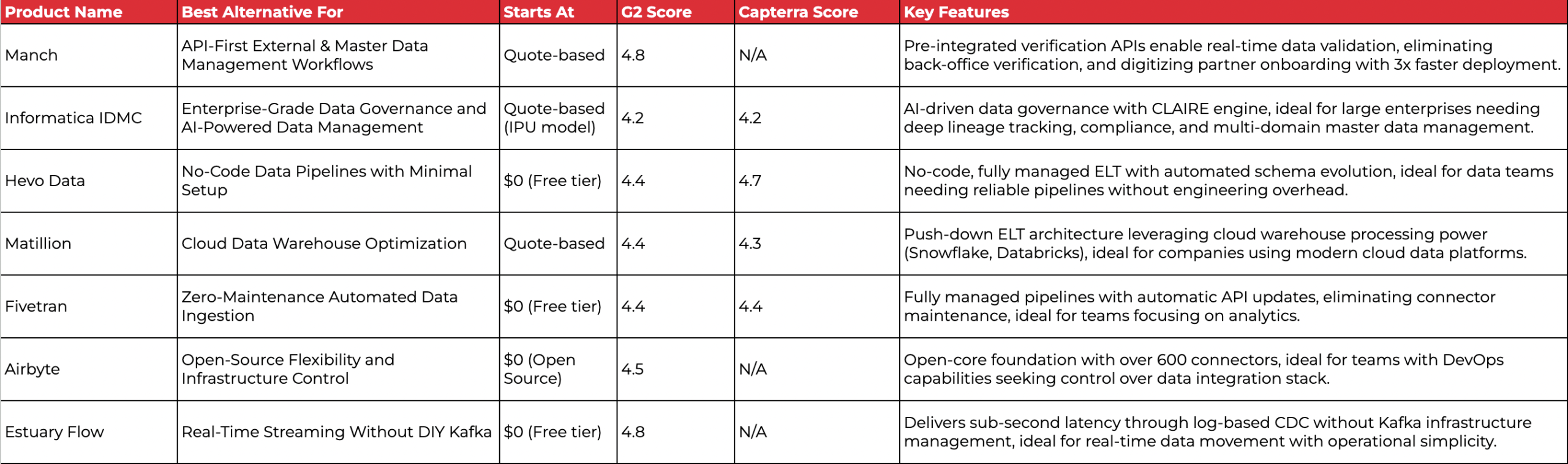
While Talend provides a comprehensive data integration and management platform, different organizations have specific requirements that call for specialized solutions. Based on our research, here are the best alternatives:
- Manch for API-first external data management workflows where pre-integrated verification APIs validate partner onboarding, KYC, and vendor data in seconds at the point of capture, with 3x faster deployment through low-code/no-code configuration
- Informatica IDMC for enterprise-grade data governance with AI-powered automation, comprehensive lineage tracking, and multi-domain MDM in heavily regulated industries
- Hevo Data for teams needing no-code data pipelines with automated schema evolution, transparent pricing, and minimal engineering overhead
- Matillion for companies standardizing on cloud data warehouses like Snowflake or Databricks who want to leverage warehouse-native processing power
- Fivetran for zero-maintenance data ingestion where eliminating connector maintenance and ensuring enterprise-grade reliability are priorities
- Airbyte for teams with DevOps capabilities who want open-core flexibility, infrastructure control, and cost-effective high-volume data processing
- Estuary Flow for real-time streaming requirements with sub-second latency without the complexity of managing Kafka infrastructure
These alternatives don’t have to replace Talend entirely. Many organizations may find value in using Talend alongside specialized tools, using Manch to capture validated external data that then flows through Talend pipelines, or complementing Talend’s capabilities with Estuary Flow’s real-time streaming.
Consider your specific needs, team capabilities, and growth plans when deciding which solution works best for your data management challenges.
Ready to validate external data in seconds, not days? Manch’s API-first platform helps enterprises digitize partner onboarding, automate KYC verification, and achieve compliance with pre-integrated verification APIs and 3x faster deployment. Talk to sales to see how Manch can transform your external data workflows.