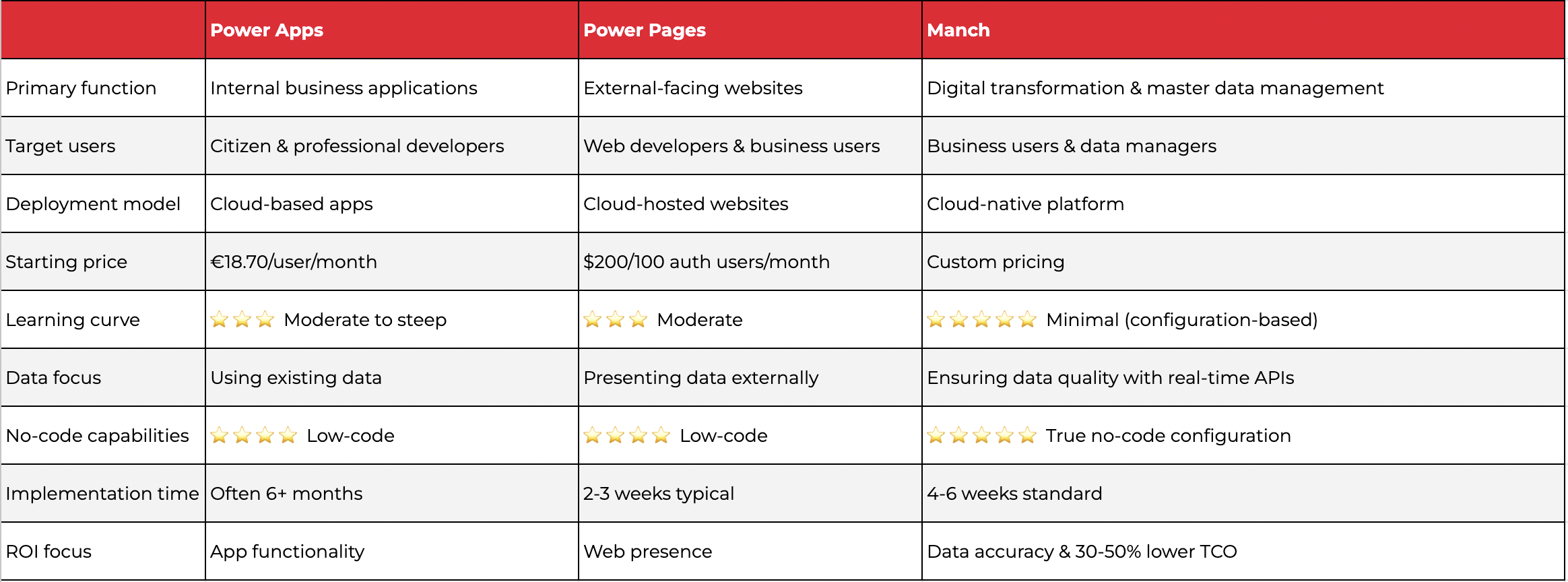
Understanding the fundamental difference: Building vs. Managing
The comparison between Power Apps, Power Pages, and Manch reveals a fundamental divide in approach to digital transformation. Microsoft’s tools focus on building new digital experiences, while Manch focuses on becoming the API-driven foundation that ensures data quality across all systems.
Power Apps and Power Pages work best when connecting to well-structured data sources. While both platforms include some data validation features through Dataverse (including duplicate detection and business rules), they primarily serve as development platforms for creating interfaces that connect to your existing data sources. This approach works well when your underlying data is relatively accurate and consistent – but only if you’re fully committed to the Microsoft ecosystem.
But many enterprises face a different reality: data exists in silos across SAP, Oracle, Microsoft, Salesforce, and legacy systems. Building applications on top of inconsistent data can amplify existing problems rather than solve them. It’s a common challenge in digital transformation projects, especially for organizations with heterogeneous IT landscapes.
Manch takes an API-first approach entirely. The platform’s pre-integrated APIs enable real-time verification and validation within seconds – eliminating the traditional need for back-office teams performing manual verification. Instead of focusing on application development, Manch establishes a single source of truth through its Master Data Management capabilities, but goes beyond traditional MDM. The platform can digitize any business process through its configuration-based approach – from vendor onboarding to contract management to compliance workflows. According to Manch’s materials, this versatility explains their zero customer churn rate: customers discover they can configure multiple business processes on the same platform, not just MDM.
Power Apps excels at internal application development
Power Apps has established itself as Microsoft’s flagship low-code development platform, empowering organizations to build custom business applications with reduced coding requirements. The platform offers flexibility through its dual approach: canvas apps for pixel-perfect design control and model-driven apps for data-centric applications.
The strength of Power Apps lies in its deep integration with the Microsoft ecosystem – if you’re already invested there. The broader Microsoft platform offers over 1,400 connectors that Power Apps can leverage, enabling it to pull data from SharePoint lists, SQL databases, and even third-party services like Salesforce. The visual development environment and Excel-like Power Fx formula language make it accessible to business users who understand their processes but may lack traditional coding skills.
However, the platform’s capabilities come with significant considerations. Despite being marketed as “low-code,” creating anything beyond simple forms often requires a developer mindset and still involves substantial coding. Users report a steep learning curve, especially when dealing with delegation limits, complex formulas, and performance optimization. The licensing model adds another layer of complexity, with premium connectors and Dataverse requirements potentially escalating costs significantly. Plus, you’re essentially locked into the Microsoft ecosystem – integrating with non-Microsoft systems becomes complex and expensive.
Real-world implementation often takes longer than initial expectations. A Forrester study of enterprise implementations found a typical timeline of 10 months, considerably longer than the “rapid development” promise might suggest. Organizations must also factor in ongoing maintenance, as apps require regular updates to accommodate Microsoft’s bi-annual release cycles.
Power Pages dominates external website creation
Power Pages represents Microsoft’s evolution from Power Apps Portals into a standalone product for building external-facing websites. The platform provides tools for creating secure, data-driven web experiences for customers, partners, and vendors, with enterprise-grade security features.
The Design Studio offers an environment with distinct workspaces for pages, styling, data, and setup. Built on Bootstrap framework, Power Pages ensures responsive, mobile-friendly websites out of the box. The platform’s deep integration with Dataverse means organizations can surface business data to external users with granular control over access and permissions – assuming they’re using Dataverse.
Security is a key differentiator for Power Pages. With support for multiple identity providers, role-based access control, and table-level permissions, organizations can expose data to external stakeholders with confidence. The built-in Web Application Firewall and integration with Azure services provide additional layers of protection.
Yet Power Pages has its own considerations. Users report that design flexibility can be constrained compared to traditional web development platforms, with some frustration around the template-based approach when trying to achieve unique branding or complex layouts. The capacity-based pricing model, charging separately for authenticated and anonymous users, can become expensive for high-traffic sites. Community discussions also mention performance considerations with complex portals, though Microsoft provides optimization guidance. And like Power Apps, you’re most successful when fully committed to the Microsoft ecosystem.
Manch transforms the data foundation both platforms depend on
While Power Apps and Power Pages focus on building user interfaces within the Microsoft ecosystem, Manch addresses a different challenge that can undermine digital transformation initiatives regardless of your technology stack: data quality and process efficiency across heterogeneous IT landscapes.
According to Manch’s documentation, their API-first platform establishes real-time data verification and validation through pre-integrated APIs – eliminating the traditional lag between data input and verification. This means organizations no longer need back-office teams performing manual verification tasks. The platform validates data against public databases including PAN, GSTN, and bank accounts in real-time, providing immediate validation that traditional systems cannot match. While initially designed for the Indian market, Manch states their modular architecture can be replicated for any country in approximately two weeks where similar verification services are available.
But Manch goes well beyond just data validation. As a true digital transformation platform, organizations can configure any business process using its drag-and-drop interface – no coding required. This configuration-based approach delivers deployment in 4-6 weeks, approximately 3x faster than traditional platforms or typical Power Apps implementations. According to the company, this versatility drives their zero customer churn rate: customers start with one use case like vendor onboarding, then discover they can digitize contract management, asset tracking, compliance workflows, and more on the same platform.
The platform’s DIY interface means business users can make changes themselves without submitting IT change requests – a stark contrast to Power Apps’ need for developer involvement even for minor modifications. Manch’s case studies report dramatic operational improvements: one pharmaceutical company achieved 100% verified KYC, while an e-commerce company reduced back-office resources by 60%. Himalaya Wellness achieved compliance with new tax regulations in just three weeks.
What distinguishes Manch’s approach is ecosystem neutrality. Unlike Microsoft’s platforms that work best within the Microsoft stack, Manch integrates equally well with SAP, Oracle, Microsoft, Salesforce, and legacy systems. As an SAP partner, the platform provides native integration while maintaining independence – organizations aren’t locked into a single vendor ecosystem. This system-agnostic design makes it ideal for enterprises with mixed technology environments.
The hidden cost of building on bad data
The most overlooked aspect of the Power Apps vs Power Pages comparison is the quality of underlying data. Both Microsoft platforms are only as effective as the data they access, and poor data quality can render even sophisticated applications less valuable – especially when that data comes from multiple systems outside the Microsoft ecosystem.
Consider a typical scenario: you build a Power App for inventory management that pulls data from SAP, Oracle, and legacy systems through complex custom connectors. If that data contains duplicates, inconsistencies, or outdated information, your app simply provides a better view of problematic data – while you’re paying premium connector fees and dealing with integration complexity. The same applies to Power Pages websites showing incorrect product information or partner details to external users.
Industry research consistently shows that poor data quality can significantly impact operations. Gartner estimates the average financial impact at $9.7 million per year. According to Manch’s approach, their platform addresses this through real-time API validation at data entry points, using AI to detect anomalies, and maintaining continuous data governance across all systems – not just Microsoft ones.
The financial considerations are substantial. While Power Apps costs €18.70 per user monthly plus premium connector fees for non-Microsoft integrations, and Power Pages requires capacity packs starting at $200, the real cost often comes from decisions made on inaccurate data and the complexity of cross-platform integration. A joint press release from Soltec Inc. and Manch Technologies claims their combined approach can cut implementation timelines by 40% and deliver 2-3x ROI within 12 months. Organizations report 30-50% lower total cost of ownership compared to traditional enterprise platforms when considering licensing, implementation, and ongoing maintenance combined.
Integration capabilities reveal different philosophies
Each platform’s approach to integration reveals its fundamental philosophy and target use case.
Power Apps can access over 1,400 connectors available across the Microsoft ecosystem, positioning itself as a versatile connector within Microsoft’s world. However, this breadth comes with ecosystem lock-in. Organizations must manage multiple connection points, each with potential failure modes. Premium connectors add significant cost for non-Microsoft systems, and custom connectors require development expertise. The moment you need serious integration with SAP, Oracle, or legacy systems, complexity and costs escalate dramatically.
Power Pages takes an even more focused approach, primarily integrating within the Microsoft ecosystem. While it can connect to external services through Power Automate, its strength lies in surfacing Dataverse data to external users. This tight integration works well for organizations fully invested in Microsoft’s platform but creates limitations for those with SAP, Oracle, or diverse technology stacks.
According to Manch’s documentation, their integration philosophy differs entirely. As an ecosystem-neutral platform, Manch integrates seamlessly across SAP, Oracle, Microsoft, Salesforce, and legacy systems without forcing organizations toward specific vendor choices. Instead of requiring expensive premium connectors or complex custom development, it focuses on becoming the authoritative source for master data that all systems consume. The platform provides APIs for real-time verification, including eKYC, document OCR, and various authentication services. This hub-and-spoke model simplifies the integration landscape by establishing clear data ownership and flow across heterogeneous IT environments.
Implementation complexity varies dramatically
The implementation timeline and complexity of each platform tells a revealing story about their target users and true deployment costs.
Power Apps implementations for enterprise applications can be substantial undertakings. A Forrester study found that large enterprises typically spent 10 months on initial implementation – far from the “rapid development” promise. Organizations must navigate environment setup, data modeling in Dataverse, security configuration, and extensive testing. Despite being called “low-code,” anything beyond basic forms requires significant development work. Post-implementation, apps require constant monitoring for compatibility with Microsoft’s regular platform updates.
Power Pages can be deployed more quickly, often within 2-3 weeks for basic portals according to implementation partners. The Design Studio streamlines much of the configuration, though complex security requirements and custom development can extend timelines. The go-live checklist helps ensure nothing is missed, but organizations still need expertise in Dataverse and the broader Power Platform.
According to Manch’s documentation, their implementations deliver go-live in 4-6 weeks standard, with some deployments as fast as 4 weeks. They cite a case where Himalaya Wellness achieved compliance with new tax regulations in just three weeks. Manch attributes this 3x faster deployment to their configuration-based approach – no coding required. Instead of building from scratch like Power Apps, organizations configure existing workflows using the drag-and-drop interface. Business users can even make changes themselves post-deployment without IT involvement or change requests, dramatically reducing the ongoing maintenance burden that plagues Power Apps implementations.
Power Apps vs Power Pages vs Manch: Which should you prioritize?
The choice between these platforms depends on correctly identifying your primary business challenge and your existing technology landscape.
Choose Power Apps if:
- You need custom internal applications for specific business processes
- Your organization is already fully invested in the Microsoft 365 ecosystem
- You have citizen developers eager to build solutions and IT resources to support them
- You can commit to the learning curve, ongoing maintenance, and premium connector costs
- Your data sources are primarily within Microsoft or you’re willing to pay for integration
- You’re comfortable with 6-10 month implementation timelines
Choose Power Pages if:
- You need secure external-facing websites for customers or partners
- You want to surface Dataverse data to external users
- Enterprise-grade security is non-negotiable
- You prefer low-code to traditional web development
- You can work within the platform’s design parameters and Microsoft ecosystem
- Your external stakeholders are comfortable with template-based experiences
Choose Manch if:
- Data quality issues impact your operations across multiple systems
- You work with SAP, Oracle, Microsoft, Salesforce, or legacy systems (or any combination)
- You need to streamline partner, vendor, or customer onboarding with real-time verification
- Regulatory compliance and data validation are critical
- You want true no-code configuration that business users can manage
- You need deployment in 4-6 weeks, not months
- You’re a mid to large organization (500+ employees, $10M+ revenue)
- You want to avoid vendor lock-in and premium connector fees
- Total cost of ownership matters – seeking 30-50% lower TCO
Consider a combined approach:
These platforms aren’t mutually exclusive, but be strategic about sequencing:
- Start with data foundation: Establish strong data management and process digitization (whether through Manch or other system-agnostic MDM solutions) to ensure quality data across all systems
- Then build interfaces: Once data sources are optimized and verified, implement Power Apps for Microsoft-centric internal applications where appropriate
- Finally, external engagement: Deploy Power Pages for external portals if you’re committed to the Microsoft ecosystem
The key insight: Power Apps excels at simple to moderately complex apps when you’re fully invested in Microsoft’s ecosystem. But the moment you need heavy integration with diverse systems, complex cross-platform workflows, or true business user empowerment without IT dependency, platforms like Manch become the more cost-effective choice. Building applications (even excellent ones) on inconsistent data or forcing complex integrations through premium connectors may not solve underlying business challenges.
Interested in exploring how an API-first digital transformation platform could complement or replace your Microsoft Power Platform investments? For organizations with heterogeneous IT landscapes seeking faster deployment, lower total cost of ownership, and true configuration-based flexibility, evaluating ecosystem-neutral platforms like Manch could significantly enhance your digital transformation outcomes.