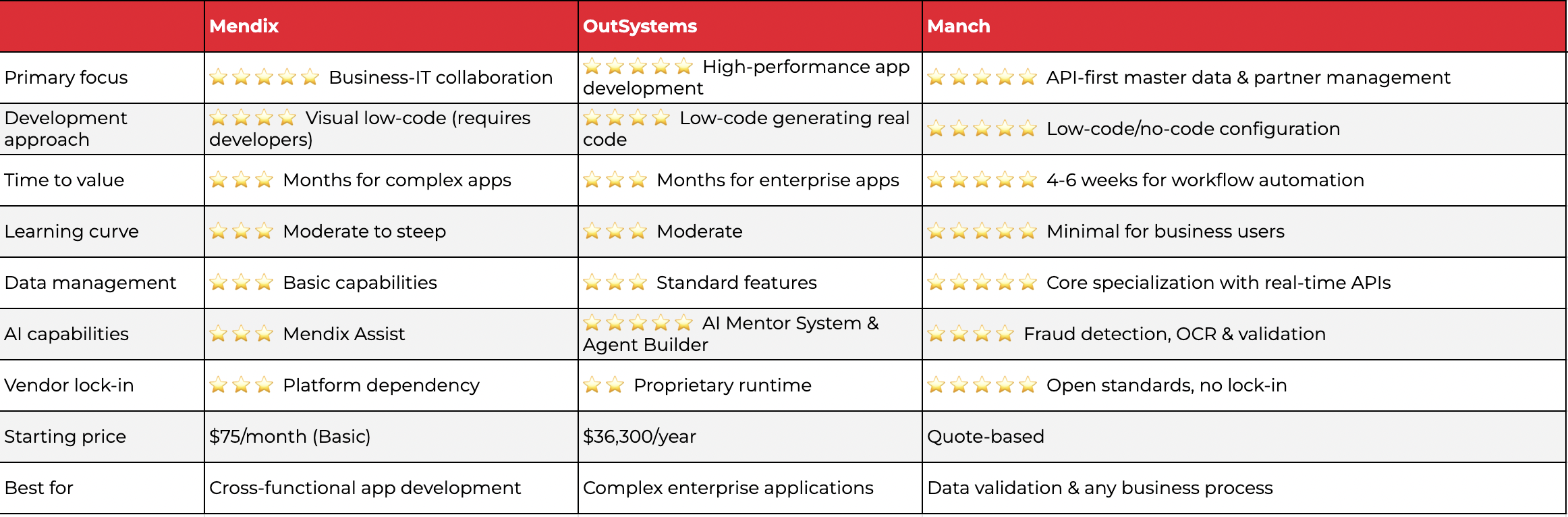
The philosophical divide: Application building vs data foundation
The fundamental difference between these platforms isn’t about features but philosophy. Mendix and OutSystems are built on the assumption that creating better applications faster will transform your business. Manch’s API-first philosophy recognizes that even the best applications fail when built on bad data—and that real-time verification at the source is the key to data integrity.
Mendix’s philosophy centers on creating an all-in-one platform where business and IT collaborate seamlessly. The visual development environment and model-driven approach reflect a belief that breaking down silos between technical and non-technical teams is the key to digital transformation. However, despite the “low-code” marketing, organizations still need skilled developers for anything beyond basic applications, requiring significant time and resources to train diverse teams.
OutSystems takes a developer-centric philosophy, focusing on generating high-performance, real code rather than interpreted instructions. The platform’s AI Mentor System and comprehensive DevOps capabilities reflect a belief that empowering professional developers with better tools will accelerate enterprise transformation. This approach works well for organizations with strong IT teams but creates vendor lock-in through its proprietary runtime environment.
Manch’s philosophy is radically different: establish accurate data foundations through API-first architecture. The platform’s pre-integrated APIs enable real-time verification and validation in seconds, eliminating the need for back-office verification teams. Rather than building new applications on shaky foundations, Manch ensures the data feeding into all your systems is accurate, validated, and compliant from the source. This versatile platform goes beyond MDM—customers can configure any business process, discovering new use cases that drive zero customer churn.
Mendix excels at business-IT collaboration (with caveats)
Mendix’s greatest strength is its ability to bring together business stakeholders and IT professionals in a shared development environment. However, the reality of this collaboration comes with important considerations:
Unified Visual Development: While Mendix previously offered separate Studio and Studio Pro environments, the platform has evolved to provide Studio Pro as its primary IDE, maintaining its commitment to visual development. Developers can visually model databases, create user interfaces through drag-and-drop, and define business logic using visual microflows. While this transparency helps business stakeholders understand the development process, they still can’t make meaningful contributions without technical training.
Model-Driven Approach: The platform’s visual approach to full-stack development allows both technical and non-technical users to understand application structure in theory. Changes are synchronized across the platform, allowing business users to create prototypes that developers can enhance with complex logic. In practice, however, anything beyond basic prototypes requires developer involvement.
Mendix Connect: The platform’s integration capabilities, including a comprehensive catalog of reusable data services and pre-built connectors, make it easier to leverage existing systems. The visual data mapping tools allow developers to connect external data sources without extensive coding.
The critical limitation: Despite being marketed as “low-code,” Mendix still requires skilled developers for real-world applications. The platform requires significant training investment for both business users and developers to become proficient. Advanced features require technical expertise, and like all low-code platforms, there are considerations about platform dependency.
OutSystems dominates developer productivity and AI innovation
OutSystems stands out for its focus on developer productivity and its pioneering integration of AI throughout the development lifecycle. However, this power comes with significant commitments:
Real Code Generation: Unlike many low-code platforms, OutSystems generates optimized, compiled code, with well-documented generation of C# and .NET applications. This approach delivers native performance and allows developers to extend applications with custom code when needed. However, the proprietary runtime environment creates vendor lock-in concerns—you can’t simply take your code and run it elsewhere.
AI-Powered Development: The AI Mentor System provides continuous code analysis, identifying performance issues, security vulnerabilities, and architectural problems. The system analyzes code every 12 hours across dimensions like maintainability and security. The new AI Agent Builder enables developers to create generative AI agents through a no-code interface.
Comprehensive DevOps: OutSystems includes built-in version control, one-click deployment, and sophisticated dependency management. The LifeTime management console provides centralized control over the entire application lifecycle, from development through production.
The platform’s power comes at a significant cost. OutSystems has a steeper learning curve than many competitors, and its enterprise focus means smaller organizations may find it overwhelming. The starting price of $36,300 per year and proprietary runtime create both financial and technical lock-in.
Manch’s API-first approach solves the data problem neither platform addresses
While Mendix and OutSystems focus on building applications, Manch’s API-first architecture addresses the foundational data challenges that undermine digital transformation efforts. The platform’s unique capabilities deliver value far beyond traditional MDM:
API-First Real-Time Verification: Manch’s pre-integrated APIs enable real-time verification and validation in seconds, eliminating the need for back-office verification teams. The platform performs real-time triangulation, cross-verifying information from multiple sources including PAN, GSTN, and bank accounts. This proactive approach ensures data accuracy at the point of entry, preventing bad data from ever entering your systems.
Master Data Management Excellence: Manch establishes a single source of truth for critical business data across the organization. The platform handles comprehensive master data including material masters, employee masters, finance masters, and pricing masters. With sophisticated AI-powered duplicate detection and merge capabilities, it prevents duplicate creation at source rather than requiring post-facto cleanup. The platform is ISO 27001 and SOC2 Type2 compliant, meeting enterprise security requirements.
Digital Transformation Platform: Here’s what sets Manch apart: while it excels at MDM, customers discover they can configure ANY business process on the same platform. This versatility drives zero customer churn—organizations use it for contract management, asset tracking, retailer onboarding, vendor management, and numerous other workflows. The platform dramatically accelerates processes, with documented cases showing partner onboarding reduced from 7 days to 7 hours.
True Low-Code/No-Code Implementation: While Mendix and OutSystems require varying degrees of technical expertise, Manch’s approach allows business users to configure complex workflows independently using visual building blocks. The DIY interface enables organizations to make minor changes themselves without raising change requests or paying for modifications. Built-in capabilities include OCR for document processing, face extraction and comparison, document classification, and fraud detection—features not available in standard ERP systems.
3x Faster Deployment: Customer testimonials report go-live times of 4-6 weeks rather than months, representing 3x faster deployment than traditional platforms. This speed advantage comes from true configuration-based setup rather than heavy coding or customization, with pre-built vertical-specific templates for common use cases.
Implementation timelines reveal different approaches
The implementation timelines for these platforms reveal their fundamental differences in approach and complexity.
Mendix implementations typically span several months for complex applications. While simple applications can be built quickly, enterprise-grade solutions require time for requirements gathering, development, testing, and deployment. Organizations must also factor in training time for developers to become proficient, as the platform requires more technical expertise than its “low-code” marketing suggests.
OutSystems implementations follow a similar timeline, though the platform’s AI assistance can accelerate certain aspects. Complex, mission-critical applications often require 6-12 months based on documented case studies. The platform’s power comes with complexity that requires careful planning and architecture, plus consideration of long-term vendor lock-in.
Manch implementations operate on a completely different timeline: 4-6 weeks for typical deployments. Because the platform focuses on configuring existing workflows rather than building new applications, implementations are 3x faster than traditional platforms. One pharmaceutical company achieved 100% compliant KYC in three weeks. A global beverage company reduced partner onboarding from 7 days to 7 hours. This rapid deployment is possible because Manch provides pre-built components with integrated APIs for real-time verification, eliminating traditional back-office setup time.
Cost considerations reflect platform complexity
The pricing structures of these platforms reflect their different approaches, with hidden costs often exceeding initial investments.
Mendix offers tiered pricing starting at $75/month for basic single-app deployments, scaling to enterprise pricing for unlimited applications. However, the true cost includes cloud resources, additional users, and extensive developer training. Organizations must budget for skilled developers despite the “low-code” promise, significantly increasing total cost of ownership.
OutSystems commands premium pricing at $36,300/year minimum, reflecting its enterprise focus and comprehensive capabilities. Additional costs include extra users, environments, and advanced features. The platform’s TCO can easily exceed $100,000/year for mid-sized deployments. The proprietary runtime environment creates additional long-term cost considerations for migration or scaling.
Manch uses quote-based pricing tailored to specific use cases and scale, typically delivering 30-50% lower total cost of ownership compared to alternatives. The platform’s DIY interface eliminates ongoing change request costs—business users can make minor modifications themselves without IT involvement or additional fees. Vendor-provided case studies indicate strong ROI: one e-commerce company reported 60% reduction in back-office resources, while others cite 80% reductions in manual tasks. The elimination of back-office verification teams through API-first automation delivers immediate operational savings.
Integration capabilities show complementary strengths
Each platform’s integration approach reveals its intended use case and potential for working together rather than competing.
Mendix Connect provides extensive integration capabilities through its catalog of reusable data services and marketplace of pre-built connectors. The platform supports REST, OData, SOAP, and GraphQL APIs, with visual tools for mapping data between systems. The Data Hub pane in Studio Pro allows developers to discover and consume registered data sources through drag-and-drop functionality.
OutSystems’ Integration Builder offers a wizard-based approach to connecting with enterprise systems like SAP, Salesforce, and Microsoft Dynamics. The platform automatically generates methods and data structures for consumed services. The extensive connector library in OutSystems Forge provides over 400 pre-built integrations, though the proprietary runtime can complicate integrations with non-standard systems.
Manch’s system-agnostic approach enables integration with any existing system—SAP, Oracle, Microsoft, Salesforce, or legacy platforms—without vendor bias. As an SAP partner, the platform provides native SAP integration while maintaining equal capability across all systems. The API-first architecture provides APIs for all major functions including eKYC, document verification, and digital signatures. Rather than replacing existing systems, Manch enriches them with validated, accurate data. Built on open standards with no proprietary runtime, data and processes remain portable without vendor lock-in.
This complementary approach means Manch works alongside application platforms like Mendix or OutSystems, ensuring the data they process is accurate, validated, and compliant from the source.
Mendix vs OutSystems vs Manch: Which should you choose?
The choice between these platforms depends on your organization’s immediate needs and strategic priorities.
Choose Mendix if:
- You need to bridge the gap between business and IT teams
- Visual development and collaboration are priorities
- You have skilled developers available despite the “low-code” marketing
- You’re already invested in the Siemens ecosystem
- You have months to invest in platform training and implementation
Choose OutSystems if:
- You need to build complex, high-performance applications
- Your team includes experienced developers who want productivity tools
- AI-powered development assistance is a priority
- You’re comfortable with vendor lock-in through proprietary runtime
- You have budget for premium solutions ($36,300+ annually)
Choose Manch if:
- Data quality and accuracy are undermining your digital initiatives
- You need real-time verification and validation without back-office teams
- You want to streamline partner, vendor, or customer onboarding
- Business users need to make changes without IT involvement
- You need results in 4-6 weeks, not months
- You want to digitize ANY business process, not just MDM
- You need ISO 27001 and SOC2 Type2 compliant solutions
- You want to avoid vendor lock-in with open standards
The optimal strategy for many enterprises:
Rather than viewing these as competing platforms, consider how they complement each other:
- Start with Manch to establish accurate master data through API-first real-time verification and streamline partner workflows in 4-6 weeks
- Leverage this clean data foundation to build applications with Mendix or OutSystems, knowing your data is validated at the source
- Let each platform do what it does best: Manch for data integrity and any business process automation, Mendix/OutSystems for complex application development
- Expand usage: As you discover new use cases on Manch’s versatile platform, configure additional business processes without switching platforms
The truth is, building better applications on bad data is like building a house on sand. No matter how sophisticated your development platform, inaccurate master data will undermine your digital transformation efforts. By addressing data quality first with Manch’s API-first approach, then leveraging that foundation for application development with Mendix or OutSystems, organizations achieve true digital transformation.
Ready to fix the data foundation that’s holding back your digital initiatives? Contact Manch to see how you can transform your partner and master data management in just 4-6 weeks.