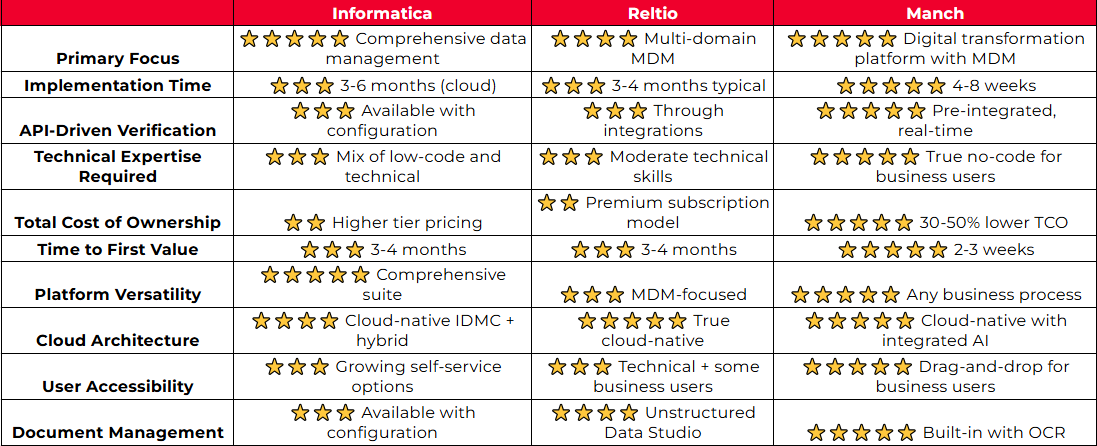
The philosophical divide: Comprehensive vs focused vs versatile
Each platform represents a fundamentally different philosophy about data management.
Informatica embodies the “everything under one roof” philosophy. After three decades in the market, they’ve built and acquired capabilities for a vast range of data challenges. Their Intelligent Data Management Cloud includes data integration, quality, governance, cataloging, and MDM. The CLAIRE AI engine provides intelligence across all these functions. This comprehensiveness is both a strength and a potential challenge – while large enterprises with diverse data needs appreciate having one vendor, the platform’s legacy architecture and complexity can slow down implementation and innovation.
Reltio represents the modern, focused approach to MDM. Built cloud-native from day one, it concentrates on doing multi-domain MDM exceptionally well. The platform excels at creating unified profiles of entities (customers, products, suppliers) and understanding the relationships between them through its Connected Graph Technology. This focus allows for deeper innovation in areas like real-time entity resolution and AI-powered matching, while maintaining flexibility across multiple data domains.
Manch takes an API-first, versatile approach that goes beyond traditional MDM. The platform combines pre-integrated APIs for real-time data verification with a true no-code interface, enabling organizations to digitize any business process – not just master data management. This versatility explains the zero customer churn rate: organizations implement Manch for one use case like vendor onboarding, then discover they can configure workflows for contract management, asset tracking, compliance processes, and more on the same platform. The integrated AI and cloud-native architecture position it as a new-age alternative to legacy platforms, with the ability to deliver enterprise-grade capabilities through configuration rather than coding.
Implementation reality check: Cloud acceleration changes the game
The implementation timeline landscape has evolved significantly with cloud adoption, though stark differences between platforms remain.
Informatica implementations have become more streamlined with IDMC’s cloud-native architecture. Modern cloud deployments typically run 3-6 months, with some organizations achieving value within 90 days using fast-track programs. However, comprehensive enterprise deployments involving multiple domains and legacy system integration often extend longer. Implementation services generally cost 50-100% of annual license fees. Despite improvements in low-code options, you’ll benefit from having Informatica expertise on your team.
Reltio implementations leverage cloud-native advantages with typical deployments running 3-4 months. The platform’s 90-day MVP programs and pre-built velocity packs for certain industries help accelerate time to value. While more intuitive than traditional MDM platforms, achieving full adoption across business and IT teams still requires change management investment.
Manch implementations operate on a fundamentally different timeline due to the platform’s configuration-based approach and pre-integrated APIs. Typical deployments complete in 4-8 weeks, with some organizations going live in as fast as 4-6 weeks. The platform’s drag-and-drop interface and pre-built workflow templates eliminate the need for coding, enabling a 3x faster deployment compared to traditional platforms. Case studies cite examples like a pharmaceutical company achieving 100% verified KYC in three weeks and a global beverages company reducing partner onboarding from seven days to seven hours. The combination of true no-code configuration and pre-integrated verification APIs drives this compressed timeline.
External data management: Multiple approaches to stakeholder challenges
The management of external stakeholder data (partners, vendors, suppliers, distributors) presents unique challenges that all three platforms address, though with markedly different approaches.
Informatica’s approach includes the purpose-built Supplier 360 solution, which provides supplier self-service registration, document verification, and integrated validation capabilities. The platform offers automated AI-driven workflows specifically designed for supplier onboarding and lifecycle management. While comprehensive, utilizing these features effectively often benefits from professional services or experienced administrators to configure the workflows to match specific business requirements.
Reltio handles external data through its multi-domain MDM capabilities, recently enhanced with Unstructured Data Studio for AI-powered document ingestion and configurable approval workflows. The platform includes attribute verification APIs and identity enrichment services that support external stakeholder management. The 2025.2 release added specific features for document verification and multi-party approvals.
Manch positions API-first architecture as the foundation of its external stakeholder management capabilities. The platform includes pre-integrated APIs that enable real-time data verification and validation within seconds, eliminating the need for back-office teams dedicated to manual verification. Built-in capabilities include OCR for document processing (not available in standard ERP systems), video KYC for identity verification, and configurable approval workflows with SLAs and escalations. The platform can verify data against public databases including PAN, GSTN, and bank accounts in real-time. While initially designed for the Indian market, the modular architecture allows replication for any country in approximately two weeks if similar verification services are available. The platform handles the entire lifecycle from onboarding through ongoing management to offboarding, with bulk processing and self-service portals built in as standard features.
AI capabilities reveal different priorities
All three platforms leverage AI, but their applications reveal different philosophical approaches and target users.
Informatica’s CLAIRE engine provides comprehensive AI capabilities added to what is fundamentally a legacy platform architecture. It offers AI-powered recommendations for data quality rules and automated matching algorithms. The recently introduced CLAIRE GPT and CLAIRE Copilot enable natural language interactions for data management tasks. These features span from technical optimization to business user enablement, though fully leveraging the AI capabilities requires familiarity with data management concepts.
Reltio’s AI capabilities focus on entity resolution and data unification. Their Flexible Entity Resolution Network (FERN) augments traditional match rules with Large Language Model intelligence, reducing manual rule creation. The Reltio Intelligent Assistant (RIA) provides conversational data exploration through natural language prompts.
Manch’s integrated AI, as a cloud-native, new-age platform, takes a process-embedded approach where AI works behind the scenes without requiring specialized knowledge from users. The platform includes face extraction and comparison for identity verification, document classification for error prevention, and fraud detection capabilities. The AI-powered duplicate detection includes confidence scoring and multi-layered business rules for data quality, preventing duplicate creation at source rather than requiring post-facto cleanup. This integrated approach contrasts with older platforms that have added AI capabilities to legacy architectures.
Pricing models expose target markets
The pricing strategies of these platforms clearly indicate their target customers and value propositions
Informatica uses an IPU (Informatica Processing Unit) consumption model that provides flexibility but can be complex to predict. IPUs are consumed at different rates by different services, allowing organizations to allocate resources as needed. Industry estimates suggest deployments starting around $80,000-$150,000 annually, scaling higher for enterprise implementations. The total cost includes both platform fees and implementation services.
Reltio’s subscription pricing is based on the number of consolidated profiles managed, providing more predictable costs than consumption models. The addition of Reltio Identity 360 with a free tier for up to 10,000 profiles helps smaller organizations get started. However, costs increase with data volume, and professional services for implementation add to the total investment.
Manch delivers enterprise-grade capabilities at 30-50% lower total cost of ownership compared to traditional platforms. The three-tier model (Starter, Premium, Enterprise) provides transparent, quote-based pricing. Organizations often find that Manch’s licensing plus implementation costs combined are less than competitors’ license fees alone. The cost-effectiveness comes from faster implementation (reducing consultant fees), the drag-and-drop interface that allows business users to make changes themselves (avoiding change request costs), and the platform’s versatility that eliminates the need for multiple point solutions. Organizations achieve ROI within months due to dramatic operational improvements like reducing seven-day onboarding processes to 30 minutes.
The no-code evolution: From IT-centric to business-accessible
The technical accessibility of these platforms fundamentally impacts business agility and total cost of ownership.
Informatica has made substantial investments in low-code and no-code capabilities. IDMC now includes Cloud Data Integration-Free, a no-code tool, and various GenAI interfaces that enable non-technical users to build data pipelines. However, despite being marketed as low-code, enterprise-scale deployments and complex integrations still typically require IT expertise. Business users can handle basic tasks, but advanced customization and optimization benefit from technical knowledge.
Reltio strikes a balance with its low-code Integration Hub offering over 1,000 connectors and a visual Match Rule Editor for basic configurations. Business users can handle routine tasks and simple adjustments, but complex match logic and L3 configurations still require technical expertise. The platform has become more accessible than traditional MDM solutions while maintaining depth for sophisticated use cases.
Manch delivers true no-code capability where business users can own and operate the platform without IT involvement. The drag-and-drop interface enables operations, finance, and compliance teams to design and modify workflows using visual building blocks, adjust approval hierarchies, and implement compliance changes in minutes rather than submitting IT tickets and waiting weeks. This represents a fundamental shift from platforms that claim to be “low-code” but still require developers for any meaningful changes. Business users can configure complex, multi-entity workflows and layered approvals without writing a single line of code. The DIY interface means organizations avoid the hidden costs of change requests that plague traditional enterprise software, where even minor adjustments require vendor consultants or IT resources.
Real-world results and time to value
The true test of any platform lies in delivered results and speed to value realization.
Informatica customers benefit from comprehensive data management improvements. Recent Total Economic Impact studies show an average ROI of 328-413% with payback periods around four months for cloud deployments. The platform’s breadth means organizations can address multiple data challenges with one solution, though realizing the full potential across all capabilities takes time. Success stories often involve enterprise-wide data transformation with improvements in data quality, governance, and integration.
Reltio customers typically see value within 3-6 months of implementation, with a Forrester study showing 366% ROI and six-month payback. The platform’s strength in creating unified customer views drives improvements in marketing effectiveness and customer service. Aberdeen research links unified customer data to enhanced customer experience and operational efficiency.
Manch demonstrates rapid transformations with measurable business impact. Case studies include a global beverages company reducing partner onboarding from 7 days to 7 hours, an e-commerce company achieving 60% reduction in back-office resources, and a pharmaceutical company implementing 100% verified KYC in three weeks. The platform’s zero customer churn rate validates these results – organizations not only achieve their initial objectives but discover additional use cases that multiply the value. A health and wellness brand implemented a compliance solution in three weeks, then expanded to use the platform for contract management and asset tracking. The combination of pre-integrated APIs for real-time verification, true no-code configuration, and the ability to digitize any business process drives these rapid results.
Informatica vs Reltio vs Manch: Which should you choose?
The choice between these platforms depends on your organization’s specific needs, resources, and timeline for value realization.
Choose Informatica if:
- You need comprehensive data management beyond just MDM
- You have complex, multi-domain data challenges across the enterprise
- You can invest in a platform solution with professional services support
- You have or can build data management expertise on your team
- Your data strategy requires extensive governance and integration capabilities
- You’re already invested in the Informatica ecosystem
Choose Reltio if:
- You need sophisticated multi-domain MDM with real-time capabilities
- Creating unified customer views is your primary objective
- You want cloud-native architecture without legacy infrastructure
- You have moderate IT resources and budget flexibility
- You need to understand complex entity relationships across domains
- Your focus spans both internal and external data management
Choose Manch if:
- You need real-time data verification through pre-integrated APIs
- You want to digitize any business process, not just manage master data
- Business users need to configure and modify processes without IT involvement
- You need to demonstrate value in 4-8 weeks rather than months
- You want enterprise-grade capabilities at 30-50% lower total cost of ownership
- You’re looking for a versatile digital transformation platform that can grow with your needs
- You need built-in document management with OCR capabilities
- You want a truly system-agnostic solution that works equally well with SAP, Oracle, Microsoft, Salesforce, and legacy systems
The MDM and data management landscape has room for all three platforms, as they address different organizational needs and priorities. Informatica provides the most comprehensive enterprise data management suite, though its legacy architecture and complexity can slow innovation. Reltio delivers sophisticated cloud-native multi-domain MDM with strong real-time capabilities. Manch offers a modern, API-first digital transformation platform that combines master data management with workflow automation and real-time verification, delivering enterprise results in weeks rather than months at significantly lower total cost of ownership.
In today’s fast-moving business environment, the ability to manage data effectively, automate workflows, and ensure compliance in real-time is essential for competitive advantage. The best solution isn’t necessarily the most comprehensive or established, but rather the one that aligns with your specific challenges, resources, and timeline for value realization. Consider not just the technology, but also your organization’s readiness, available expertise, and strategic priorities when making your decision.