Informatica Review: How it Works & Key Features
Considerations for Specific Use Cases
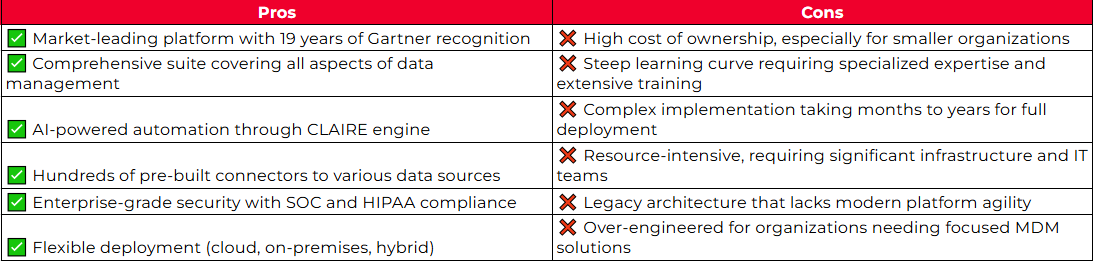
While Informatica provides powerful enterprise data management capabilities backed by decades of experience, organizations should carefully consider whether its complexity and cost align with their actual needs.
Complexity and lengthy deployment cycles: Informatica implementations typically span months to years, requiring specialized expertise and extensive planning. The platform’s comprehensive nature means organizations must configure multiple components, establish governance frameworks, and train technical teams before achieving value. User reviews frequently cite the need for dedicated Informatica specialists and ongoing training investments that significantly increase the total cost of ownership.
Resource-intensive requirements: Beyond licensing costs, Informatica requires substantial infrastructure and human resources. Organizations need dedicated data engineers, IT administrators, and often external consultants to manage the platform effectively. The IPU-based pricing model can lead to unexpected costs as data volumes grow, with some organizations reporting budget overruns of 40-60% compared to initial projections.
Limited business user accessibility: Despite claims of low-code capabilities, Informatica remains primarily an IT-driven platform. Business users struggle with the technical interface and typically require IT support for even minor workflow changes. This creates bottlenecks and delays in responding to changing business needs, with simple rule updates often taking weeks to implement through IT change request processes.
Over-engineering for focused needs: Organizations seeking MDM for specific domains or operational workflows may find Informatica’s comprehensive platform excessive. The requirement to implement the full IDMC framework means paying for and managing capabilities that may never be utilized. Mid-market companies and departments within larger enterprises often discover that 70-80% of Informatica’s features remain unused while still contributing to complexity and cost.
Vendor lock-in concerns: While Informatica offers flexible deployment options, the proprietary nature of its platform creates dependencies that are difficult to unwind. Organizations invest heavily in Informatica-specific skills, processes, and integrations that don’t transfer to other platforms. Migration away from Informatica typically requires complete re-implementation rather than simple data portability.
These considerations reflect the reality that while Informatica excels as a comprehensive enterprise platform, modern organizations increasingly seek more agile, cost-effective solutions that deliver faster time-to-value without the overhead of traditional enterprise software.
Intelligent Data Management Cloud (IDMC) Platform
At the heart of Informatica is the IDMC, a unified platform that brings together all data management capabilities. The platform operates on a consumption-based pricing model using Informatica Processing Units (IPUs), allowing organizations to access different services as needed. Users begin by setting up runtime environments through Secure Agents, lightweight programs that process data securely within the organization’s network.
The platform provides a centralized interface where different teams can access the tools they need. Data engineers might work in Cloud Data Integration to build pipelines, while data stewards use the Data Governance and Catalog to manage business terms and data quality rules. The platform includes services for Data Catalog, Data Integration, API & App Integration, Data Quality & Observability, MDM & 360 Applications, and Data Marketplace.
Each service within IDMC is designed to work together as part of an integrated ecosystem. Data quality rules defined in one service can be applied across data integration pipelines through rule specification transformations, while the metadata collected during integration feeds into the data catalog for discovery and governance.
Master Data Management Capabilities
Informatica’s MDM solution creates and maintains a “golden record” for critical business entities like customers, products, and suppliers. The process begins with data modeling, where organizations define their master data entities and relationships without writing code. The platform then ingests data from various sources, applying cleansing and standardization rules to ensure consistency.
The system employs sophisticated matching algorithms, including deterministic and fuzzy matching techniques, to identify duplicate records across systems. These duplicates are then merged according to survivorship rules that determine which data elements to retain. The platform supports complex hierarchy management, allowing organizations to model relationships like parent-subsidiary structures or product categories.
Informatica offers pre-built 360 solutions for common domains including Customer 360, Product 360, and Supplier 360. These come with pre-configured data models and workflows that can significantly accelerate implementation. The Supplier 360 solution, for example, includes self-service registration portals and onboarding workflows for external partners. The MDM solution also includes a dedicated stewardship interface where business users can review potential matches, resolve conflicts, and manage data governance tasks.
Data Integration and Quality
The Cloud Data Integration service provides a visual, low-code environment for building data pipelines. Users design mappings through a drag-and-drop interface, selecting from dozens of transformation types including aggregations, lookups, joiners, and routers. The platform supports both ETL and ELT patterns, with the ability to push down transformations to target databases for improved performance.
Data quality capabilities are embedded throughout the platform. The Data Quality service can profile data to understand its current state, identifying patterns, anomalies, and quality issues. It provides pre-built rules for common quality checks like address standardization and email validation, while also allowing custom rules to be defined. The platform can automatically cleanse data, removing duplicates, correcting misspellings, and standardizing formats.
The integration and quality services work in concert through the platform’s AI engine, CLAIRE. This engine provides intelligent recommendations for mappings, suggests data quality rules based on profiling results, and can even generate data pipelines using natural language through the CLAIRE Copilot feature.
Enterprise Focus and Scalability
Informatica is designed to support enterprise-scale operations. The platform supports both vertical scaling (adding resources to existing servers) and horizontal scaling (distributing workloads across multiple nodes). For cloud deployments, the Advanced Serverless option provides automatic scaling based on workload demands, with resources provisioned dynamically and released when not needed.
The platform offers multiple deployment options to match enterprise requirements. Organizations can deploy on-premises using PowerCenter for legacy systems, in the cloud through IDMC, or in hybrid configurations that span both environments. This flexibility allows enterprises to approach modernization while maintaining existing investments.
Security and governance are core priorities throughout the platform. Informatica maintains certifications including SOC 1, SOC 2, and HIPAA compliance. All data is encrypted in transit using TLS 1.2 or greater and at rest using AES-256. The platform provides detailed audit trails, role-based access controls, and integration with enterprise identity providers through SCIM 2.0.
Considerations for Specific Use Cases
While Informatica provides powerful enterprise data management capabilities backed by decades of experience, organizations should carefully consider whether its complexity and cost align with their actual needs.
Complexity and lengthy deployment cycles: Informatica implementations typically span months to years, requiring specialized expertise and extensive planning. The platform’s comprehensive nature means organizations must configure multiple components, establish governance frameworks, and train technical teams before achieving value. User reviews frequently cite the need for dedicated Informatica specialists and ongoing training investments that significantly increase the total cost of ownership.
Resource-intensive requirements: Beyond licensing costs, Informatica requires substantial infrastructure and human resources. Organizations need dedicated data engineers, IT administrators, and often external consultants to manage the platform effectively. The IPU-based pricing model can lead to unexpected costs as data volumes grow, with some organizations reporting budget overruns of 40-60% compared to initial projections.
Limited business user accessibility: Despite claims of low-code capabilities, Informatica remains primarily an IT-driven platform. Business users struggle with the technical interface and typically require IT support for even minor workflow changes. This creates bottlenecks and delays in responding to changing business needs, with simple rule updates often taking weeks to implement through IT change request processes.
Over-engineering for focused needs: Organizations seeking MDM for specific domains or operational workflows may find Informatica’s comprehensive platform excessive. The requirement to implement the full IDMC framework means paying for and managing capabilities that may never be utilized. Mid-market companies and departments within larger enterprises often discover that 70-80% of Informatica’s features remain unused while still contributing to complexity and cost.
Vendor lock-in concerns: While Informatica offers flexible deployment options, the proprietary nature of its platform creates dependencies that are difficult to unwind. Organizations invest heavily in Informatica-specific skills, processes, and integrations that don’t transfer to other platforms. Migration away from Informatica typically requires complete re-implementation rather than simple data portability.
These considerations reflect the reality that while Informatica excels as a comprehensive enterprise platform, modern organizations increasingly seek more agile, cost-effective solutions that deliver faster time-to-value without the overhead of traditional enterprise software.
Modern Alternative: Cloud-Native MDM with Manch
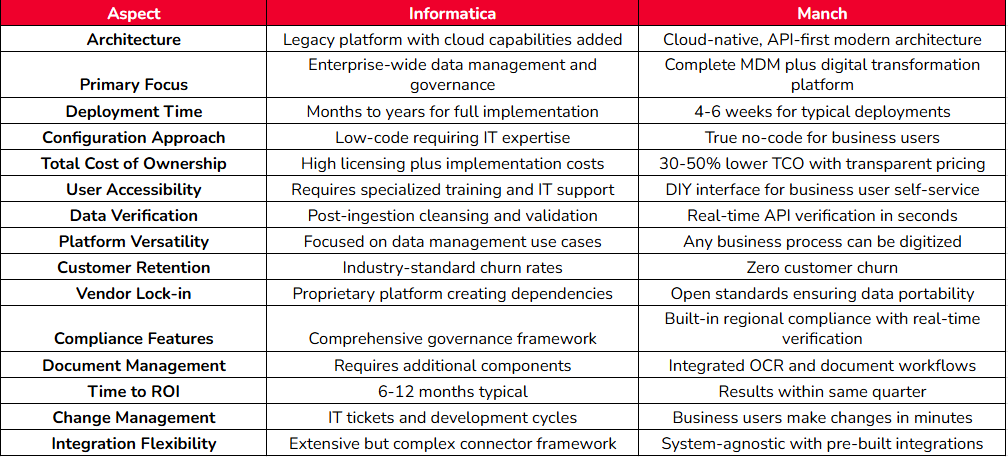
Manch represents a new generation of MDM platforms designed for the speed and agility modern businesses demand. Founded around 2016-2017 with a focus on eliminating the complexity of traditional data management, Manch has achieved zero customer churn while serving major enterprises including Coca-Cola, Compass Group, and United Breweries. The platform’s unique approach—API-first architecture with true no-code configuration—enables organizations to achieve in weeks what traditionally takes months or years.
API-First Architecture with Real-Time Verification
Manch’s primary differentiator is its pre-integrated API architecture that enables real-time data verification and validation within seconds. Unlike traditional platforms that require back-office teams for manual verification processes, Manch connects directly to public databases and verification services to validate data instantly. This eliminates the typical lag between data input and verification that plagues enterprise MDM systems.
The platform includes built-in integrations for PAN verification, GSTN validation, bank account verification, and comprehensive KYC capabilities. While initially designed for the Indian market, Manch’s modular architecture allows replication for any country in approximately two weeks where similar verification services are available. This API-first approach means organizations can reduce processes that traditionally take seven days down to just 30 minutes—delivering immediate ROI that appeals to CFOs and operations leaders.
The real-time verification capability extends beyond simple validation. Manch’s AI-powered fraud detection identifies suspicious patterns as data enters the system, preventing issues before they become embedded in master data. Organizations report verification accuracy rates exceeding 99% while eliminating the need for dedicated verification teams.
Complete MDM Plus Digital Transformation Platform
While Manch excels at master data management, positioning it solely as an MDM platform understates its capabilities. The platform is fundamentally a digital transformation solution that can digitize any business process—from asset tracking and contract management to vendor onboarding and employee workflows. This versatility explains the zero customer churn rate: organizations discover they can do far more on the platform than initially intended.
Manch handles comprehensive master data across six organizational pillars: products/services, customers (primary, secondary, tertiary), vendors/suppliers, assets, employees, and operational data. The platform includes sophisticated duplicate detection using AI with confidence scoring, multi-layered business rules for data quality, and merge and survivability rules to create single data masters from redundant entries. Unlike Informatica’s post-facto cleanup approach, Manch prevents duplicate creation at the source by applying validation rules at the time of data creation.
The platform includes complete workflow automation with dynamic, role-based processes featuring SLAs and escalations—all configurable without coding. Organizations use the same platform for contract management, asset tracking, retailer onboarding, vendor management, and numerous other workflows, maximizing their platform investment while avoiding the need for multiple specialized solutions.
True No-Code Configuration for Business Users
Manch’s drag-and-drop interface represents genuine no-code capability where business users can configure workflows, update business rules, and make changes in minutes rather than submitting IT tickets and waiting weeks. This isn’t the “low-code” approach that still requires developer involvement—it’s true citizen development that empowers operations, finance, and compliance teams to drive processes themselves.
The Process Configurator allows organizations to convert existing paper-based or manual workflows into automated digital processes using visual building blocks. These include components for information collection, document management with OCR capabilities, verification, multi-level approvals, and digital signatures. Business users can set up maker-checker workflows, configure layered approvals across departments, and modify routing rules based on business logic—all without writing a single line of code.
This accessibility delivers extraordinary deployment speed. While Informatica implementations span months to years, Manch deployments go live in 4-6 weeks for typical implementations, with some as fast as 4 weeks. One wellness brand (Himalaya Wellness) implemented a complete compliance solution in just three weeks. The platform’s pre-built frameworks and accelerators enable organizations to achieve measurable results within the same quarter rather than waiting 6-12 months for ROI.
Cost-Effective Enterprise-Grade Capabilities
Manch delivers enterprise-grade functionality at 30-50% lower total cost of ownership compared to traditional platforms like Informatica. The cost advantage comes from multiple factors: faster implementation reduces consulting fees, true no-code configuration eliminates ongoing development costs, and the ability for business users to make changes themselves avoids expensive change requests.
The platform operates on transparent, competitive pricing without the hidden costs that accumulate with other platforms through premium connectors, API usage fees, or partner-led implementations. Organizations find that Manch’s combined licensing and implementation costs are often less than just the license fees of premium alternatives. This cost-effectiveness doesn’t compromise on security—Manch holds ISO 27001 and SOC 2 Type 2 certifications, meeting the same compliance standards as enterprise platforms.
Importantly, Manch operates on open standards with no proprietary runtime environment, ensuring organizations avoid vendor lock-in. Data and processes remain portable, and the platform integrates equally well with SAP, Oracle, Microsoft, Salesforce, and legacy systems—making it ideal for organizations with heterogeneous IT landscapes that don’t want to be forced into specific vendor ecosystems.
Informatica vs Manch: Detailed Comparison