The fundamental divide: General app development vs specialized workflow automation
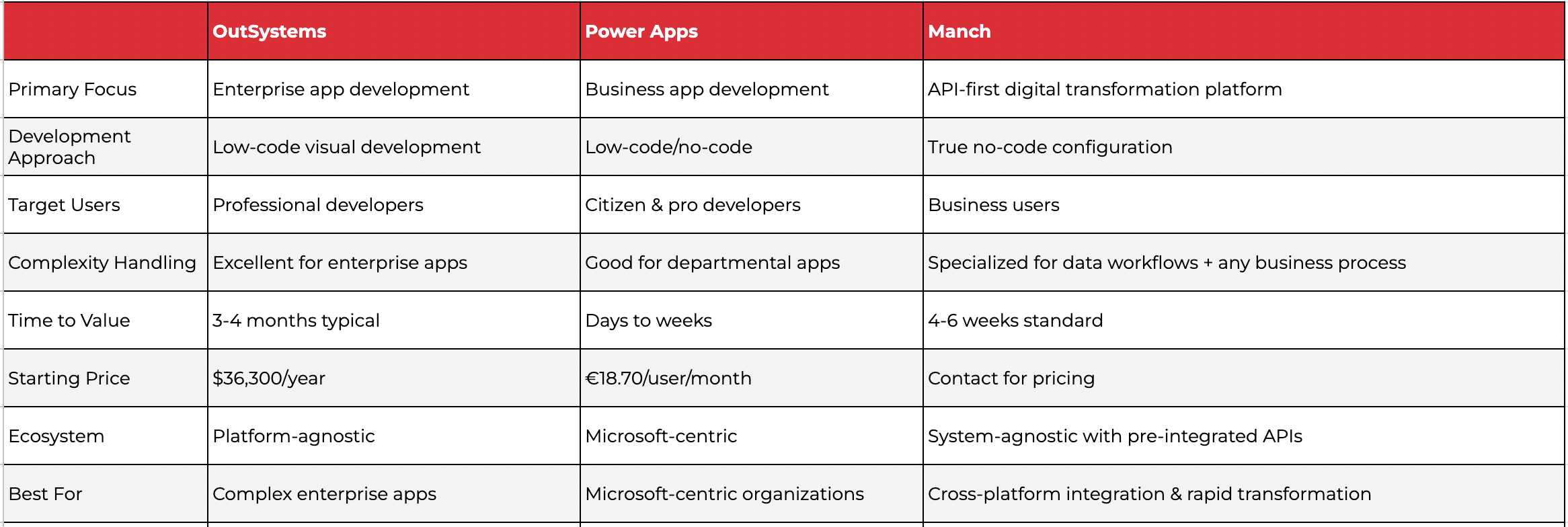
The comparison between these platforms reveals a fundamental split in the low-code market: general-purpose development platforms versus API-first, configuration-based solutions.
OutSystems and Power Apps operate in the broad application development space. They’re designed to build virtually any type of business application, from simple forms to complex enterprise systems. OutSystems emphasizes its unified architecture and single codebase approach, while Power Apps offers multiple development paradigms (Canvas and Model-driven) to cater to different needs.
Manch, however, has chosen a different path with its API-first architecture. The platform’s pre-integrated APIs enable real-time data verification and validation in seconds, eliminating the traditional need for back-office teams dedicated to manual verification processes. While Manch excels at managing external and master data, its true strength lies in platform versatility – customers consistently discover they can digitize any business process beyond their initial implementation, from contract management to asset tracking to vendor workflows. This versatility is a key reason for the platform’s zero customer churn rate.
The specialization extends to deployment methodology. Where OutSystems requires months of development even with low-code, and Power Apps varies from days to months depending on complexity, Manch delivers consistent 4-6 week deployments through pure configuration. This 3x faster deployment isn’t just about speed – it fundamentally changes the ROI equation for digital transformation initiatives.
OutSystems excels at enterprise-grade complexity
When it comes to building complex, mission-critical applications, OutSystems stands in a class of its own. The platform’s architecture is designed from the ground up to handle enterprise-scale challenges that would be difficult for simpler low-code tools.
The key differentiator is OutSystems’ approach to code generation. Unlike many low-code platforms that rely on interpreted code or runtime engines, OutSystems generates real, optimized C#, JavaScript, and SQL code. This means applications built on OutSystems can potentially achieve native performance levels, crucial for high-transaction systems or applications with thousands of concurrent users.
The platform’s Service Studio provides a comprehensive visual development environment where developers can model everything from data structures to complex business logic. The visual development doesn’t limit capability; developers can extend applications with custom C# code through Integration Studio when needed. This balance between visual productivity and code flexibility is what makes OutSystems particularly appealing to professional development teams.
However, this power comes with trade-offs. OutSystems still requires skilled developers despite being “low-code,” with deployment timelines typically running 3-4 months for complex applications. The platform creates dependencies through its proprietary runtime environment, and the total cost of ownership can be substantial – often 50-70% higher than more modern alternatives when factoring in licensing, implementation, and ongoing maintenance.
The AI Mentor System takes development further by continuously analyzing applications for performance, security, and architectural issues. It’s like having an expert architect reviewing your code 24/7, identifying potential problems before they impact production.
Power Apps dominates the Microsoft-centric organization
For organizations already invested in the Microsoft ecosystem, Power Apps offers compelling advantages that are hard to match. The platform’s deep integration with Microsoft 365, Dynamics 365, and Azure isn’t just a technical feature; it’s a strategic advantage that can accelerate development and reduce complexity – as long as you stay within Microsoft’s walls.
Consider data connectivity: Power Apps can seamlessly connect to SharePoint lists, Excel files in OneDrive, SQL Server databases, and Dynamics 365 data through Dataverse. For a typical enterprise already using these tools, this means instant access to existing data without complex integration projects. An employee can create an app that pulls data from a SharePoint list quickly, often in under an hour for simple scenarios.
The platform offers two distinct development approaches. Canvas apps provide fine-grained control over the user interface, allowing detailed designs that match corporate branding. Model-driven apps, built on top of Dataverse, automatically generate responsive interfaces based on your data model. This dual approach means both quick departmental solutions and sophisticated data-driven applications are possible within the same platform.
Yet Power Apps’ strength becomes its limitation the moment you step outside the Microsoft ecosystem. Integration with non-Microsoft systems like SAP, Oracle, or legacy applications becomes complex and expensive, often requiring premium connectors that can escalate costs significantly. Organizations with heterogeneous IT landscapes find that Power Apps works beautifully for Microsoft-centric workflows but struggles with true cross-platform scenarios.
Power Fx, the formula language used in Canvas apps, leverages Excel-like syntax that millions of business users already understand. This lowers the barrier to entry for citizen developers. A business analyst who’s comfortable with Excel formulas can start building functional applications with minimal training – though more complex, enterprise-grade workflows still require significant IT involvement.
Manch transforms with API-first architecture and true no-code
While OutSystems and Power Apps focus on code generation and visual development, Manch has built its entire platform around a fundamentally different principle: API-first architecture with true no-code configuration.
The platform’s most distinctive feature is its pre-integrated APIs that enable real-time data verification, validation, and authentication within seconds. This isn’t just about speed – it eliminates entire categories of work. Traditional platforms require organizations to set up back-office teams for manual verification processes. Manch removes this need entirely, with APIs that can verify data against public databases including PAN, GSTN, and bank accounts in real-time. Originally designed for the Indian market, the modular architecture allows deployment in any country in approximately two weeks if similar verification services are available.
What sets Manch apart is its versatility beyond initial expectations. While organizations typically adopt it for external data management or partner onboarding, they discover the platform can handle any business process – contract management, asset tracking, retailer onboarding, vendor management, and more. This versatility drives the platform’s zero customer churn rate; customers find so many additional applications that they have no reason to look elsewhere.
The true no-code approach means business users can configure complex workflows using Manch’s drag-and-drop Process Configurator without writing any code or formulas. Unlike platforms that claim “no-code” but still require IT for anything complex, Manch enables operations, finance, and compliance teams to make changes themselves in minutes. This DIY interface transforms how organizations approach digital transformation – from IT-led projects to business-driven continuous improvement.
Deployment speed is another game-changer. Where OutSystems typically requires 3-4 months and Power Apps varies widely based on complexity, Manch consistently delivers in 4-6 weeks through configuration rather than coding. This 3x faster deployment translates directly to ROI – organizations see results within the same quarter rather than waiting 6-12 months. Case studies report reducing partner onboarding from 7 days to just 30 minutes, with 80% optimization in back-office capacity.
The platform includes sophisticated capabilities that would require extensive custom development in general-purpose tools: Video KYC with ML-based speech-to-text, AI-powered face extraction and comparison, intelligent document processing with OCR, and multi-level authentication. These aren’t add-ons or future roadmap items – they’re built-in, enterprise-grade features available from day one.
Development approach reveals each platform’s DNA
The way each platform approaches development reveals fundamental differences in philosophy and target audience.
OutSystems employs a visual, model-driven approach through Service Studio that still fundamentally requires professional developers. While it’s “low-code,” developers need to understand software architecture, design patterns, and often write custom C# code for complex scenarios. The platform assumes technical knowledge and provides powerful capabilities for those who can leverage them. This approach works well for IT-led transformation but creates bottlenecks when business needs change rapidly.
Power Apps takes a more democratic approach, explicitly catering to both citizen developers and professionals. Canvas apps can be built by anyone comfortable with basic logic and Excel-like formulas, while Model-driven apps require more understanding of data structures. However, this dual nature creates governance challenges – simple apps are easy, but enterprise-grade workflows still require significant IT involvement. The promise of citizen development often meets reality when complex integration or advanced features require premium connectors and technical expertise.
Manch’s true no-code configuration represents a fundamentally different philosophy. Business users configure workflows using modular components without writing any code, formulas, or even understanding technical concepts. The Process Configurator allows teams to design complex workflows by combining pre-built functional blocks for information collection, data validation, approvals, and digital signatures. When changes are needed – which is inevitable in today’s dynamic business environment – users can adapt workflows themselves without raising IT tickets or paying for professional services.
This difference extends to customization philosophy. OutSystems provides extensive customization through custom code but requires developers to implement it. Power Apps offers customization through Power Fx formulas and some custom code capabilities, but again, complexity requires technical skills. Manch focuses on configuration over customization, providing extensive options within its domain that business users can actually leverage. The trade-off is clear: while you might not be able to customize every pixel, you can achieve business outcomes 3x faster with 50% lower total cost of ownership.
AI capabilities show different philosophies
All three platforms incorporate AI, but their approaches reveal different philosophies about how artificial intelligence should augment digital transformation.
OutSystems integrates AI throughout the development lifecycle with its AI Mentor System. This isn’t just about adding AI features to applications; it’s about using AI to make developers more productive and applications better. The system continuously analyzes code for performance, security, and architectural issues, providing actionable recommendations. The recently announced Project Morpheus takes this further with generative AI capabilities for instant app generation. However, these AI capabilities primarily benefit IT teams rather than business users.
Power Apps approaches AI through two angles. First, AI Builder allows developers to add AI capabilities to their applications, such as form processing, object detection, and prediction models. Second, Copilot integration brings generative AI to the development process itself. This dual approach makes AI accessible to citizen developers, though accessing advanced AI features often requires additional licensing and stays confined within Microsoft’s AI services.
Manch embeds AI directly into business processes rather than treating it as a separate capability or development tool. The platform includes AI/ML tools for fraud detection, face extraction and comparison, and intelligent document classification as standard features. During partner onboarding, AI automatically validates documents, detects potential fraud, and ensures compliance without users needing to configure or understand the AI components. This embedded approach means organizations get AI benefits immediately without additional setup or training.
The philosophical difference is striking: OutSystems uses AI to help developers build better, Power Apps democratizes AI for business users within Microsoft’s ecosystem, while Manch embeds AI invisibly into business processes to deliver immediate value without technical complexity.
Pricing models reflect target markets
The pricing structures of these platforms clearly indicate their target markets, value propositions, and hidden costs that can impact total cost of ownership.
OutSystems commands premium pricing, starting at $36,300 per year for a production application with 100 internal users. This pricing reflects its positioning as an enterprise-grade platform for mission-critical applications. While the investment is significant, hidden costs can escalate further – implementation typically requires specialized OutSystems developers, ongoing maintenance needs technical expertise, and the proprietary runtime environment creates long-term dependencies. Organizations often find their total cost over 3-5 years is 2-3x the initial licensing cost.
Power Apps takes a per-user approach, starting at €18.70 per user per month for the Premium tier. This model seems attractive for gradual expansion, but costs escalate quickly with hidden expenses. Premium connectors for non-Microsoft systems, API usage fees for high-volume operations, and additional Dataverse storage can double or triple the base cost. For organizations with 2,000 or more seats, the price drops to €11.20 per user per month, but even then, cross-platform integration costs can make Power Apps expensive for heterogeneous IT environments.
Manch uses a tiered pricing model with three levels: Starter, Premium, and Enterprise. While specific prices require consultation, the total cost of ownership is typically 30-50% lower than OutSystems or Power Apps when factoring in implementation, maintenance, and ongoing changes. The configuration-based approach eliminates expensive professional services for changes, the pre-integrated APIs remove the need for costly integration projects, and the DIY interface means business users can adapt workflows without IT costs. Organizations report that Manch’s combined license and implementation cost is often less than just the license fees of premium alternatives.
The ROI timeline differs dramatically. OutSystems implementations typically take 3-4 months before seeing results, meaning ROI might not materialize for 6-12 months. Power Apps varies widely – simple apps deliver value quickly, but enterprise deployments can take months. Manch’s 4-6 week deployment means organizations see measurable results within the same quarter. Case studies showing 7-day to 30-minute process improvements and 80% back-office optimization demonstrate ROI that justifies the investment within weeks, not months.
Integration strategies and ecosystem lock-in
Each platform’s approach to integration reveals strategic choices about openness, flexibility, and the real cost of connectivity.
Power Apps is deeply embedded in the Microsoft ecosystem. While it offers over 1,000 connectors, the reality is more complex. Native Microsoft integrations work beautifully – connecting to SharePoint, Dynamics 365, or Azure services is seamless. But the moment you need to integrate with SAP, Oracle, or legacy systems, you hit the premium connector paywall. These connectors not only cost extra but often have API call limitations that can make high-volume operations expensive. Organizations with heterogeneous IT landscapes find themselves either accepting Microsoft lock-in or paying significant premiums for cross-platform connectivity.
OutSystems takes a more platform-agnostic approach through its Integration Builder and extensive connector library. While it doesn’t assume any particular technology stack, integrations often require technical configuration and custom development. The platform’s proprietary runtime environment means that while you can integrate with anything, you’re still locked into OutSystems’ way of doing things. Migrating away from OutSystems later requires significant re-engineering since the generated code is optimized for their runtime.
Manch’s integration philosophy is fundamentally different – it’s designed to be system-agnostic from the ground up. As an SAP partner, the platform provides certified integration with SAP while maintaining equal capability with Oracle, Microsoft, Salesforce, and legacy systems. The pre-integrated APIs mean external data verification works immediately without integration projects. Rather than trying to integrate with everything, Manch focuses on the integrations needed for external data and partner management, providing deep, robust connections that work out-of-the-box.
The platform operates on open standards with no proprietary runtime environment, ensuring data and process portability. Organizations can integrate Manch with whatever systems they already use without being pushed toward specific vendor choices. This is particularly valuable for companies that use multiple ERPs, CRMs, or other enterprise systems – Manch serves as the unifying layer for data governance across all platforms without creating new dependencies.
For organizations concerned about vendor lock-in, the implications vary significantly. Power Apps creates strong ecosystem dependencies that become expensive to escape. OutSystems locks you into their runtime and development paradigm. Manch, designed to complement rather than replace existing systems, maintains independence through open standards and standard API protocols, making it easier to adapt as your technology landscape evolves.
OutSystems vs Power Apps vs Manch: Which should you choose?
The choice between these platforms depends on your organization’s specific needs, existing technology investments, and strategic priorities for digital transformation.
Choose OutSystems if:
- You need to build complex, mission-critical applications that require enterprise-grade performance
- Your applications need to scale to thousands of users with high transaction volumes
- You have professional developers who can leverage a sophisticated low-code platform
- You’re willing to invest 3-4 months and significant budget for comprehensive transformation
- You can accept vendor lock-in through proprietary runtime for the power it provides
Explore OutSystems’ capabilities for your enterprise transformation
Choose Power Apps if:
- You’re already fully invested in the Microsoft ecosystem with limited non-Microsoft systems
- You want to empower citizen developers for departmental solutions
- You need to quickly build applications that primarily integrate with Microsoft services
- You’re comfortable with escalating costs for premium connectors and API usage
- Your use cases are primarily internal applications within the Microsoft boundary
Start building with Power Apps and transform your Microsoft investment
Choose Manch if:
- You need real-time data verification and validation without manual back-office processes
- You want true no-code configuration that business users can manage independently
- You’re seeking 30-50% lower total cost of ownership with 4-6 week deployments
- You operate in a heterogeneous IT environment with SAP, Oracle, Microsoft, and legacy systems
- You need a platform that can start with one use case (like partner onboarding) and expand to any business process
- You want enterprise-grade capabilities (ISO 27001, SOC2 Type2 compliant) without enterprise-grade complexity
- You prioritize rapid ROI with measurable results in weeks, not months
See how Manch can transform your operations with API-first architecture and true no-code configuration
The key insight is that these platforms address different aspects of digital transformation. OutSystems and Power Apps compete for general application development with different strengths – OutSystems for complex, mission-critical systems and Power Apps for Microsoft-centric organizations. Manch offers a fundamentally different approach with its API-first architecture and true no-code configuration, delivering faster deployment, lower TCO, and business user empowerment.
Many organizations might benefit from using OutSystems or Power Apps for complex custom applications while leveraging Manch for rapid process digitization, external data management, and cross-platform workflows. The real winner is the organization that matches the right tool to the right problem – and in today’s fast-moving business environment, the ability to deploy in 4-6 weeks with 30-50% lower costs while maintaining enterprise-grade capabilities makes Manch the smarter choice for organizations prioritizing speed, flexibility, and ROI.