The fundamental philosophy divide
The philosophical differences between these platforms reveal why feature comparisons often miss the point entirely.
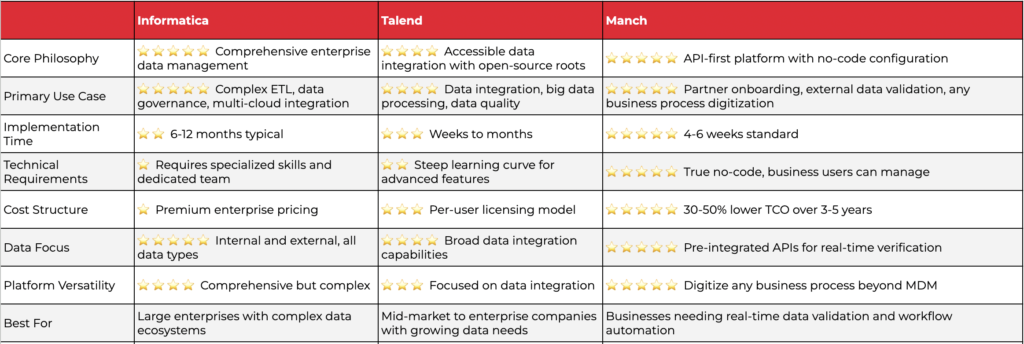
Informatica was built on the belief that enterprises need a single, comprehensive platform for all data management needs. Their “Intelligent Data Management Cloud“ represents decades of evolution from on-premises ETL tools to a cloud platform. However, this legacy architecture shows its age when compared to modern, cloud-native alternatives. It’s designed for organizations where data management is a strategic initiative requiring dedicated resources and significant investment—but often delivers complexity where simplicity would suffice.
Talend emerged from the open-source movement with a different vision: democratize data integration by making powerful tools accessible to more organizations. While they’ve moved upmarket with enterprise features, their DNA remains rooted in providing a more approachable alternative to expensive, proprietary solutions. Their visual, drag-and-drop interface and extensive connector library reflect this philosophy of making data integration accessible to developers without requiring deep specialization.
Manch represents a fundamentally different, modern paradigm. Built as an API-first platform from day one, Manch’s philosophy centers on eliminating the traditional back-office setup that requires time, money, resources, and creates lag between data input and verification. With pre-integrated APIs enabling real-time verification in seconds, the platform prevents data quality issues by validating data at the source. But more importantly, it’s not just an MDM platform—it’s a versatile digital transformation platform where organizations can configure any business process without coding, explaining why they maintain zero customer churn as clients discover new use cases beyond their initial implementation.
This philosophical divide becomes practical very quickly. When you need to onboard a new vendor, Informatica and Talend provide data integration capabilities that require IT teams to build workflows over weeks or months. Manch’s pre-integrated APIs instantly verify vendor data against government databases, validate documents using AI-powered OCR, and automate the entire workflow—all configured by business users in a DIY interface without writing code.
Informatica excels at enterprise complexity (but shows its age)
For organizations with genuinely complex data management needs, Informatica remains a recognized leader. The platform’s capabilities are comprehensive in their breadth and depth.
The Intelligent Data Management Cloud (IDMC) offers over 300 cloud connectors and can handle virtually any data integration scenario. Their CLAIRE AI engine provides intelligent recommendations for data quality rules, automatically discovers relationships between data elements, and helps identify data quality issues through machine learning.
Their Master Data Management solution creates golden records that serve as a single source of truth across the enterprise, managing multiple master data domains within a single solution.
But here’s what Informatica’s marketing won’t tell you: this is fundamentally a legacy platform trying to adapt to modern requirements. The architecture, built over decades, carries the weight of its on-premises heritage. While powerful, it represents the old way of thinking about data management—complex, IT-centric, and slow to deliver value.
The real costs of this legacy approach include:
For Fortune 500 companies with dedicated data teams and seven-figure budgets, these trade-offs might be acceptable. For organizations seeking quick wins and business agility, they represent significant barriers to actually solving business problems.
Talend balances power with accessibility
Talend strikes an impressive balance between enterprise capabilities and accessibility. Their visual development environment genuinely simplifies the process of building data pipelines, making it possible for developers without deep ETL expertise to be productive.
The platform shines in several areas. With over 1,000 pre-built connectors, Talend can connect to virtually any data source. Their native support for big data technologies like Hadoop and Spark is robust, generating optimized code that runs directly on these platforms. The recent acquisition by Qlik has strengthened their analytics capabilities, creating interesting synergies for organizations already in the Qlik ecosystem.
Talend’s pricing model, with per-user licensing that’s generally more cost-effective than Informatica’s enterprise pricing, makes it attractive for mid-market companies. The platform built a large community and knowledge base through its open-source heritage (though Talend Open Studio was discontinued in January 2024).
However, Talend still faces significant limitations:
- Performance issues with very large datasets remain a common complaint
- The platform requires significant technical expertise for advanced features
- The platform can be resource-intensive, requiring significant memory and processing power
- Real-time data integration capabilities exist but may face performance considerations with high volumes
- The complexity of the platform can be overwhelming for business users
Most critically, like Informatica, Talend is fundamentally an IT tool. Business users who need to onboard partners or validate vendor data still depend on technical teams to build and maintain the necessary workflows.
Manch revolutionizes with API-first architecture
This is where Manch fundamentally changes the conversation. Instead of asking “How do we move and transform data?”, Manch asks “How do we eliminate manual verification processes and automate business workflows?”
The platform’s core innovation starts with its pre-integrated APIs that enable real-time data verification and validation within seconds. Unlike traditional platforms where you need to set up back-office teams for manual verification—consuming time, money, and resources—Manch instantly verifies data against government databases, validates documents using AI-powered OCR, and ensures compliance with your business rules. This API-first architecture means bad data never enters your systems in the first place.
But Manch isn’t just about data validation—it’s a comprehensive digital transformation platform. The true no-code approach with its drag-and-drop interface lets business users configure complex workflows without IT involvement. A procurement manager can build a complete vendor onboarding workflow, including document collection, real-time verification through pre-integrated APIs, multi-party approvals, and digital signatures, in 4-6 weeks, not months.
The platform’s versatility explains its zero customer churn rate. Organizations initially implementing Manch for vendor onboarding discover they can also use it for:
- Contract management and agreement workflows
- Asset tracking and management
- Employee onboarding and HRMS integration
- Retailer and distributor management
- Material master and pricing master governance
- Any business process requiring workflow automation
According to vendor case studies, real-world implementations have shown significant results:
As an SAP partner with ISO 27001 and SOC2 Type2 compliance, Manch provides enterprise-grade security while maintaining the agility of a modern platform. The system integrates seamlessly with SAP, Microsoft 365/Dynamics, Salesforce, Oracle, and legacy systems—acting as a bridge between different platforms without vendor lock-in.
Implementation reality check
The implementation experience reveals the true nature of each platform.
Informatica implementations are major undertakings. Organizations typically need to:
- Engage certified Informatica consultants (adding 50-100% to software costs)
- Dedicate internal IT resources for 6-12 months typically
- Train administrators and developers on the platform
- Configure and test extensive mappings and workflows
- Navigate complex licensing and infrastructure requirements
Talend implementations are somewhat more manageable but still significant:
- Developers need weeks to become productive with the platform
- Setting up the infrastructure (on-premise or cloud) requires technical expertise
- Building production-ready data pipelines takes considerable time
- Performance optimization can be an iterative process
- Integration with existing systems can be complex
Manch takes a completely different approach with configuration instead of coding:
- Implementation completed in 4-8 weeks for typical deployments
- No coding required; business users configure workflows using the DIY interface
- Pre-built templates for common processes like vendor onboarding
- Cloud-native architecture requires no infrastructure setup
- 30-50% reduction in delivery time compared to traditional platforms
According to vendor case studies, a health and wellness company implemented Manch’s solution for tax compliance in just three weeks. Try achieving that with Informatica or Talend.
The AI and automation capabilities
All three platforms leverage AI, but the distinction between old and new approaches is stark.
Informatica’s CLAIRE engine represents AI retrofitted onto a legacy platform. While it provides AI-powered recommendations across the platform—suggesting data quality rules, automating metadata discovery, and providing intelligent mappings—it’s still fundamentally about helping IT teams work within a complex system. The AI doesn’t eliminate complexity; it just helps navigate it.
Talend incorporates AI primarily through machine learning models for data quality and smart suggestions in their data preparation tools. The Qlik acquisition promises to bring more AI capabilities, but these remain focused on technical data management tasks that require IT expertise to implement.
Manch’s AI represents modern, embedded intelligence that automates actual business work:
- Face extraction and comparison for identity verification
- Real-time document classification and validation through OCR (not available in standard ERP systems)
- Fraud detection that operates automatically during onboarding
- Intelligent routing of approvals based on configurable business rules
- AI that works through the pre-integrated APIs to validate data instantly
The difference is fundamental: While Informatica and Talend use AI to help technical users work more efficiently within complex systems, Manch uses AI to eliminate manual work entirely, allowing business users to achieve results without IT involvement.
Cost comparison reveals different target markets
The pricing models tell you everything about who these platforms are really for.
Informatica’s pricing reflects its enterprise, legacy platform status. While specific pricing varies by deployment and consumption, it’s positioned as premium enterprise software with costs that reflect its comprehensive but complex capabilities. Implementation costs, consulting fees, training, and ongoing administration add substantially to the total cost of ownership. This is enterprise software with enterprise pricing for enterprises willing to pay for complexity.
Talend’s pricing model, primarily based on per-user licensing, is generally more accessible than Informatica. Annual licenses typically run in the thousands per user, making it attractive for mid-market companies. However, costs still add up quickly for organizations with many users or significant data volumes. The need for technical resources to build and maintain pipelines adds to the ongoing operational cost.
Manch delivers a fundamentally different value proposition with 30-50% lower total cost of ownership over 3-5 years. The cost-effective pricing model focuses on ROI and business outcomes. When you can reduce onboarding time by 80% and cut back-office resources by 60% while implementing in 4-6 weeks instead of months, the cost conversation shifts from “How much does it cost?” to “How quickly will it pay for itself?”
Consider the total cost of ownership:
- Informatica: High software costs + substantial implementation costs + ongoing technical resources
- Talend: Moderate software costs + moderate implementation costs + ongoing technical resources
- Manch: Cost-effective software + minimal implementation (4-6 weeks) + business users can manage with DIY interface
Which platform actually solves your business problem?
The choice between these platforms isn’t really about features or capabilities. It’s about matching the solution to your actual business needs.
Choose Informatica if:
- You’re a large enterprise with complex, multi-cloud data architecture
- You have dedicated data management teams and significant budgets
- You need comprehensive data governance across all data types
- You can justify 6-12 month implementations for long-term value
- You prefer working with legacy platforms despite their limitations
Choose Talend if:
- You need powerful data integration at a more accessible price point
- You have technical resources but not enterprise budgets
- Big data processing is a key requirement
- You value the flexibility and community from open-source roots
- You’re already in the Qlik ecosystem
Choose Manch if:
- You need pre-integrated APIs for real-time data verification
- You want to digitize any business process, not just manage data
- Your biggest challenge is managing external stakeholder data
- You need business users to own and manage processes without IT
- You want implementation in 4-6 weeks, not months
- You value modern, cloud-native architecture over legacy platforms
- You need versatility to expand beyond initial use cases (zero churn rate proves this)
- You prioritize solving business problems over technical capabilities
Ready to see how Manch can transform your external data management and business processes with pre-integrated APIs and true no-code configuration? Request a demo and discover why leading enterprises are choosing modern, API-first platforms over legacy ETL tools.
The real insight? In 2025, the question isn’t whether you need data management, it’s whether you need yesterday’s complex ETL tools or today’s API-first platforms that actually automate business workflows. For organizations drowning in partner onboarding delays, vendor compliance issues, and external data chaos, the answer isn’t another legacy data integration tool. It’s a versatile platform that validates data in real-time through pre-integrated APIs and lets business users configure any process they need.
That’s not just a different approach. It’s the difference between having powerful tools and actually solving problems in weeks, not months.