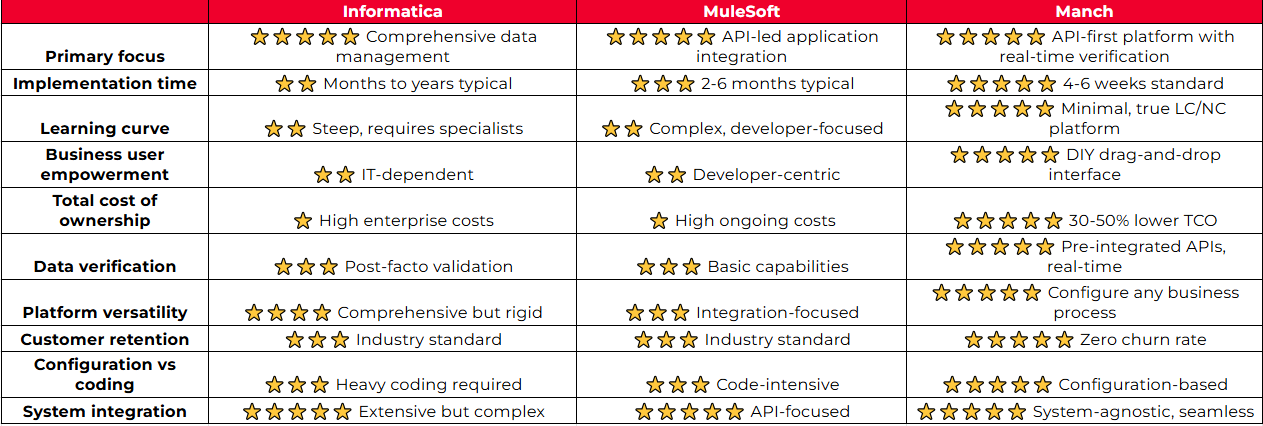
Understanding the fundamental differences in approach
The philosophical divide between these platforms explains why feature-for-feature comparisons often miss the point.
Informatica takes the traditional enterprise approach: build a comprehensive platform that can handle any data management scenario. Their Intelligent Data Management Cloud (IDMC) offers everything from ETL/ELT to data quality, governance, and master data management. While powerful, it’s designed for organizations with dedicated data teams who can invest months to years in implementation and handle the complexity.
MuleSoft champions API-led connectivity, viewing integration through the lens of creating reusable APIs that form an application network. The Anypoint Platform excels at connecting disparate systems. Following its $6.5 billion acquisition by Salesforce, it’s become increasingly integrated with the Salesforce ecosystem while maintaining broad capabilities.
Manch represents a fundamentally different philosophy: an API-first, low-code/no-code platform that prioritizes real-time data verification and business user empowerment. With pre-integrated APIs that validate data in seconds—eliminating the need for back-office verification teams—the platform enables deployment in 4-6 weeks through configuration rather than coding. Most importantly, its versatility means organizations discover they can digitize any business process on the same platform, driving the company’s zero customer churn rate.
This isn’t just about technical architecture; it’s about organizational impact. While Informatica and MuleSoft require significant IT resources and specialized skills, Manch’s drag-and-drop interface enables business teams to make changes themselves without raising costly change requests. Organizations save not just on implementation but on ongoing maintenance—achieving 30-50% lower total cost of ownership.
Implementation reality: Months vs 4-6 weeks
The gap between these platforms becomes most apparent during implementation.
Informatica implementations typically run months to years depending on complexity. Cloud deployments might complete in under 3 months while complex enterprise projects often extend well beyond 6 months. Implementation costs often run 50-100% of annual license costs. Organizations need specialized Informatica developers, and the learning curve means productivity ramps up slowly even after go-live.
MuleSoft implementations typically take 2-6 months, with simpler projects completing in 2 weeks to 4 months according to implementation partners. The modular nature requires different teams handling different components, demanding strong project coordination. Implementation costs can be substantial, sometimes approaching licensing costs, especially when integrating multiple modules.
Manch disrupts this timeline entirely with its configuration-based approach. The platform’s low-code/no-code nature and pre-built templates enable implementations in 4-6 weeks standard, with some achieving 4-8 weeks for complex scenarios. This 3x faster deployment comes from true configuration rather than coding, with “lego-like building blocks” that business users can arrange themselves. Pre-built frameworks for common use cases like asset tracking, agreements, and onboarding workflows accelerate deployment further.
This speed difference delivers measurable ROI within the same quarter rather than waiting 6-12 months. Organizations using Manch can process transactions and see results while competitors are still in implementation phases—a critical advantage in dynamic business environments.
Informatica dominates traditional data management
While Informatica is powerful and has been consistently recognized as a Leader in Gartner’s Magic Quadrant for Data Integration Tools for 19 consecutive years, Manch delivers comparable capabilities faster and more cost-effectively.
Key strengths of Informatica include:
However, this power comes with significant trade-offs. The IPU consumption-based pricing model becomes complex and costly for large deployments. The platform’s complexity requires specialized skills, with many organizations using only a fraction of available features. Performance can be slow with large, complex mappings, and the user interface feels dated according to reviews.
For organizations with massive data landscapes and resources to fully leverage its capabilities, Informatica provides depth. But as a cloud-native, new-age platform with integrated AI, Manch can do everything Informatica can do, but faster and more cost-effectively—with customer testimonials to prove it.
MuleSoft owns the API integration space
MuleSoft has established itself as the leader in API-led connectivity, with strong capabilities following its $6.5 billion Salesforce acquisition.
MuleSoft’s key advantages include:
Yet MuleSoft faces challenges. Enterprise pricing starts in tens of thousands annually, ranging from $27,000 for basic capabilities to much higher for advanced features. Users report the platform is overly complex for straightforward integrations. The learning curve is steep, especially for new developers. Since the acquisition, some report innovation focusing more on Salesforce-specific features.
MuleSoft excels for comprehensive API management and complex application integration. For organizations primarily dealing with data management and partner workflows requiring real-time verification, evaluating more specialized, cost-effective solutions becomes important.
Manch revolutionizes with API-first architecture and real-time verification
While Informatica and MuleSoft compete in traditional integration, Manch has built an API-first platform specifically designed for modern data management challenges.
Manch’s game-changing approach includes:
- Pre-integrated APIs for real-time verification: The platform’s defining feature—pre-integrated APIs that verify data against public databases in seconds, eliminating the need for back-office verification teams. This API-first architecture enables immediate validation that traditional systems cannot match.
- Platform versatility driving zero churn: While excelling at MDM, customers discover they can configure any business process on the same platform. This versatility beyond the initial implementation scope drives Manch’s zero customer churn rate—customers have no reason to leave when they can expand usage infinitely.
- True business user empowerment: The drag-and-drop interface and “lego-like building blocks” enable business users to make changes themselves without IT involvement or change requests. This DIY capability eliminates the cost escalation typically associated with software modifications.
- System-agnostic integration: Works equally well across SAP, Oracle, Microsoft, Salesforce, and legacy systems—designed from the ground up to be system-agnostic, making it ideal for heterogeneous IT landscapes.
According to Manch’s documented results:
- A global beverages company reduced partner onboarding from 7 days to 30 minutes
- An e-commerce company achieved 60% reduction in back-office resources
- A pharmaceutical company achieved 100% verified KYC with zero errors
- Fortune 500 and leading enterprises report 30-50% lower TCO compared to traditional platforms
The platform’s enterprise-grade security includes ISO 27001 and SOC2 Type2 compliance, meeting rigorous requirements of regulated industries while delivering localized compliance adaptability often faster than global platforms.
The true cost comparison: 30-50% TCO reduction is possible
The pricing models reveal each platform’s philosophy and target market realities.
Informatica’s IPU consumption model sounds flexible but quickly becomes complex and expensive. With implementation costs running 50-100% of annual license fees plus specialized resources, total costs escalate rapidly. Organizations often find themselves locked into escalating costs as data volumes grow.
MuleSoft’s subscription model involves enterprise-level pricing across multiple packages. The Integration Starter provides core features while Integration Advanced adds critical capabilities like clustering. API Management is priced separately. Most enterprises need multiple packages, with costs reaching six figures annually according to reports.
Manch delivers enterprise-grade capabilities at 30-50% lower total cost of ownership through flexible, transparent pricing from Starter to Enterprise tiers. The cost-effectiveness comes from multiple factors:
- Faster implementation: 4-6 weeks vs months reduces upfront costs
- No specialized resources: Business users manage the platform themselves
- Self-service changes: DIY interface eliminates change request costs
- Platform consolidation: One platform for MDM, workflows, documents, and more
- Configuration vs coding: 3x faster deployment and maintenance
The Starter tier includes basic platform access. Premium adds MDM and digital signing. Enterprise includes everything plus eKYC, video KYC, APIs, and advanced AI/ML tools—all at a fraction of competitor costs.
Consider hidden costs too. Informatica and MuleSoft require ongoing investment in specialized skills and training. Manch’s low-code/no-code approach allows existing teams to manage the platform, delivering ongoing savings that compound over time.
AI capabilities reveal each platform’s future
The three platforms’ AI approaches reveal strategic directions and competitive positioning.
Informatica’s CLAIRE engine represents deep AI integration throughout the platform. It provides intelligent recommendations, automates discovery and classification, and offers self-tuning capabilities. CLAIRE GPT and CLAIRE Copilot bring generative AI to data management.
MuleSoft incorporates AI through Einstein for Anypoint Code Builder, using natural language for code generation. The focus is on “agentic enterprises” where AI automates complex workflows, continuing to evolve capabilities for developer productivity.
Manch’s AI/ML focuses on solving real-world external data challenges with purpose-built AI tools. Face extraction and comparison, document detection, and fraud prevention are integrated natively—not add-ons. The AI continuously learns to enhance user experience, specifically optimized for partner onboarding and verification workflows that are critical for modern businesses.
Each platform leverages AI for its strengths: Informatica for data intelligence, MuleSoft for API automation, and Manch for streamlining external data workflows with real-time verification.
Informatica vs MuleSoft vs Manch: Which should you choose?
The best platform depends on your specific needs, resources, and timeline.
Choose Informatica if:
- You need comprehensive data management across complex, heterogeneous environments
- You have dedicated data teams with specialized skills
- Your focus is purely on internal data quality and traditional MDM
- You can invest months to years in implementation
- Budget allows for high enterprise-level investment
- You need to handle massive data volumes with complex transformations
Choose MuleSoft if:
- API-led connectivity is central to your integration strategy
- You need to connect multiple applications across hybrid environments
- You’re heavily invested in the Salesforce ecosystem
- You have dedicated integration developers
- You need comprehensive API lifecycle management
- You can afford premium pricing for enterprise features
Choose Manch if:
- You’re a mid to large organization (500+ employees, $10M+ revenue)
- You need real-time data verification through pre-integrated APIs
- Fast implementation is critical (4-6 weeks, not months)
- You want business users to manage the platform with a drag-and-drop interface
- You need to reduce total cost of ownership by 30-50%
- Platform versatility matters—you want to digitize multiple business processes
- You’re dealing with external stakeholder data (partners, suppliers, customers)
- You need integrated capabilities like eKYC, OCR, digital signatures, and document management
- You want to avoid vendor lock-in with system-agnostic integration
- Zero customer churn and proven ROI matter (like reducing 7-day processes to 30 minutes)
Ready to see how modern data management can transform your business? Discover how Manch’s API-first, low-code/no-code platform can deliver enterprise-grade capabilities in 4-6 weeks at 30-50% lower total cost of ownership.
The enterprise data management landscape is evolving rapidly. While Informatica and MuleSoft continue serving organizations needing traditional comprehensive platforms, Manch represents the future—an API-first approach that prioritizes real-time verification, business user empowerment, and platform versatility.
For organizations seeking faster deployment, lower TCO, and the ability to expand beyond initial use cases without switching platforms, the choice becomes clear. In today’s fast-moving business environment, the ability to implement in weeks and adapt rapidly with business users making their own changes matters more than having every possible feature. Sometimes the best solution isn’t the most comprehensive one, but the one that solves your specific problems cost-effectively, quickly, and grows with your needs—explaining why Manch maintains a zero customer churn rate.