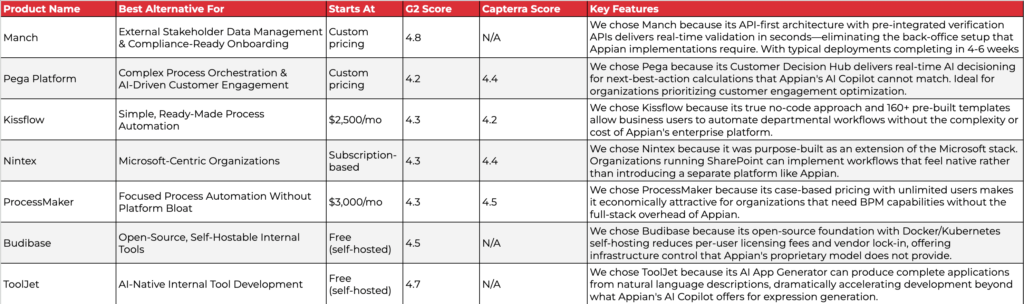
1. Manch: Best Alternative for External Stakeholder Data Management & Compliance-Ready Onboarding
Manch is an API-first, cloud-native, no-code platform specializing in External and Master Data Management (MDM) for enterprises. While Appian requires custom development to build partner onboarding and verification workflows, Manch delivers these capabilities out of the box through pre-integrated APIs that enable real-time data verification, validation, and authentication within seconds.
Its key features include:
- API-first architecture with pre-integrated verification APIs for PAN, GSTN, Aadhaar, and bank account validation—eliminating the need for back-office verification teams
- Master Data Management with a centralized repository creating a single source of truth for partner, vendor, and customer data
- Digital Onboarding (Onboard) providing 100% paperless workflows with configurable approval chains and bulk processing
- eKYC and Video KYC for real-time identity verification designed to meet RBI and SEBI regulatory requirements
- Process Configurator using “lego-like building blocks” to design workflows through configuration rather than coding
- AI/ML capabilities for fraud detection, face comparison, document auto-detection, and OCR
- mSign for digital signatures with OTP verification and multi-party signing support
- ISO 27001 and SOC 2 Type 2 certifications for enterprise-grade security and compliance
- System-agnostic integration with SAP, Microsoft 365/Dynamics 365, Salesforce, and legacy ERP/CRM systems
For enterprises whose primary automation need is managing external relationships (partner onboarding, vendor lifecycle management, distributor verification, gig workforce compliance), Manch provides a specialized solution that would require months of custom development to replicate on a general-purpose platform like Appian—with Manch typically going live in 4-6 weeks.
Why Choose Manch Over Appian for External Stakeholder Data Management
Appian offers a powerful general-purpose platform for building enterprise applications with strong data virtualization and process mining capabilities. However, for organizations specifically focused on external stakeholder management and compliance-ready onboarding, Manch excels as a purpose-built solution that handles the complete lifecycle of external data with built-in verification and validation.
Pre-Integrated APIs: Real-Time Verification Without Back-Office Setup
The fundamental difference between Appian and Manch lies in their architectural approach to data verification. Appian’s Data Fabric virtualizes data from external sources and enables applications to read and write across systems—but implementing real-time identity and document verification requires configuring Connected Systems, building custom integrations with third-party verification providers, and developing the validation logic within your applications.
Manch’s API-first architecture comes with pre-integrated verification APIs that validate data against public databases in real-time:
- Instant PAN, GSTN, and bank account verification against government databases
- Real-time validation at the point of entry through the “First Time Right” approach
- Elimination of back-office teams traditionally required for manual verification
- Automated data cleansing and enrichment capabilities
- Built-in GRC (Governance, Risk, and Compliance) engine for periodic data checks
This architectural difference translates to significant time and cost savings. Where Appian requires development resources to build verification workflows, Manch delivers them through configuration—reducing deployment time by 30-50% compared to building equivalent functionality on a general-purpose platform.
⚡ Manch in Action: When a new retail partner submits their details through Manch’s self-service portal, the platform immediately validates their GSTN, PAN, and bank account details against external databases. If the partner misspells their company name or enters an invalid tax ID, Manch catches it in real-time and prompts for correction. The validated data then flows to your ERP as a verified, golden record—no back-office team required.
Digital Onboarding: Go-Live in Weeks, Not Months
Appian’s Process Modeler allows you to design sophisticated onboarding workflows using BPMN notation. But creating a comprehensive partner onboarding process requires building the form interfaces in the Interface Designer, understanding SAIL expressions for logic and validation, configuring Smart Services for document handling, implementing approval logic, and integrating external verification APIs. This is precisely what Appian is designed for, but it requires development resources and typically takes months to implement.
Manch’s configuration-based approach delivers pre-built, customizable onboarding capabilities that business users can adapt without IT dependency:
- Configurable digital workflows using the Process Configurator’s drag-and-drop blocks
- Real-time verification of critical documents (PAN, Aadhaar, GSTN, bank accounts) through integrated APIs
- Multi-level authentication with mobile OTP, email OTP, and external ID verification
- Bulk processing for high-volume partner onboarding scenarios
- Pre-set templates for multi-party agreements, corporate account opening, and NDAs
- Dynamic, role-based workflows with SLAs and escalations—configured, not coded
Manch customers report significant reductions in partner onboarding time. One case study showed onboarding time reduced from hours to 30 minutes. A top global beverages company achieved an 80% reduction in manual tasks, while an e-commerce platform reduced back-office resources by 60%. Typical implementations go live in 4-6 weeks, with some completing in as few as three weeks.
⚡ Manch in Action: A food delivery platform needs to onboard thousands of restaurant partners. With Manch, the restaurant owner receives a link, uploads their FSSAI certificate and GST documents, completes video KYC verification, and digitally signs the partnership agreement. Manch’s OCR extracts the document data, validates it against government databases in real-time, and routes for approval. The entire process completes in one session—and the workflow was configured by the operations team in weeks, not built by developers over months.
eKYC and Video KYC: Built-In Compliance Without Third-Party Integration
Appian offers Connected KYC as a pre-built application, but it relies on third-party data provider integrations for actual identity verification. Implementing comprehensive identity verification still requires configuring these external services through Connected Systems and building the verification logic.
Manch provides comprehensive KYC capabilities natively through its API-first architecture:
- eKYC with real-time validation of PAN, Aadhaar, bank accounts, and other identity documents
- Video KYC with two-way video communication and AI-powered fraud detection
- Face extraction and comparison across multiple documents to detect identity fraud
- ID detection that automatically classifies uploaded documents and validates their type
- Designed to comply with RBI and SEBI regulatory requirements for financial services
According to Manch, the entire KYC process can complete in as little as 60 seconds, with ML-based fraud prevention running continuously throughout.
⚡ Manch in Action: A fintech company needs to verify customers before issuing credit. The customer initiates video KYC through Manch, presents their PAN card to the camera, and Manch’s AI extracts the face from the document and compares it with the live video feed. The platform simultaneously validates the PAN details against government databases, performs triangulation across multiple data sources, and generates a complete audit trail. The entire verification completes while the customer is still on the video call.
NOTE: Manch’s compliance capabilities are particularly valuable for organizations in regulated industries like fintech, FMCG, and talent staffing. The platform’s ISO 27001 and SOC 2 Type 2 certifications, combined with built-in audit trails and role-based access controls, provide enterprise-grade security as standard—not a premium add-on.
Manch Pricing
Manch utilizes a quote-based, flexible pricing model with three tiers designed for different organizational needs:
- Starter: Basic platform access with self-service mode
- Premium: Adds additional capabilities to the Starter features
- Enterprise: Full platform access including advanced verification and AI/ML tools
Manch offers a free trial with no credit card required. Specific pricing is provided through their sales team based on your business requirements and expected transaction volumes.
The platform positions itself as delivering 30-40% lower total cost of ownership compared to enterprise alternatives, with customers reporting faster ROI due to the rapid deployment timeline and elimination of back-office verification teams. The configuration-based approach also means organizations can make minor workflow changes themselves without raising change requests or paying for modifications—avoiding the cost escalation typically associated with enterprise platform customizations.
Who Should Use Manch?
Choose Manch if:
- Your primary automation need is external stakeholder management. If most of your process automation requirements involve partners, vendors, distributors, customers, or contractors rather than internal operations, Manch’s specialized MDM and onboarding capabilities can deliver faster time-to-value than building custom solutions on Appian.
- You need to go live in weeks, not months. If your timeline demands rapid deployment (4-6 weeks typical), Manch’s configuration-based approach and pre-built frameworks dramatically accelerate implementation compared to custom development on general-purpose platforms.
- You operate in regulated industries requiring KYC compliance. If your business requires identity verification, document validation, or regulatory compliance for onboarding (fintech, BFSI, staffing, healthcare), Manch’s built-in eKYC and video KYC capabilities eliminate the need for third-party integrations and custom development.
- You want to eliminate back-office verification overhead. If you currently have teams dedicated to manually verifying partner documents and data, Manch’s pre-integrated APIs can automate this entirely—enabling your teams to focus on data governance rather than data collection.
- Data quality is paramount for your external relationships. If bad partner data (incorrect bank details, invalid tax IDs, fraudulent documents) is costing you money through compliance penalties, payment failures, or operational rework, Manch’s “First Time Right” validation ensures data accuracy from the point of entry.
- You want to avoid vendor lock-in. Unlike Appian’s proprietary SAIL expressions, Manch operates on open standards with system-agnostic integration across SAP, Microsoft, Salesforce, and legacy systems—ensuring data and process portability without being locked into a single vendor ecosystem.
- You anticipate expanding beyond MDM. While Manch excels at external stakeholder management, its versatile platform supports additional business processes—contract management, asset tracking, agreements—on the same infrastructure, providing headroom for future digital transformation initiatives.
Ready to streamline your external stakeholder management? Discover how Manch can reduce partner onboarding from days to minutes with API-first verification and configuration-based deployment. Contact Manch to see the platform in action.
2. Pega Platform: Best Alternative for Complex Process Orchestration & AI-Driven Customer Engagement
Pega Platform (specifically Pega Infinity) is a unified enterprise low-code platform that combines Business Process Management, CRM, AI-powered decisioning, and case management into a single architectural stack. Unlike Appian’s workflow-centric approach, Pega is built on a “Center-out” philosophy where business logic is defined centrally and deployed across all channels simultaneously.
Its key capabilities include:
- Enterprise-grade case management for long-running processes spanning days or months across departments
- Customer Decision Hub (CDH) delivering real-time next-best-action calculations in under 200 milliseconds
- Unified platform architecture consolidating workflow, customer service, sales, and document processing
- AI-assisted development including GenAI Blueprint for generating applications from natural language
- Process Mining embedded directly for discovering bottlenecks and simulating improvements
Why Choose Pega Platform Over Appian for Complex Process Orchestration
Pega distinguishes itself through maturity in three dimensions critical for sophisticated enterprise operations:
Real-Time AI Decisioning for Customer Engagement
While Appian’s AI Copilot assists developers with tasks like PDF-to-interface conversion and test case generation, Pega’s Customer Decision Hub functions as an “always-on” centralized brain analyzing customer context in real-time. CDH calculates and delivers the most relevant action across any touchpoint in under 200 milliseconds, with Adaptive Models that learn automatically from every interaction. For organizations processing millions of customer interactions daily (banks, insurers, telecoms), this transforms customer engagement from reactive campaigns to proactive orchestration.
Unified Front-Office and Back-Office Transformation
Pega delivers a unified environment spanning customer-facing engagement and internal operations on a single platform with shared data models. When a customer calls about a service issue, the agent sees complete context (marketing interactions, service cases, purchase history, risk scores) in one interface. While Appian also offers customer service capabilities, Pega’s strength lies in its deep integration of real-time decisioning with case management.
Center-Out Architecture for Enterprise Reusability
Pega’s patented “Center-out” architecture defines business logic once centrally and renders it across all channels automatically. A change to fraud detection rules propagates instantly to web, mobile, chat, and contact center without maintaining separate codebases. The “Situational Layer Cake” enables regional variations while sharing core logic. For global enterprises, independent studies suggest this approach can reduce total cost of ownership by up to 40% compared to maintaining region-specific applications.
🏅 NOTE: We also evaluated OutSystems and Mendix. While OutSystems excels at high-productivity development with strong design tools, and Mendix offers robust multi-cloud deployment, Pega Platform provides particularly strong real-time AI decisioning and next-best-action capabilities for enterprises prioritizing intelligent customer engagement at scale.
Pega Platform Pricing
Pega uses tiered subscription pricing:
- Low-Code Factory Edition: Starting around $35/user/month for departmental apps with basic case management
- Standard Edition: Around $90/user/month for fuller platform capabilities
- Premium Edition: Custom pricing for enterprise-scale deployments
- Customer Decision Hub: Separate licensing
Deployment options include Pega Cloud (fully managed SaaS), client-managed Kubernetes, or hybrid architectures.
Who Should Use Pega Platform?
Choose Pega Platform if:
- Your organization operates complex, long-running case management processes spanning multiple departments that may take months to resolve (loan origination, claims adjudication, clinical trials)
- You need enterprise-scale AI decisioning for 1:1 customer engagement optimization where lifetime value depends on personalized interactions
- Your enterprise requires a unified platform strategy to eliminate tool sprawl across CRM, BPM, marketing automation, and customer service
- You operate in highly regulated industries where every process step must be auditable and compliant
3. Kissflow: Best Alternative for Simple, Ready-Made Process Automation
Kissflow is a cloud-based unified work platform combining process automation, project management, and case management into a single no-code interface designed specifically for business users. Unlike Appian’s enterprise positioning, Kissflow targets mid-market organizations (500+ employees) who have outgrown spreadsheets but cannot justify enterprise platform complexity.
Its key capabilities include:
- Visual Process Builder with drag-and-drop workflow design for multi-step approvals without coding
- 160+ pre-built workflow templates covering HR, Finance, and Operations processes
- Unified App Builder consolidating process automation, Boards, and Data Forms
- Native Google Workspace integration for seamless connectivity with Gmail, Drive, and Calendar
- Multi-tenant cloud SaaS with 99% uptime SLA
Why Choose Kissflow Over Appian for Simple Process Automation
Kissflow stands out through deliberate focus on accessibility and speed:
True No-Code Builder Reduces Developer Dependency
While Appian markets as “low-code,” building effective applications benefits from understanding SAIL expressions, Data Fabric configuration, and BPMN notation, with Appian’s standard developer training spanning five days. Kissflow’s interface uses natural language prompts and visual metaphors. An HR manager can build a functional leave approval workflow quickly during their first session.
Pre-Built Templates Provide Production-Ready Starting Points
Kissflow ships with 160+ pre-configured templates embodying best practices: Purchase Order templates with vendor lookup and approval routing, Employee Onboarding orchestrating parallel tasks across IT, HR, and Facilities. These activate immediately and customize incrementally.
Unified Pricing Eliminates Surprise Costs
Appian’s pricing combines per-user licensing, per-application fees, and capability-based tiers. Kissflow bundles unlimited workflows and processes within each tier, removing per-app surcharges.
🏅 NOTE: We also evaluated Pipefy and Zoho Creator. While Pipefy excels at structured pipe-based workflows and Zoho Creator offers deeper customization through Deluge scripting, Kissflow provides a seamless balance between no-code simplicity and enterprise governance for mid-market teams.
Kissflow Pricing
- Basic Plan: $2,500/month with unlimited workflows, limited apps and integrations
- Enterprise Plan: Custom pricing with unlimited apps, AI Copilot, external portals, SSO, and dedicated support
Who Should Use Kissflow?
Choose Kissflow if:
- Your organization has 500+ employees needing to automate routine operations without purchasing separate point solutions
- Your team is heavily invested in Google Workspace and requires native integration
- Business process owners need autonomy to build workflows without IT tickets for every modification
- You prioritize speed-to-value over deep customization, preferring templates over blank canvases
4. Nintex: Best Alternative for Microsoft-Centric Organizations
Nintex is a process intelligence and automation platform with deep roots in the Microsoft ecosystem. While it serves organizations of various sizes and also supports other platforms like Salesforce, it particularly shines for businesses invested in Microsoft 365 and SharePoint who need to digitize processes without introducing entirely separate tooling.
Its key capabilities include:
- Visual workflow and form designer requiring minimal technical expertise
- Native deep integration with Microsoft 365, SharePoint Online, and legacy SharePoint environments
- Nintex Process Manager for documenting and standardizing processes before automating
- Nintex DocGen for enterprise document generation within Salesforce environments
- Flexible deployment supporting cloud, on-premises, and hybrid via Nintex Gateway
Why Choose Nintex Over Appian for Microsoft-Centric Automation
Nintex differentiates through its focus on the Microsoft ecosystem:
Native Microsoft Integration Without Middleware Complexity
Nintex was purpose-built as a SharePoint extension. Workflows trigger directly from document libraries without extensive configuration; forms integrate seamlessly with SharePoint lists. The interface appears within SharePoint ribbon and context menus. Appian requires users to work within a separate interface and necessitates explicit integration projects for SharePoint connectivity.
Process Intelligence Before Process Automation
Nintex Process Manager allows business users to map workflows in simple text that automatically generates visual diagrams, creating documentation before automation. Employees provide feedback directly on process steps. Appian’s process mining discovers how work flows by analyzing logs, which assumes digital maturity many organizations haven’t achieved.
Consumption-Based Pricing Model
Nintex’s instance-based pricing (starting at 10,000 workflow instances annually) serves departmental adoption well. Organizations calculate ROI per process rather than projecting platform-wide usage.
🏅 NOTE: We also evaluated Bizagi and Creatio. While Bizagi excels at complex case management and Creatio provides unified CRM with process automation, Nintex offers the most seamless integration for teams already standardized on Microsoft 365 and SharePoint.
Nintex Pricing
Instance-based subscription model:
- Pro Tier: 10,000 workflow instances/year, 2,000 DocGen runs
- Premium Tier: 50,000 instances/year with additional capabilities
- Custom/Enterprise: Tailored for larger scale with SSO and dedicated support
Who Should Use Nintex?
Choose Nintex if:
- Your organization has invested in Microsoft 365 and SharePoint and wants to extend these investments with tightly integrated automation (while recognizing Nintex is an additional platform)
- You’re in a growth phase needing to map and standardize workflows before automating them
- You need enterprise document generation integrated tightly with workflows, especially in Salesforce
- Your IT team prefers gradual, departmental adoption over complex platform rollouts
5. ProcessMaker: Best Alternative for Focused Process Automation Without Platform Bloat
ProcessMaker is a low-code BPM platform positioning itself as an alternative to heavyweight platforms by offering focused process orchestration without full application development complexity. Following its 2025 merger with Decisions, it combines AI-enriched workflows with enterprise-grade rules orchestration.
Its key capabilities include:
Why Choose ProcessMaker Over Appian for Focused Process Automation
ProcessMaker stands out in three areas:
Transparent Case-Based Pricing vs. Complex Per-User Licensing
ProcessMaker’s case-based model (starting $3,000/month for 1,000 cases) includes unlimited users and unlimited processes. Teams add users without triggering additional licensing costs. For organizations with many occasional users (expense submitters, approvers), this eliminates Appian’s “success tax” where more adoption means more cost.
Open-Source Heritage and Customization Flexibility
ProcessMaker was built from 2008 as an early open-source workflow solution. Organizations access the core codebase on GitHub, create custom modifications, and contribute improvements. Technical teams build custom connectors without waiting for vendor support. Appian operates as closed, proprietary code where customization is limited to exposed APIs.
Lower Barrier to Entry for Non-Technical Process Designers
ProcessMaker prioritizes visual configuration over code. The AI Process Modeler generates complete BPMN diagrams from plain English descriptions (“Create a purchase approval process where orders over $5,000 go to a director”).
🏅 NOTE: We also evaluated Bizagi and Nintex for focused BPM. ProcessMaker offers an accessible path to sophisticated process automation for teams wanting BPMN-standard workflows without steep learning curves or enterprise platform complexity.
ProcessMaker Pricing
- Standard Plan: $3,000/month for 1,000 cases, unlimited processes and users
- Professional Plan: Custom pricing adding Decision Tables and IDP capabilities
- Enterprise Plan: Custom pricing including AI features, FlowGenie agents, and Process Intelligence
Higher Education receives specialized pricing for Transfer Credit Evaluation use cases.
Who Should Use ProcessMaker?
Choose ProcessMaker if:
- You need focused BPM capabilities without full low-code application platform overhead
- Your organization has many occasional users who need infrequent workflow access
- You value open-source flexibility and want to avoid vendor lock-in
- Your team includes business analysts who need to design processes without extensive IT involvement
- You’re in banking, higher education, or manufacturing with document-intensive, approval-based workflows
6. Budibase: Best Alternative for Open-Source, Self-Hostable Internal Tool Development
Budibase is an open-source low-code platform designed to help IT teams build internal tools, admin panels, and business applications significantly faster than traditional development. It provides organizations with ability to self-host their entire low-code infrastructure while maintaining complete control over data and security.
Its key capabilities include:
- Open-source architecture with Docker/Kubernetes self-hosting for complete infrastructure control
- Built-in database (Budibase DB) based on CouchDB for rapid prototyping without external infrastructure
- Visual drag-and-drop interface builder with Adobe Spectrum design system components
- Rich external data source connectivity to PostgreSQL, MySQL, MongoDB, REST APIs, and Google Sheets
- Server-side automation engine with triggers, schedules, and webhooks
Why Choose Budibase Over Appian for Open-Source Internal Tool Development
Budibase distinguishes itself through fundamental architecture and economics:
Open-Source Foundation Reduces Per-User Costs
Appian’s per-user, per-application licensing starts at approximately $75/user/month. Budibase’s open-source licensing (AGPL v3) allows deployment on your own infrastructure. The Free tier supports up to 20 users with unlimited apps and data sources, making it accessible for smaller teams.
Built-In Database Accelerates Prototyping Without Infrastructure Setup
Appian’s Data Fabric assumes you have existing enterprise data sources and focuses on federating them (though Appian can also generate new database tables for greenfield projects). Budibase includes Budibase DB where you create tables, define columns, and build interfaces within minutes of starting, making it particularly fast for prototyping.
Developer-Centric Low-Code With Full Code Access
Appian abstracts complexity to where advanced customization requires understanding proprietary SAIL. Budibase supports JavaScript directly in automations, Handlebars in UI bindings, and custom plugins using Svelte/Node.js. Developers write standard ECMAScript code with library access, maintaining the ability to “drop into code” when needed.
🏅 NOTE: We also evaluated Appsmith and ToolJet as open-source alternatives. While Appsmith provides robust Git-based version control and ToolJet offers broader AI capabilities, Budibase offers a strong combination of built-in database, design-first aesthetics, and beginner-friendly learning curve.
Budibase Pricing
- Free Plan (Self-hosted): Up to 20 users, unlimited apps and data sources, unlimited automation runs
- Premium Plan: $50/creator/month + $5/user/month (annual pricing) with 25,000 internal records on cloud, Budibase AI, custom branding
- Enterprise Plan: Custom pricing with Active Directory/SCIM, air-gapped deployment, unlimited automation logs
Who Should Use Budibase?
Choose Budibase if:
- Your organization prioritizes data sovereignty and infrastructure control in regulated industries
- You need internal tools rapidly without budget for enterprise platform licensing
- Your team consists of developers who value code-level access and extensibility
- You’re starting greenfield applications without existing database infrastructure
- You value modern UI/UX aesthetics built on Adobe Spectrum design system
7. ToolJet: Best Alternative for AI-Native Internal Tool Development
ToolJet is an open-source, low-code platform engineered for building internal tools with an AI-first development paradigm. It provides self-hosting capability while leveraging AI to accelerate application development from natural language prompts to complete working applications.
Its key capabilities include:
- AI-native application generation producing complete apps from text descriptions including UI, database, and queries
- Self-hosting flexibility with Docker, Kubernetes, and air-gapped deployment support
- 70+ data source integrations including PostgreSQL, MongoDB, Snowflake, Stripe, and Salesforce
- Dual-language code execution supporting JavaScript and Python
- AI Agent Builder for creating autonomous multi-step workflows
Why Choose ToolJet Over Appian for AI-Native Development
ToolJet differentiates through fundamental architectural advantages:
Open-Source Architecture With True Self-Hosting
ToolJet’s AGPL v3 codebase on GitHub (37,000+ stars) enables deployment entirely within private infrastructure. For healthcare (HIPAA), financial services (data residency), and government agencies, this allows internal tools within Virtual Private Clouds without vendor data access. Appian also offers self-managed and on-premises deployment options, but ToolJet’s open-source model provides additional flexibility and transparency.
AI-First Development Paradigm Beyond Copilot Assistance
Appian’s AI Copilot assists developers with tasks like PDF-to-interface conversion and test case generation. ToolJet’s AI App Generator accepts natural language descriptions and produces fully functional applications with database tables, UI layouts, and data bindings. A PRD (Product Requirements Document) step helps validate requirements before generation.
Per-Builder Pricing With Unlimited End-Users
Appian’s licensing escalates as user count grows. ToolJet’s Team plan ($199/builder/month) includes unlimited end-users and unlimited applications. Five builders could develop multiple tools used by thousands of employees for approximately $995/month total.
🏅 NOTE: We also evaluated Appsmith and Budibase. While both offer open-source self-hosting, ToolJet delivers strong AI-native capabilities combined with flexible deployment for teams needing rapid development without vendor dependency.
ToolJet Pricing
- Free Plan (Cloud): 2 builders, 50 end-users, 2 applications, 100 AI credits
- Team Plan: $199/builder/month with unlimited end-users and applications, 2,000 AI credits, enterprise SSO
- Enterprise Plan: Custom pricing with air-gapped deployment, SCIM provisioning, dedicated support
- Self-Hosted Community: Free with same limits as the Free cloud plan (2 builders, 50 end-users, 2 applications)
Who Should Use ToolJet?
Choose ToolJet if:
- Your organization requires strict data sovereignty controls due to regulatory compliance
- You’re a technical team comfortable with Git workflows wanting AI-powered development acceleration
- Your internal tool user base is large or rapidly growing and you want to avoid per-end-user licensing (note: ToolJet charges per-builder instead)
- You need to build AI agents or autonomous workflows across different systems
- You’re a startup prioritizing speed-to-market with transparent pricing
The Final Verdict
While Appian excels as a unified enterprise platform for organizations undertaking broad digital transformation, many businesses need specialized solutions that deliver faster time-to-value in specific areas. Based on our research, here are the best alternatives:
- Manch for external stakeholder data management with API-first architecture, pre-integrated eKYC and video KYC, and compliance-ready partner onboarding that goes live in weeks through configuration rather than coding
- Pega Platform for complex process orchestration and AI-driven customer engagement with real-time next-best-action decisioning
- Kissflow for simple, ready-made process automation with true no-code accessibility and pre-built templates
- Nintex for Microsoft-centric organizations wanting native SharePoint and Microsoft 365 integration
- ProcessMaker for focused BPM capabilities with case-based pricing and open-source flexibility
- Budibase for open-source, self-hostable internal tool development with complete infrastructure control
- ToolJet for AI-native internal tool development with text-to-application generation
Remember, you don’t have to choose between Appian and these alternatives exclusively. Many organizations use Appian for core enterprise transformation while deploying specialized tools for specific functions. Consider your primary requirements, budget constraints, and technical capabilities when deciding which solution fits best.
Looking for a specialized solution for partner onboarding and external data management? Manch’s API-first platform delivers compliance-ready workflows with pre-integrated eKYC, video KYC, and real-time verification—going live in 4-6 weeks through configuration, not custom development. Contact Manch to see how you can transform partner onboarding from days to minutes.