What is OutSystems?
OutSystems is a high-performance, AI-powered low-code development platform that enables organizations to build, deploy, and manage enterprise-grade web and mobile applications. Unlike traditional development approaches that require extensive hand-coding, OutSystems provides a visual, model-driven environment where developers can create applications through drag-and-drop interfaces and pre-built components.
Its key features include:
- Visual Development Environment (Service Studio): A comprehensive IDE with drag-and-drop functionality for building front-end interfaces, back-end logic, and database structures
- Data Modeling and Management: Visual tools for creating database schemas with automatic SQL generation and optimization
- Process and Workflow Automation: BPMN-based workflow designer for orchestrating business processes with human and AI tasks
- Extensive Integration Capabilities: Over 400 pre-built connectors plus REST/SOAP API support for connecting to enterprise systems
- Full Lifecycle DevOps: Application versioning, one-click deployment, and performance monitoring
- AI Agent Builder: No-code tools for creating and deploying generative AI agents
- Enterprise Security and Governance: ISO 27001, SOC 2 Type II certified with comprehensive access controls
When a developer builds an application in OutSystems, the platform generates optimized C#, JavaScript, and SQL code rather than relying on interpreted code. This code-generation approach delivers strong performance while still providing the speed benefits of low-code development. The platform handles the entire lifecycle from initial development through deployment, monitoring, and ongoing maintenance.
OutSystems excels as a comprehensive platform for organizations building diverse application portfolios. However, this very comprehensiveness means it may be more than what’s needed for specific, specialized use cases. Organizations with focused requirements (such as external data management, internal admin tools, or budget-conscious SMB deployments) might find purpose-built alternatives deliver better value for their particular needs.
Looking for a purpose-built solution for partner onboarding and external data management? Manch’s API-first platform delivers pre-integrated verification workflows that go live in weeks, not months, without the complexity of building custom integrations. Learn more about Manch’s approach to External MDM
How We Curated Our List of OutSystems Alternatives
After evaluating OutSystems and researching the enterprise low-code market, we focused on finding platforms that excel in specific areas where organizations often need specialized capabilities. While OutSystems provides a powerful, comprehensive platform for building virtually any enterprise application, we noticed that certain business requirements call for more targeted solutions:
- External stakeholder management and compliance workflows that require pre-integrated verification APIs and real-time validation rather than custom development
- Multi-cloud flexibility and open DevOps integration for organizations prioritizing deployment portability and avoiding vendor lock-in
- Business-user accessibility for mid-market operations teams who need to build applications without developer dependencies
- Ecosystem integration for organizations already invested in specific software ecosystems like Zoho
- Developer-first internal tooling where direct SQL and JavaScript control matters more than visual abstraction
- Cost-effective open-source deployment with complete data sovereignty and self-hosting capabilities
Each platform on this list excels in one of these specific areas. You might use them alongside OutSystems for specialized needs, or you might find one that completely replaces OutSystems for your particular use case.
| ❗DISCLAIMER: We aren’t covering every single low-code platform on the market! Our focus is on highlighting the best alternatives that address specific requirements where a specialized solution might serve you better than OutSystems’ comprehensive approach. |
|---|
1. Manch — Best Alternative for External Data Management and Partner Onboarding Workflows
Manch is an API-first, cloud-native, no-code platform that specializes in External and Master Data Management (MDM) for enterprises. What sets Manch apart is its pre-integrated API architecture that enables real-time data verification and validation within seconds, eliminating the need for organizations to build custom integrations or maintain back-office teams for manual verification processes. Unlike general-purpose low-code platforms that require you to construct data management workflows from scratch, Manch provides purpose-built solutions for digitizing and automating the entire partner lifecycle. Its key features include:
- Pre-Integrated Verification APIs: Real-time validation against public databases including PAN, GSTN, bank accounts, and identity documents, delivering verification in seconds rather than days
- Digital Onboarding: 100% paperless partner, vendor, and employee onboarding with configurable workflows
- eKYC and Video KYC: Built-in identity verification meeting RBI and SEBI regulatory requirements
- Master Data Management: Centralized repository with AI-powered duplicate detection, confidence scoring, and merge/survivability rules creating a single source of truth
- AI/ML-Powered Fraud Detection: Automated face extraction, document verification, and fraud prevention
- Process Configurator: No-code workflow builder using “lego-like building blocks” for complex approval processes
- Enterprise-Grade Security: ISO 27001 and SOC2 Type 2 certified with comprehensive audit trails and role-based access control
Manch serves Fortune 500 companies across E-Commerce, Fintech, FMCG, and Manufacturing sectors for use cases including partner verification, vendor management, distributor lifecycle management, and gig workforce onboarding.
Why Choose Manch Over OutSystems for External Data Management
While OutSystems provides powerful tools for building any enterprise application, Manch offers a fundamentally different value proposition for organizations focused on external data management and partner lifecycle workflows. The distinction comes down to configuration versus coding: Manch enables deployment in 4-6 weeks through pre-built frameworks, compared to the months-long development cycles typical of custom-built solutions on general-purpose platforms.
API-First Architecture with Real-Time Verification
The core difference between Manch and OutSystems lies in what happens at the point of data entry. OutSystems gives you a powerful toolkit to build virtually any application, but for partner onboarding and vendor verification, you’ll need to construct API integrations, build validation logic, create approval workflows, and develop the user interfaces yourself.
Manch’s API-first architecture comes with pre-integrated connections to verification services that validate data in real-time. When a partner enters their details, the platform immediately verifies information against public databases, government registries, and financial institutions. This “right-first-time” approach prevents bad data from ever entering your systems, rather than requiring cleansing afterward.
The platform also employs “triangulation,” using business rules to cross-verify information from multiple sources automatically. This level of real-time validation would require substantial custom development in OutSystems, including building API connections, handling authentication, managing error cases, and designing the user experience for validation feedback.
⚡ Manch in Action: One e-commerce company needed to onboard thousands of restaurant partners with real-time verification of GST, PAN, and bank account details. Using Manch, they configured a self-service onboarding workflow that reduced partner onboarding time from 7 days to under an hour. Building similar functionality from scratch would have required defining custom entities, building integration logic for each verification API, designing approval workflows, and creating both admin and partner-facing interfaces.
Pre-Built External MDM vs. Custom Development
OutSystems provides access to development accelerators and templates in the OutSystems Forge, but these still require customization and development expertise to implement fully. You’ll need to adapt data models, build validation logic, create approval workflows, integrate with verification APIs, and develop the user interfaces.
Manch, by contrast, provides these capabilities out of the box. The platform comes with pre-built workflows for partner onboarding, vendor verification, distributor management, and employee consent processes. Organizations typically go live in 4-8 weeks, representing deployment times approximately 3x faster than traditional platform implementations. This speed advantage translates directly to faster ROI: organizations can achieve measurable results within the same quarter rather than waiting 6-12 months.
The total cost of ownership difference is equally significant. When factoring in licensing, implementation, and ongoing maintenance, organizations using Manch typically see 30-50% lower costs compared to building equivalent functionality on enterprise low-code platforms.
Comprehensive Compliance Suite Without Custom Development
Building KYC and compliance workflows in OutSystems requires development effort. While the OutSystems Forge marketplace offers some KYC accelerators, video conferencing components, and OCR utilities, assembling these into a complete compliance solution still requires integration work. You would need to connect video conferencing for video KYC, implement document OCR and classification, set up face recognition and comparison, build fraud detection logic, and manage audit trails.
Manch provides this entire compliance suite as integrated platform capabilities:
- eKYC: Multi-level authentication with OTP verification, document OCR for PAN, Aadhaar, GSTN, and real-time database validation
- Video KYC: Two-way video communication meeting RBI/SEBI requirements with ML-based speech-to-text
- mSign: Single OTP digital signatures with multi-party support and bulk signing capabilities
- AI/ML Engine: Face extraction, face comparison across documents, ID detection, and document auto-classification
⚡ Manch in Action: A top pharmaceutical company needed to achieve 100% verified KYC for their distribution network while reducing back-office workload. Manch’s integrated compliance suite automated the verification process, eliminating manual document checking and achieving verified validation across their network.
True No-Code for Business Ownership
OutSystems, while offering visual development, is primarily designed for professional developers. Service Studio requires understanding concepts like entities, aggregates, and server actions. Building sophisticated workflows requires technical expertise even with the visual tools. This creates ongoing IT dependency for changes and updates.
Manch’s platform is designed for business users to own and evolve their processes. The Process Configurator uses genuinely no-code building blocks that operations managers and compliance teams can assemble without IT involvement. When business requirements change, teams can update workflows, modify approval hierarchies, and adjust validation rules in minutes rather than submitting IT tickets and waiting weeks for updates.
This business-led approach is why Manch maintains zero customer churn: organizations discover they can do much more on the platform beyond the initial implementation scope. Once they start using it for one function (such as vendor onboarding), they extend it to additional use cases (contract management, asset tracking, employee onboarding) without needing to evaluate new platforms or engage in lengthy development cycles.
Open Standards Without Vendor Lock-In
OutSystems uses a proprietary runtime environment and code generation approach. While this delivers strong performance, it creates dependency on the OutSystems ecosystem for deployment, scaling, and ongoing development.
Manch operates on open standards with no proprietary runtime environment, ensuring data and process portability. Organizations own their data and processes without being trapped in a single vendor ecosystem. The platform integrates equally well with SAP, Oracle, Microsoft Dynamics, Salesforce, and legacy systems, making it ideal for organizations with heterogeneous IT landscapes rather than forcing alignment with a specific vendor stack.
🏅 NOTE: We considered other MDM and workflow platforms, but found that most require significant custom development for external stakeholder management use cases. Platforms like Informatica MDM or Reltio primarily focus on internal data management rather than partner-facing workflows. OutSystems and similar low-code platforms provide the building blocks but require development expertise. Manch is positioned as a no-code solution purpose-built for external data management and partner lifecycle digitization.
Manch Pricing
Manch uses a quote-based, flexible pricing model with three tiers designed to accommodate different organizational needs:
Starter
- Basic platform access
- Self-service mode
- Suitable for initial deployment and smaller implementations
Premium
- Everything in Starter
- MDM (Master Data Management) capabilities
- mSign digital signatures
- For organizations needing comprehensive data management
Enterprise
- Everything in Premium
- eKYC and Video KYC
- API access for custom integrations
- AI/ML advanced tools
- For large-scale deployments requiring full compliance capabilities
Manch offers a free trial with no credit card required. Specific pricing is provided through their sales team based on implementation scope and requirements.
Who Should Use Manch?
Choose Manch if:
- Your organization manages a large external stakeholder ecosystem (partners, vendors, distributors, retailers, gig workers) and needs to digitize onboarding, verification, and lifecycle management workflows. Rather than building these capabilities from scratch in a general-purpose platform, Manch provides pre-built, configurable solutions that deploy in weeks rather than months.
- Compliance and KYC verification are critical requirements for your business operations, particularly in regulated industries like financial services, pharmaceuticals, or e-commerce. Manch’s integrated eKYC, video KYC, and real-time verification capabilities reduce the need to build and maintain complex compliance infrastructure.
- You need business users to own and evolve partner management processes without constant IT involvement. Manch’s truly no-code Process Configurator enables operations teams to configure workflows, approval hierarchies, and validation rules without technical expertise, enabling agility that beats “one massive transformation program” approaches.
- Data quality at the source is a priority and you want to prevent bad data from entering your systems rather than cleansing it afterward. Manch’s API-first validation engine and real-time verification create a single source of truth for external stakeholder data.
- You’re budget-conscious but need enterprise-grade capabilities and cannot justify the total cost of ownership of comprehensive low-code platforms for focused use cases. Manch delivers comparable or superior functionality for external data management at significantly lower TCO.
- You have a heterogeneous IT landscape with multiple ERPs, CRMs, or legacy systems and need a platform that integrates equally well across all of them without pushing you toward a specific vendor ecosystem.
Ready to transform your partner onboarding and external data management? Manch’s API-first platform delivers pre-integrated verification workflows that go live in 4-6 weeks, not months. Request a demo to see how leading enterprises are digitizing their partner lifecycles without custom development.
2. Mendix — Best Alternative for Model-Driven, Multi-Cloud Enterprise Development
Mendix is a comprehensive enterprise low-code application development platform owned by Siemens that empowers organizations to build, deploy, and manage complex applications through a visual, model-driven approach. Founded in 2005, Mendix was specifically created to bridge the communication gap between software developers and business users. Its key capabilities include:
Why Choose Mendix Over OutSystems for Enterprise Development
- True Model-Driven Architecture with Business-IT Collaboration While OutSystems emphasizes high-performance code generation primarily for professional developers, Mendix’s philosophy centers on a model-driven approach where the visual model itself is the application. Mendix provides development environments that enable both business users and developers to collaborate on the same underlying model. This differs from OutSystems’ Service Studio, which remains primarily developer-centric.
- Multi-Cloud Portability Without Vendor Lock-In Mendix’s containerized architecture based on Docker and Kubernetes enables applications to be truly portable across any infrastructure. While OutSystems offers deployment flexibility (including self-managed options on various clouds), OutSystems Developer Cloud is optimized for its managed cloud environment. Mendix applications can move between AWS, Azure, GCP, private clouds, or on-premises without architectural redesign. This portability is particularly valuable for organizations with multi-cloud strategies or those concerned about long-term vendor dependency.
- Open DevOps Ecosystem Integration Rather than requiring teams to adopt a proprietary DevOps platform, Mendix provides robust APIs that integrate with industry-standard CI/CD tools like Jenkins, Azure DevOps, GitLab-CI, and Bamboo. Organizations can incorporate Mendix applications into their existing DevOps pipelines. The platform’s Git-based version control provides familiar workflows for development teams, whereas OutSystems uses its own version control approach requiring platform-specific patterns.
🏅 NOTE: We also evaluated Microsoft Power Apps and Appian. While Power Apps excels within the Microsoft 365 ecosystem and Appian specializes in process automation with strong case management, Mendix offers a comprehensive model-driven development environment for teams needing multi-cloud flexibility and open DevOps integration.
Mendix Pricing
Mendix offers tiered pricing with options for single-application or unlimited application development:
- Free Edition: $0/month, includes 2 environments, limited to prototypes and evaluation
- Basic Plan: Starts at $75/month for one application, deployment limited to Mendix Cloud
- Standard Plan: Starts at $998/month for one application, includes multi-cloud deployment options and dedicated database tenancy
- Premium Plan: Custom pricing for mission-critical deployments with advanced infrastructure control
Who Should Use Mendix?
Choose Mendix if:
- Multi-cloud flexibility is essential and you need to deploy applications across AWS, Azure, GCP, private clouds, or on-premises without vendor lock-in
- Business-IT collaboration is a strategic priority and you need both business users and professional developers working on the same applications
- You’re heavily invested in SAP or Siemens systems and need deep, pre-built integration with these platforms
3. Quickbase — Best Alternative for Mid-Market Dynamic Work Management
Quickbase is a low-code application development platform designed to help organizations manage complex workflows and “dynamic work“ (project-based, unpredictable processes too complex for spreadsheets but not generic enough for off-the-shelf SaaS). Unlike OutSystems’ developer-centric approach, Quickbase targets business operations professionals who need to build solutions without writing code. Its key capabilities include:
Why Choose Quickbase Over OutSystems for Dynamic Work Management
- Business-User Empowerment Without Developer Dependencies Quickbase fundamentally prioritizes enabling business operations teams to build solutions independently. The Visual Builder uses a database-first methodology where operations managers can drag table icons, draw relationships, and see their data model connect, all without understanding APIs or code. The “Smart Builder” AI lets users describe needs in plain English and receive functional applications in about 90 seconds.
- Purpose-Built for Project Hierarchies and Field Operations Quickbase is architecturally optimized for project-based operations where work happens both in offices and in the field. The “Project Hub“ addresses managing hundreds of simultaneous projects with unique timelines and dependencies. The FastField integration provides robust offline mobile capabilities that sync automatically when connectivity returns.
- Transparent Mid-Market Pricing Quickbase’s pricing ($35/user/month for Team, $55/user/month for Business) is publicly available and predictable. OutSystems’ enterprise pricing starting at $36,300 annually with complex “Application Objects” calculations may be prohibitive for mid-market organizations building departmental applications.
🏅 NOTE: We evaluated Microsoft Power Apps and Airtable. While Power Apps integrates tightly with Microsoft 365 and Airtable offers an intuitive spreadsheet-inspired interface, Quickbase offers a strong combination of enterprise security, relational database power, and business-user accessibility for operations teams.
Quickbase Pricing
Quickbase’s pricing includes:
- Team Plan: $35/user/month, visual app builder with AI-powered generation, workflow automation
- Business Plan: $55/user/month, adds SSO, FDA/HIPAA compliance, sandbox environment, point solution integrations
- Enterprise Plan: Custom pricing, customer-managed encryption, governance APIs, advanced security, enterprise system integrations
Who Should Use Quickbase?
Choose Quickbase if:
- You’re a mid-market or larger organization managing complex, project-based work in construction, manufacturing, utilities, or government without large IT resources
- You need to eliminate spreadsheet-based processes with proper database applications that business users can build and maintain themselves
- Your work involves coordinating office planning and field execution with robust offline mobile capabilities
4. Zoho Creator — Best Alternative for SMBs Needing Affordable Ecosystem-Integrated Low-Code
Zoho Creator is a cloud-based low-code platform that democratizes custom software development for small-to-medium businesses through an intuitive drag-and-drop interface combined with Deluge, a proprietary scripting language. Its key capabilities include:
Why Choose Zoho Creator Over OutSystems for SMB Development
- Dramatically Lower Total Cost of Ownership OutSystems starts at $36,300/year for a single medium-sized production application. Zoho Creator offers a free tier with paid plans starting at $8/user/month (billed annually). For SMBs building departmental applications, this represents an order of magnitude difference in cost.
- Deep Native Integration Within Zoho Ecosystem For organizations using Zoho products, Creator offers native, first-class integration. You can directly reference and manipulate data from Zoho CRM, Zoho Books, Zoho Analytics, or Zoho Desk using simple Deluge commands rather than constructing HTTP requests or managing API connections.
- Lower Complexity Ceiling with Template-Driven Development Zoho Creator optimizes for common business applications that would otherwise be too expensive to build with traditional development. Over 60 pre-built templates cover common use cases. The platform is genuinely accessible to citizen developers who understand their processes but lack formal engineering training.
🏅 NOTE: We evaluated Google AppSheet and Airtable. While AppSheet excels at spreadsheet-to-app transformation and Airtable provides an intuitive database interface, Zoho Creator offers the most complete low-code platform for SMBs already invested in the Zoho ecosystem.
Zoho Creator Pricing
Zoho Creator’s pricing includes:
- Free Plan: 1 application, 1 user, 1,000 records
- Standard Plan: $8/user/month (billed annually), 1 application, 25,000 records per user
- Professional Plan: $20/user/month (billed annually), 5 applications, advanced workflow automation
- Enterprise Plan: Custom pricing, unlimited applications, advanced security features
Who Should Use Zoho Creator?
Choose Zoho Creator if:
- Your organization already uses multiple Zoho applications and needs custom applications that orchestrate data across the Zoho ecosystem without integration complexity
- You’re a small-to-medium business that cannot justify enterprise platform pricing and needs to start small and scale gradually
- You prioritize speed-to-market over architectural complexity for departmental applications serving dozens to hundreds of users
5. Retool — Best Alternative for Developer-First Internal Tools with Direct Database Control
Retool is a low-code development platform specifically engineered for building custom internal tools, admin panels, and operational dashboards that gives developers direct control over SQL queries, JavaScript logic, and UI components. Its key capabilities include:
Why Choose Retool Over OutSystems for Internal Tools
- Specialized Focus with Direct Data Layer Access While OutSystems handles everything from customer-facing portals to core system modernization, Retool maintains laser focus on internal tools. Developers can write raw SQL queries directly against databases and see them execute in real-time. OutSystems’ visual “Aggregates” abstract away the SQL layer, removing the transparency that backend engineers prefer for complex queries.
- Lower Implementation Overhead for Engineering Teams OutSystems requires understanding “Application Objects,” platform-specific versioning, and the interaction between Service Studio and LifeTime. Retool assumes developers already know SQL and JavaScript and simply provides a faster way to build UIs. For a startup needing a customer support dashboard, Retool’s “connect database, build UI, deploy” workflow is notably faster.
- Developer-First Extensibility Retool treats custom code as a first-class citizen throughout development. Developers can write JavaScript in any component property, create JavaScript queries for client or server-side logic, define transformers for data manipulation, and import custom React components. OutSystems positions code extensibility as a specialized activity requiring separate tools.
🏅 NOTE: We also evaluated Mendix and Microsoft Power Apps. While both offer enterprise capabilities, Retool offers extensive developer control over SQL and JavaScript for teams building internal tools without sacrificing low-code speed benefits.
Retool Pricing
Retool’s pricing includes:
- Free Plan: Up to 5 users, unlimited apps, 500 workflow runs/month
- Team Plan: $10/month per standard user, $5/month per end user, 5,000 workflow runs
- Business Plan: $50/month per standard user, audit logging, external user support
- Enterprise Plan: Custom pricing, SAML/OIDC SSO, Git-based source control, custom branding
Who Should Use Retool?
Choose Retool if:
- Your engineering team builds primarily internal operational tools (admin panels, dashboards, CRUD interfaces) rather than customer-facing products
- You require direct control over SQL queries and prefer writing raw SQL you can inspect and optimize
- Your team has JavaScript and SQL skills and views low-code as an accelerator rather than a coding replacement
6. Appsmith — Best Alternative for Open-Source Internal Tools Without License Costs
Appsmith is an open-source, low-code development platform specifically designed for building custom internal tools, admin panels, and dashboards. Under the Apache 2.0 license, organizations can self-host the Community Edition and deploy unlimited applications with no per-user fees. Its key capabilities include:
- Open-Source Core: Free self-hosted deployment with complete code transparency
- 45+ Pre-Built Widgets: Production-ready UI components for internal tools
- JavaScript-First Development: Write JavaScript throughout the application
- Native Database Connectors: PostgreSQL, MongoDB, MySQL, REST/GraphQL APIs
- Flexible Deployment: Docker, Kubernetes, or cloud platform images
Why Choose Appsmith Over OutSystems for Internal Tools
- Zero License Costs with Open-Source Freedom OutSystems starts at $36,300 annually. Appsmith’s Community Edition is entirely free for self-hosted deployments with unlimited applications and no per-user fees. Organizations only incur infrastructure costs for their cloud or on-premises hosting. The Apache 2.0 license provides protection against vendor lock-in and price increases.
- Developer-Centric JavaScript Flexibility Appsmith embraces JavaScript as a first-class citizen throughout the platform. Developers write JavaScript expressions in widget properties, create reusable functions in JS Objects with full IDE features, and import external npm libraries. This “JavaScript everywhere” philosophy contrasts with OutSystems’ visual abstractions and C# code generation.
- Complete Data Sovereignty Through Self-Hosting Appsmith’s architecture is designed from the ground up for self-hosting. Organizations can run it entirely within their VPC, on-premises, or in air-gapped environments. The platform never stores data that passes through it; it acts as a proxy layer with AES-256 encrypted credentials.
🏅 NOTE: We evaluated Budibase and NocoBase. While Budibase offers a similar open-source model and NocoBase focuses on data modeling, Appsmith emerged as a strong alternative due to its large community (38,000+ GitHub stars) and established market visibility.
Appsmith Pricing
Appsmith’s pricing includes:
- Free (Community Edition): Free for self-hosted deployments, unlimited applications (cloud free tier limited to 5 users)
- Business Plan: $15/user/month, unlimited workspaces, white-labelling, granular permissions, audit logging
- Enterprise Plan: $2,500/month for 100 users, custom branding, SSO, SOC 2 Type 2 compliance
Who Should Use Appsmith?
Choose Appsmith if:
- Your engineering team prefers JavaScript and wants low-code to accelerate rather than replace coding
- Enterprise licensing costs are prohibitive for internal tooling needs
- Data sovereignty requirements mandate self-hosted solutions in regulated industries
7. ToolJet — Best Alternative for Self-Hosted Development with Air-Gapped Deployment
ToolJet is an open-source, low-code platform designed for building custom internal tools with full deployment flexibility. Under the AGPL license, it offers self-hostable alternatives that allow development teams to retain enhanced data control while building internal applications. Its key capabilities include:
Why Choose ToolJet Over OutSystems for Self-Hosted Internal Tools
- Open-Source Architecture for Air-Gapped Deployments ToolJet explicitly supports air-gapped deployments for defense contractors, financial institutions, and healthcare providers operating in zero-trust environments. The Community Edition codebase is available on GitHub, enabling security teams to audit the open-source components. OutSystems offers self-managed deployment on Standard and Enterprise tiers, but primarily operates as managed cloud.
- Developer-Centric Customization with Native Python ToolJet assumes developers prefer code-first workflows but want to avoid boilerplate. The platform supports RunJS and RunPy query types for custom JavaScript and Python code directly within the query editor. A developer can write Python to parse JSON payloads, perform statistical analysis with NumPy, and return structured data to UI components, all without leaving ToolJet. Database queries still use SQL for their respective data sources.
- Transparent Per-Builder Pricing ToolJet charges per “builder” rather than per end-user on its paid tiers. A company with 5 developers building tools for 5,000 employees pays only for 5 builder seats ($995/month on Team plan with unlimited end-users), whereas OutSystems would charge for both developers and significant end-user counts.
🏅 NOTE: We evaluated Retool and Appsmith for this position. While Retool offers polished UI components, its SaaS model and per-user pricing mirror OutSystems’ cost challenges. Appsmith is also open-source but does not include native Python support; however, Appsmith has recently added AI features and both platforms continue to evolve rapidly.
ToolJet Pricing
ToolJet’s pricing includes:
- Self-Hosted Community Edition: Free, limited to 2 builders, 2 apps, 50 end-users
- Starter: $19/builder/month, limited to 2 builders, 2 apps, 50 end-users
- Team: $199/builder/month, unlimited apps and end-users, SSO, Git sync
- Enterprise: Custom pricing, air-gapped deployment, SCIM provisioning, premium SLAs
Who Should Use ToolJet?
Choose ToolJet if:
- You operate in regulated industries (FinTech, Healthcare, Defense) where data sovereignty prohibits SaaS platforms
- Your internal tools serve large employee populations and per-user licensing is economically prohibitive
- Your development team prefers JavaScript/Python over exclusively visual development
The Final Verdict
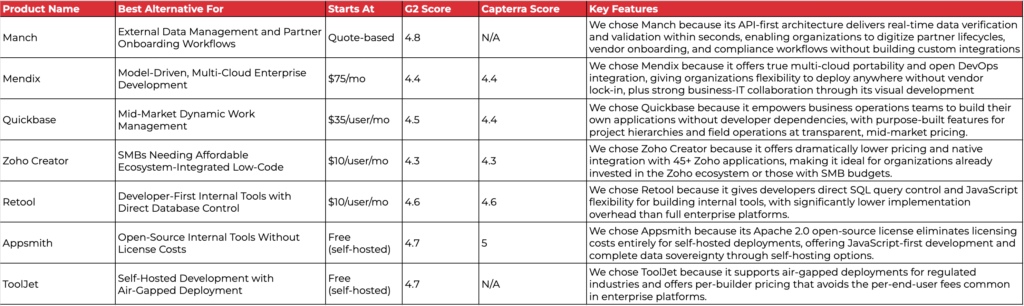
While OutSystems excels as a comprehensive, AI-powered platform for building enterprise-grade applications, organizations often have specific requirements that call for more specialized solutions. Based on our research, here are the best alternatives for different needs:
- Manch for enterprises needing pre-integrated verification APIs, real-time data validation, and pre-built partner onboarding workflows that deploy in weeks with significantly lower total cost of ownership
- Mendix for organizations prioritizing multi-cloud portability, open DevOps integration, and business-IT collaboration
- Quickbase for mid-market operations teams managing dynamic, project-based work without developer dependencies
- Zoho Creator for SMBs seeking affordable low-code within the Zoho ecosystem
- Retool for developer teams needing direct SQL and JavaScript control for internal tools
- Appsmith for organizations seeking open-source internal tool development without license costs
- ToolJet for regulated industries requiring self-hosted, air-gapped deployment with per-builder pricing
Remember, you don’t have to choose between OutSystems and these alternatives exclusively. Many organizations successfully use OutSystems for complex, customer-facing applications while leveraging specialized platforms for specific workflows. Consider your particular requirements, existing ecosystem, budget constraints, and deployment preferences when making your decision.
Looking for an API-first solution for partner onboarding and external data management? Manch delivers pre-integrated verification workflows that go live in 4-6 weeks, with real-time validation, integrated eKYC, and enterprise-grade compliance capabilities. Request a demo to see how leading enterprises are digitizing their partner lifecycles without the complexity of custom development.