The fundamental disconnect: Building apps vs configuring processes
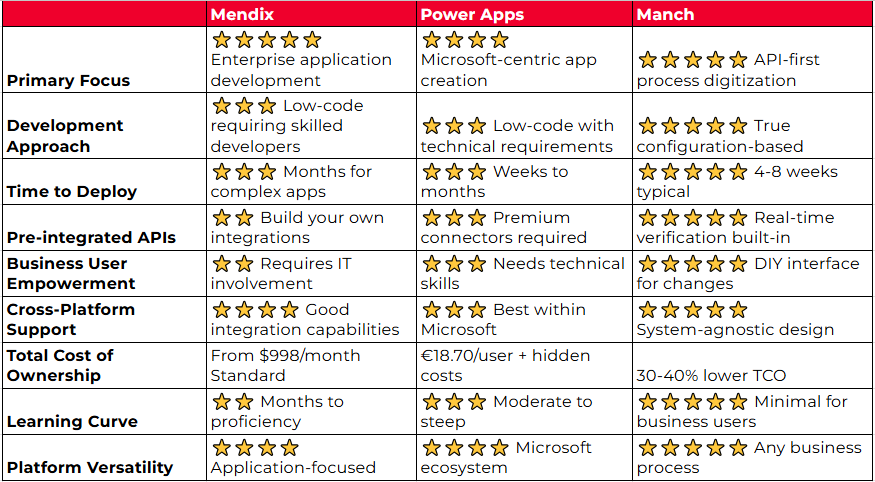
Here’s a critical distinction that shapes everything else: Mendix and Power Apps are fundamentally application development platforms, while Manch is a process digitization platform with pre-integrated capabilities.
Most enterprises don’t need another tool to build apps—they need to digitize existing processes quickly with real-time data verification. Consider typical challenges: onboarding partners, validating vendor information, ensuring compliance, managing master data across systems. These don’t require building new applications; they require configuring existing business processes with integrated verification capabilities.
Mendix approaches this through portal templates and external user licensing, requiring developers to build and customize applications for each use case. While powerful, this means months of development even with templates.
Power Apps offers Power Pages for external portals, but organizations still need to build forms, configure validation logic, set up workflows, and pay for premium connectors to integrate with non-Microsoft systems. The promise of citizen development often hits reality when complex integrations require IT involvement.
Manch recognized that organizations spend millions on back-office teams for manual verification and validation. Their API-first platform includes pre-integrated verification APIs (PAN, GST, Aadhaar, bank accounts) that validate data in real-time. Instead of building verification logic, organizations configure pre-built workflows that include eKYC, video KYC, OCR document processing, and multi-level approvals—all deployable in 4-8 weeks.
Development approach reveals different philosophies
The development philosophy of each platform reveals critical differences in time-to-value and resource requirements.
Mendix offers a dual-IDE approach with Studio and Studio Pro. While marketed as low-code, the reality is that creating substantial applications requires skilled developers familiar with domain models, microflows, and the Mendix framework. Despite the low-code label, organizations typically need dedicated Mendix developers, with certification paths taking several months. The learning curve remains steep for business users who want to make simple changes.
Power Apps promises democratization but delivers complexity. Canvas Apps require understanding Power Fx formulas, while Model-driven apps need Dataverse expertise. What starts as “citizen development” quickly becomes an IT project when organizations realize they need premium connectors, custom APIs, and technical skills to build anything beyond basic forms. The Microsoft-centric design means additional complexity and cost when integrating with non-Microsoft systems.
Manch eliminates the build-versus-configure debate with its Process Configurator’s drag-and-drop interface. Business users arrange “lego-like building blocks” representing actual business functions: document collection, real-time verification, multi-level approvals, digital signatures. No coding, no formulas, no technical training required. When business rules change, users update configurations themselves in minutes—no IT tickets, no change requests, no additional costs. This approach delivers what low-code platforms promise but rarely achieve: true business user empowerment.
Mendix excels at enterprise application complexity
Mendix undeniably excels when organizations need to build complex, unique applications from scratch. Its cloud-native architecture and comprehensive development capabilities make it suitable for mission-critical custom applications. The platform’s Workflow Editor with BPMN support and Mendix Connect integration framework provide powerful tools for skilled development teams.
However, this power comes with significant investment requirements. Basic apps start at $75/month, but the Standard plan begins at $998/month for a single app, jumping to $2,495/month for unlimited apps, with Premium tier requiring custom quotes. More critically, the time and resource investment is substantial—Mendix’s own documentation indicates months to reach proficiency, and most organizations need dedicated Mendix developers or expensive consulting partners.
The Mendix Marketplace offers modules and connectors, but these still require technical expertise to implement and customize. For organizations that truly need custom-built applications and have the resources for long-term investment in platform expertise, Mendix delivers powerful capabilities—but at a premium in both time and cost.
Power Apps wins within Microsoft ecosystem boundaries
Power Apps’ strength lies entirely within Microsoft’s ecosystem. For organizations fully committed to Microsoft 365, Dynamics 365, and Azure, Power Apps offers native connectivity to SharePoint, Excel, and Dynamics data. Within these boundaries, it provides value through familiar interfaces and integrated experiences.
The platform’s variety—Canvas Apps, Model-driven Apps, and Power Pages—seems comprehensive. AI Builder provides pre-built models and Copilot generates apps from descriptions, though at approximately €187/month for 25,000 messages.
But step outside Microsoft’s ecosystem, and costs escalate quickly. Premium connectors for SQL Server, custom APIs, and non-Microsoft systems require premium licensing. Organizations with SAP, Oracle, or legacy systems face complex integration challenges and mounting costs. What appears cost-effective at €18.70/user/month becomes expensive when factoring in premium connectors, Dataverse storage, API usage fees, and the technical resources needed for cross-platform integration.
Manch accelerates transformation with pre-integrated APIs
While Mendix and Power Apps focus on giving you tools to build, Manch delivers pre-integrated capabilities that eliminate months of development. This API-first approach addresses the reality that organizations don’t have time to build verification systems—they need them working now.
Consider vendor onboarding: Traditional platforms require building forms, implementing validation, integrating with verification services, creating approval workflows, and managing documents. With Manch’s MDM 2.0 solution, these capabilities come pre-configured. Real-time verification of PAN, GST, Aadhaar, and bank accounts happens instantly. OCR extracts data from documents automatically. AI-powered fraud detection flags suspicious submissions. Multi-level approval workflows route everything appropriately.
The result? Organizations report reducing onboarding from 7 days to 7 hours. Deployment happens in 4-8 weeks, not months or years. Most importantly, the platform’s versatility drives zero customer churn—once organizations use Manch for vendor management, they discover they can configure it for contract management, asset tracking, compliance workflows, and any other business process, all on the same platform without additional licensing complexity.
This versatility transforms the economics of digital transformation. Instead of multiple specialized tools or extensive custom development, organizations get a single platform that adapts to their evolving needs.
AI and automation capabilities across platforms
All three platforms incorporate AI, but their implementations reveal different priorities and accessibility.
Mendix Assist provides AI-powered development recommendations and Amazon Bedrock integration for generative AI. However, these tools primarily help developers build faster—they don’t eliminate the need for technical expertise.
Power Apps offers extensive AI through AI Builder and Copilot, but most features require additional licensing. Organizations face consumption-based pricing that makes costs unpredictable, especially when AI becomes integral to workflows.
Manch embeds AI into core functionality rather than treating it as an add-on. Document uploads trigger automatic OCR and intelligent extraction. KYC documents undergo automated face matching. Fraud detection runs on every submission. These aren’t premium features—they’re built into the platform, included in the base price, eliminating the need for separate AI services or unpredictable usage fees.
Implementation reality: Weeks vs months
The true cost of any platform includes implementation time, and here the differences are stark.
Mendix implementations vary widely. While showcasing apps built in 6-8 weeks, these are typically simple applications. Enterprise deployments routinely take several months, plus additional months for team training and certification. Organizations should budget for significant consulting costs or dedicated developer hiring.
Power Apps can deliver simple apps quickly, but Forrester’s Total Economic Impact study models a 10-month implementation for enterprise deployment. The per-user pricing of €18.70/month seems attractive until organizations calculate premium connectors, Dataverse storage, AI Builder credits, and the IT resources needed for complex scenarios.
Manch delivers consistent 4-8 week deployments through configuration rather than coding. Organizations report compliance solutions in three weeks and dramatic process improvements like reducing onboarding from 7 days to 7 hours. The configuration-based approach means business teams can start using the platform immediately, modifying workflows as they learn rather than waiting months for IT to complete development. With 30-40% lower total cost of ownership over 3-5 years compared to traditional platforms, the ROI becomes clear within the first quarter.
Integration approaches: Ecosystem lock-in vs system agnostic
How each platform handles integration reveals fundamental architectural differences that impact long-term flexibility.
Mendix Connect provides integration through OData services and REST APIs. While capable, each integration requires development work. Organizations need technical resources to build and maintain connections, with complexity varying based on systems involved. The approach works but requires ongoing technical investment.
Power Apps boasts over 1,000 certified connectors, impressive until you realize most enterprise connectors require premium licensing. Worse, the platform clearly favors Microsoft technologies—integrating with SAP, Oracle, or legacy systems requires custom connectors and technical expertise. Organizations not fully committed to Microsoft face escalating complexity and costs.
Manch takes a system-agnostic approach, working equally well across SAP, Microsoft, Salesforce, Oracle, and legacy systems. As an SAP partner, Manch provides native SAP integration while maintaining the same level of support for other platforms. Pre-configured integrations for verification APIs, payment gateways, and document services come standard. The platform acts as a bridge between different systems without forcing organizations into vendor-specific ecosystems. No vendor lock-in, no premium connector fees, no ecosystem boundaries—just consistent integration regardless of your technology stack.
Mendix vs Power Apps vs Manch: Which should you choose?
The choice depends on your specific requirements, existing resources, and transformation timeline.
Choose Mendix if:
- You need to build complex, unique applications from scratch
- You have skilled developers or budget for extensive training
- Your applications require sophisticated custom logic
- You can invest months in platform mastery and development
- The tiered pricing model (from $998/month Standard) aligns with your custom application needs
Choose Power Apps if:
- You’re fully invested in the Microsoft ecosystem
- You need to build various Microsoft-centric applications
- Your team has technical skills for Power Fx and Dataverse
- You primarily work within Microsoft boundaries
- You accept premium connector costs for non-Microsoft integration
- Per-user pricing model fits your organization structure
Choose Manch if:
- You need real-time data verification and validation capabilities
- Your priority is digitizing existing processes, not building new apps
- You want deployment in 4-8 weeks, not months
- Business users need to make changes without IT involvement
- You work across multiple systems (SAP, Microsoft, Oracle, legacy)
- You want 30-40% lower TCO without sacrificing enterprise capabilities
- Platform versatility matters—using one platform for multiple processes
- You prefer pre-integrated APIs over building integrations from scratch
Ready to accelerate your digital transformation? Consider proof-of-concept projects to validate deployment speed and business user empowerment.
The enterprise software landscape continues evolving. While Mendix and Power Apps represent powerful application development platforms for organizations with technical resources and time to invest, Manch represents a different paradigm: configuration over coding, pre-integrated APIs over custom development, weeks over months for deployment. Each platform has its place, but for organizations seeking rapid transformation with true business user empowerment and without vendor lock-in, the choice becomes clear.
For enterprises evaluating these platforms, consider not just features but implementation reality: Do you have months and technical resources for development, or do you need results in weeks? Can your business users wait for IT to make changes, or do they need autonomy? Will you accept vendor ecosystem boundaries, or do you need system-agnostic flexibility? The answers to these questions will guide you to the right platform for your transformation journey.