Talend Pricing: Worth It or Consider Manch? November 2025

If you’ve ever tried to estimate your Talend costs by figuring out whether your data volume, job executions, and processing duration will push you from Standard to Premium tier, while discovering that detailed pricing requires a sales consultation, you know that enterprise data integration pricing can feel like solving an equation with multiple unknown variables.

Talend has established itself as a comprehensive data integration platform, powering data transformations for organizations worldwide with its suite of ETL, data quality, and big data solutions. Following its acquisition by Qlik in 2023, the platform promises to create a trusted data foundation for AI, machine learning, and analytics. But as Talend has evolved from its open-source roots to encompass cloud-native architectures and AI-ready data pipelines, its pricing structure has become increasingly complex with usage-based tiers, capacity subscriptions, and metrics that vary by edition.

I’ve spent time analyzing Talend’s pricing tiers, usage model, and feature limitations. While Talend excels at technical ETL and data integration capabilities with its extensive connectivity to over 900 data sources, it’s the ideal choice if:

  • You need comprehensive ETL and data integration capabilities for complex transformations
  • Your team has technical expertise in Java and data engineering
  • You’re processing big data workloads across Hadoop and Spark clusters
  • You require extensive connectivity to data sources and components
  • You can invest in implementation periods that vary based on project complexity

However, Talend’s pricing structure and platform complexity create challenges if:

  • You need real-time verification and validation of external stakeholder data in seconds
  • Your business users need to configure workflows without IT involvement
  • You want deployment in 4-6 weeks, not months
  • You’re looking for a versatile platform that can handle any business process beyond just data integration
  • You prefer transparent, predictable pricing with 30-50% lower total cost of ownership

In this case, you should consider Manch: an API-first, low-code/no-code platform with pre-integrated APIs that enable real-time data verification and validation in seconds. While it excels at master data management, customers discover they can configure any business process on the same platform—which explains its zero customer churn rate—all while deploying 3x faster through configuration rather than coding.

Because of that, I’ve included a detailed comparison with Manch in this review, as the best choice for businesses seeking rapid workflow automation with integrated document management and real-time verification capabilities. With that said, if you’re eager to jump into the Manch comparison, go ahead and do so with this link.

Table of contents

  • Talend Pricing Summary
  • Talend Pricing: In-Depth Overview
  • Where Talend Falls Short
  • Manch: API-First Platform for Business Process Automation
  • Talend Feature Value Breakdown (vs Manch)
  • Talend Pricing FAQ
  • Final Verdict: Talend vs Manch
 

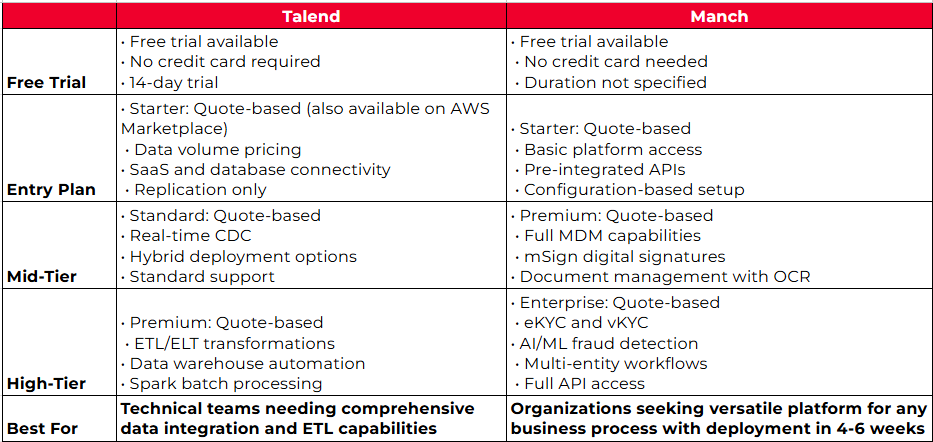
Talend Pricing Summary

Talend Pricing: In-Depth Overview

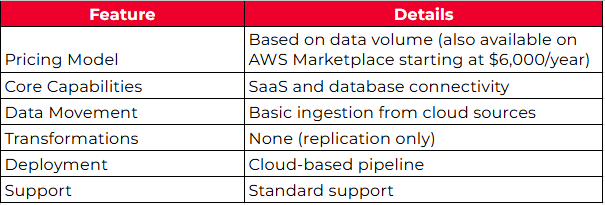
Talend operates on a usage-based pricing model with four distinct tiers, where customers subscribe to a certain capacity of usage for their chosen edition. The platform uses different pricing metrics depending on the tier: Starter and Standard editions are priced based on data volume moved, while Premium and Enterprise editions factor in data volume, job executions, and processing duration. This complex pricing structure coincides with Talend’s evolution from open-source tool to enterprise platform. Customers can monitor usage through a self-serve telemetry dashboard and receive alerts when approaching capacity limits.


Talend Starter Plan: Quote-Based Pricing

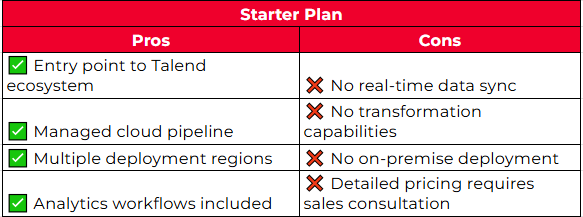
The Starter plan targets organizations beginning their cloud data journey with basic integration needs. It provides pre-built connectivity to SaaS applications and databases with managed data pipelines. The plan includes ready-to-query schemas and basic data cataloging capabilities. However, it lacks real-time synchronization and transformation features, limiting its usefulness for complex integration scenarios.

The Bottom Line 👉 While Talend Starter works for simple cloud-to-cloud data replication, organizations needing real-time verification or transformation capabilities should explore higher tiers or alternative platforms.


Talend Standard Plan: Quote-Based Pricing

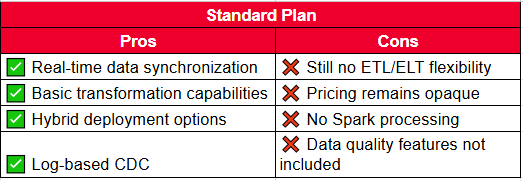
Standard represents a significant capability jump with real-time change data capture (CDC) for log-based synchronization. This tier introduces hybrid deployment options, allowing data processing behind firewalls. While Talend’s Standard tier provides basic transformation capabilities, it still requires technical expertise to configure and maintain.

The Bottom Line 👉 Standard suits organizations needing real-time data movement and hybrid deployment, but heavy transformation workloads require Premium tier investment.


Talend Premium Plan: Quote-Based Pricing

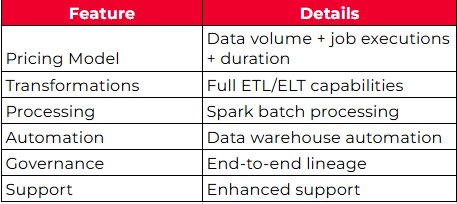
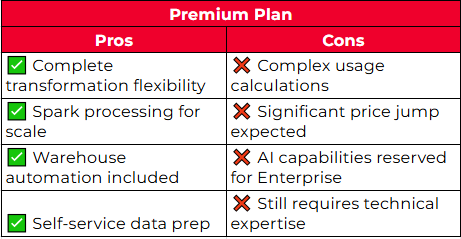
Premium unlocks Talend’s full transformation power with flexible ETL and ELT processing options. Spark batch processing enables high-volume data movements efficiently. The addition of data warehouse automation and data mart creation streamlines analytics infrastructure. This tier’s pricing complexity increases with job execution and duration metrics joining data volume calculations.

The Bottom Line 👉 While Talend Premium delivers comprehensive ETL capabilities for organizations with complex data integration requirements, the multi-metric pricing makes costs less predictable compared to platforms with transparent pricing models.


Talend Enterprise Plan: Quote-Based Pricing

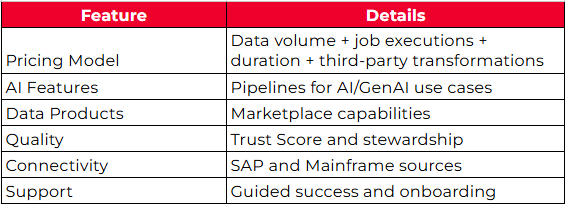
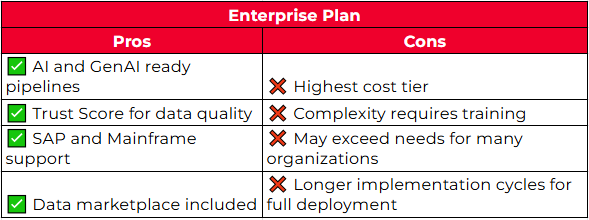
Enterprise adds AI-specific capabilities with pipelines designed for machine learning and generative AI workloads. The Qlik Talend Trust Score provides quantifiable data reliability metrics across validity, completeness, and timeliness dimensions. Data marketplace features enable internal data product creation and sharing. The addition of SAP and Mainframe connectivity addresses legacy system integration needs.

The Bottom Line 👉 Enterprise makes sense for large organizations building AI initiatives on trusted data foundations, but most businesses won’t utilize its full capabilities and may find better value in more focused solutions.


Where Talend Falls Short

While Talend excels at technical data integration and ETL processing with its comprehensive toolset, several limitations create challenges for organizations seeking rapid business process automation:

Steep Learning Curve Without Business User Empowerment

  • The platform works best for users with Java programming backgrounds
  • Mastering the full capabilities requires extensive training and time investment
  • While Talend offers self-service tools like Pipeline Designer and Data Preparation, advanced workflows typically require IT department involvement
  • This technical orientation contrasts with true no-code platforms where business users can configure workflows in minutes without IT tickets
 

Resource-Intensive Implementation Without Pre-Built Accelerators

  • Talend Studio requires adequate memory and processing power to run efficiently
  • Implementation timelines vary significantly: simple pipelines may take 2-4 weeks, while enterprise deployments can stretch into months
  • Organizations often need dedicated technical resources to manage the platform
  • Lacks pre-built frameworks that enable 4-6 week deployments for typical implementations
 

Missing Real-Time Verification and Document Management

  • No pre-integrated APIs for real-time data verification against public databases
  • Partner onboarding and vendor management workflows require custom development
  • Document management with OCR capabilities not native to the platform
  • Digital signatures and multi-entity workflows need third-party tools or custom code
 

Complex Pricing with Higher TCO

  • Detailed pricing requires sales consultation with limited transparency
  • Usage-based model with multiple metrics creates cost variability and unpredictability
  • Premium and Enterprise tiers calculate costs on data volume, job executions, and duration
  • Total cost of ownership typically 30-50% higher when considering licensing, implementation, and ongoing maintenance

These limitations have led many organizations focused on business process automation and rapid deployment to explore fundamentally different approaches..


Best Talend Alternative: Manch

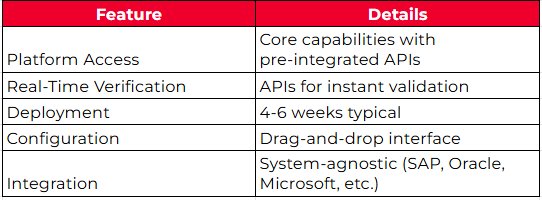
Manch takes an API-first approach to digital transformation, with pre-integrated APIs that enable real-time data verification and validation in seconds—eliminating the need for traditional back-office setup that requires time, money, and resources.

For organizations finding Talend’s technical complexity and lengthy implementations challenging, Manch offers a cloud-native, low-code/no-code platform that addresses these gaps with deployment in 4-6 weeks through configuration rather than coding. What sets Manch apart is its versatility: while it excels at master data management, customers discover they can configure any business process on the same platform, which drives the platform’s zero customer churn rate.

Founded in 2017 as a digital transformation platform, Manch serves companies like Coca-Cola, United Breweries, and Swiggy who need comprehensive business process automation beyond just data pipelines. The platform’s strength lies in its pre-built frameworks and integrated capabilities: real-time verification APIs, document management with OCR, digital signatures, and multi-entity workflows—all accessible through a drag-and-drop interface that business users can operate without IT involvement.

Manch excels for mid to large organizations (500+ employees, $10M+ revenue) seeking cost-effective digital transformation, companies with heterogeneous IT landscapes (SAP, Oracle, Microsoft, Salesforce, legacy systems), and any business where rapid deployment and business user empowerment are critical for success.


Manch Starter Plan: Quote-Based Pricing

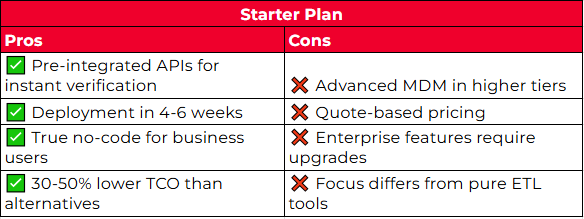
Unlike Talend’s technical focus, Manch’s Starter plan provides immediate business value through pre-integrated APIs that enable real-time verification in seconds. Organizations can configure partner onboarding, document management, and compliance workflows without writing code. The platform’s API-first architecture means business teams achieve measurable results within the same quarter rather than waiting 6-12 months for ROI.

The Bottom Line 👉 Starter provides the foundation for digital transformation with real-time verification capabilities that would require extensive custom development in traditional data integration platforms.


Manch Premium Plan: Quote-Based Pricing

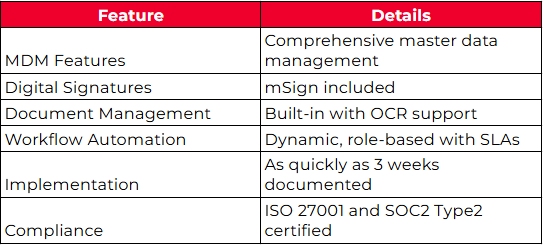
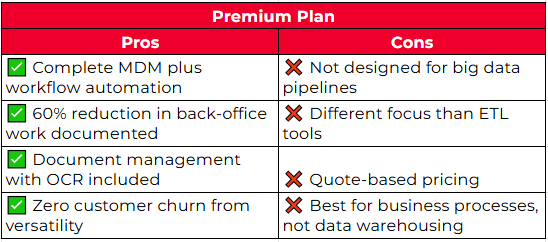
The Premium plan adds comprehensive MDM capabilities with a crucial difference from Talend’s approach: Manch handles master data across six organizational pillars (products/services, customers, vendors, assets, employees, operational data) with AI-powered duplicate detection and merge rules. The integrated document management with OCR and mSign digital signatures eliminates the need for separate tools. This versatility explains why customers discover additional use cases beyond initial implementation, contributing to zero customer churn.

The Bottom Line 👉 Premium delivers enterprise-grade capabilities at 30-50% lower total cost of ownership, with deployment speed that enables ROI within the same quarter.


Manch Enterprise Plan: Quote-Based Pricing

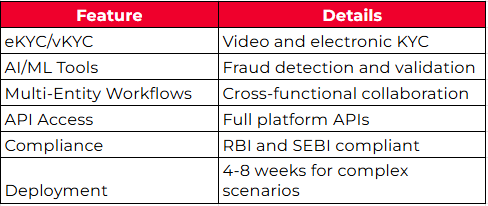
Enterprise adds advanced verification and AI capabilities focused on business outcomes. The eKYC and video KYC features enable compliant customer onboarding that traditionally takes seven days in just 30 minutes. AI-powered fraud detection and validation ensure data accuracy from the source. The platform’s open standards and system-agnostic design mean no vendor lock-in—organizations can integrate with any existing system while maintaining data portability.

The Bottom Line 👉 Enterprise automates complex business processes with pre-integrated capabilities that deliver measurable ROI, explaining why the platform maintains zero customer churn as organizations discover expanding use cases.


Talend Feature Value Breakdown (vs Manch)


Technical Integration vs Business Process Configuration

Talend’s Approach: Talend provides extensive technical capabilities with over 900 connectors and components, native code generation for Java and Spark, and sophisticated transformation logic through visual components like tMap. While powerful for complex data pipelines, this technical approach typically requires specialized skills and development time that varies by project complexity.

Manch’s Approach: Manch’s API-first platform with pre-integrated APIs enables real-time data verification in seconds without coding. Users configure automated processes using a drag-and-drop interface for partner onboarding, document verification, and compliance checks. The platform’s versatility means customers can configure any business process on the same foundation, which drives zero customer churn as organizations discover additional applications beyond initial implementation.

Value Verdict: Manch delivers faster time-to-value for organizations needing business process automation with its 4-6 week deployment and true no-code configuration, while Talend suits technical teams building complex data infrastructure over longer timelines.


Implementation Time and Total Cost of Ownership

Talend’s Approach: Talend implementations vary significantly: simple pipelines may take 2-4 weeks, mid-size projects typically span 2-3 months, and enterprise deployments can extend to 6-12 months. Organizations often need Java developers, data engineers, and extensive testing cycles. The learning curve combined with usage-based pricing creates higher total cost of ownership.

Manch’s Approach: Manch delivers working solutions in 4-6 weeks for typical implementations, with some documented cases completing in just 3 weeks. The platform’s pre-built frameworks and accelerators enable 30-50% reduction in delivery time compared to competitors. With 30-50% lower total cost of ownership over 3-5 years when considering licensing, implementation, and maintenance combined, Manch provides faster ROI with predictable costs.

Value Verdict: Manch’s cost-effective approach with transparent pricing and rapid deployment delivers measurable ROI within the same quarter, compared to Talend’s variable costs and longer implementation cycles.


User Accessibility and Platform Versatility

Talend’s Approach: While Talend has introduced self-service options like Pipeline Designer, the platform fundamentally requires technical expertise. Users benefit from Java programming knowledge, and advanced integrations typically require IT involvement. The platform focuses specifically on data integration and ETL workloads.

Manch’s Approach: Manch empowers business users with true no-code capability where non-technical teams can configure workflows in minutes without IT dependency. The DIY interface allows organizations to make simple changes themselves without raising change requests. Beyond initial MDM implementation, customers discover they can digitize any business process on the same platform—from contract management to asset tracking—maximizing their platform investment.

Value Verdict: Manch’s business user empowerment and platform versatility drive its zero customer churn rate, as organizations continuously discover new use cases without needing additional platforms or technical resources.


Integration Philosophy and Vendor Independence

Talend’s Approach: Talend offers extensive connectivity options with over 900 connectors, particularly strong in cloud and database integrations. However, organizations still face vendor dependencies through Talend’s proprietary development environment and usage-based pricing model that can create cost unpredictability.

Manch’s Approach: Manch operates on open standards with no proprietary runtime environment, ensuring complete vendor independence. The system-agnostic platform works equally well across SAP, Oracle, Microsoft, Salesforce, and legacy systems—ideal for heterogeneous IT landscapes. As an SAP partner with native integration capabilities, Manch bridges different systems without forcing organizations into specific vendor ecosystems.

Value Verdict: Manch’s open integration philosophy and freedom from vendor lock-in provides long-term flexibility, while its pre-integrated APIs deliver immediate value that Talend’s connectors don’t address for business verification needs.


Talend Pricing FAQ


Does Talend offer a free trial?

Yes, Talend offers a 14-day free trial with no credit card required, accessible through their website. Manch also offers a free trial which explicitly requires no credit card, though the specific duration is not publicly detailed.


What determines Talend’s pricing?

Talend uses different pricing metrics by tier. Starter and Standard editions price based on data volume moved, while Premium and Enterprise editions factor in data volume, job executions, and processing duration. This multi-metric approach can make cost prediction complex compared to platforms with more transparent pricing models.


How long does Talend implementation take?

Talend implementations vary based on project complexity: simple data pipelines may take 2-4 weeks, mid-size projects typically span 2-3 months, and enterprise deployments can extend longer. Organizations need technical resources familiar with Java and data integration concepts. Manch implementations, by contrast, deploy in 4-6 weeks typically, with some documented cases completing in just 3 weeks through configuration rather than coding.


Can business users work with Talend independently?

While Talend offers self-service tools like Pipeline Designer and Data Preparation, the platform’s technical nature means advanced workflows typically require IT support and Java expertise. Manch’s true no-code approach with drag-and-drop interface allows business users to configure and manage workflows independently, making changes in minutes rather than submitting IT tickets and waiting weeks for updates.


Which platform offers better total cost of ownership?

Manch delivers 30-50% lower total cost of ownership compared to larger enterprise platforms when considering licensing, implementation, and ongoing maintenance costs combined. While Talend’s usage-based pricing with multiple metrics creates cost variability, Manch’s transparent pricing and rapid deployment (4-6 weeks vs months) enable organizations to achieve ROI within the same quarter rather than waiting 6-12 months.


What’s the main difference between Talend and Manch?

The fundamental difference is approach and versatility: Talend is a technical data integration platform requiring programming skills with variable implementation timelines, focused specifically on ETL and data pipelines. Manch is an API-first, low-code/no-code platform with pre-integrated APIs for real-time verification, enabling business users to configure any business process—not just data management—with deployment in 4-6 weeks and zero customer churn due to its platform versatility.


Final Verdict: Talend vs Manch

The choice between Talend and Manch depends on your fundamental digital transformation needs:

👍 Talend excels as a comprehensive data integration platform for technical teams building complex ETL pipelines and big data transformations. With usage-based pricing across four tiers and extensive connectivity to over 900 sources, it enables organizations to create sophisticated data architectures. This technical approach works best for companies with dedicated data engineering teams, organizations processing big data workloads across Hadoop and Spark clusters, and enterprises focused specifically on data warehouse and analytics infrastructure.

Get started with Talend here.

👉 Manch delivers on the promise that digital transformation should be fast, cost-effective, and business-led. With pre-integrated APIs enabling real-time verification in seconds, deployment in 4-6 weeks through configuration rather than coding, and a versatile platform where customers can digitize any business process, it achieves zero customer churn as organizations continuously discover new applications. The platform’s 30-50% lower total cost of ownership, combined with integrated document management, digital signatures, and true no-code capability for business users, makes it ideal for mid to large organizations seeking rapid ROI without vendor lock-in.

Get started with Manch here.

The fundamental difference is philosophical: While Talend asks “How can we provide powerful technical data integration?”, Manch asks “How can we enable organizations to achieve digital transformation in weeks, not months, with a platform versatile enough that customers never need to leave?”

For organizations where business agility, rapid deployment, and user empowerment matter more than technical data pipeline complexity, Manch’s API-first approach and zero customer churn rate tell the complete story.